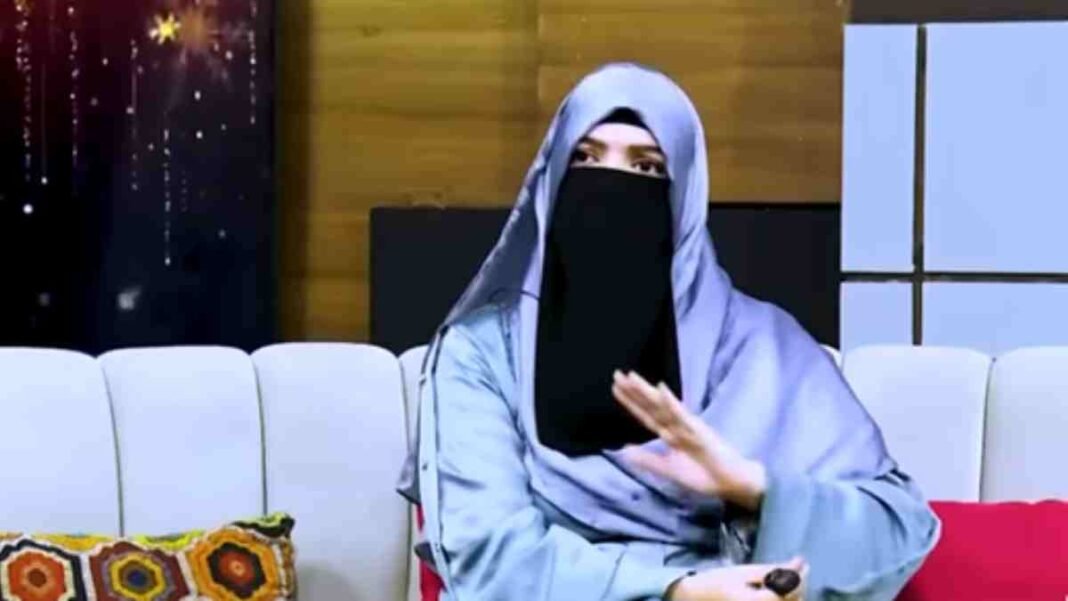
Sara Chaudhry often begins by clearing one misunderstanding. She did not step away from television because of marriage, pressure, or force. The real change, she says, happened much earlier and much more quietly.
When Sara slowed down her acting career, she was not struggling. She was at the peak of her success. Popular dramas, constant work, and recognition had already placed her among well-known faces of Pakistani television. Fame was not leaving her life. It was firmly present.
What changed was not her career, but her thinking.
In her podcasts and interviews, Sara has repeatedly shared that her journey was not triggered by a dramatic incident. There was no sudden shock, no emotional breakdown, and no life-altering event. The transformation came gradually, over time.
Faith, for Sara, was never something new. It had been part of her life since childhood. Her mother made sure she stayed connected to prayer, the Qur’an, and the habit of turning to Allah during hardship.
Even at a young age, Sara knew where to seek comfort. When there was illness at home, emotional pain, or difficulty, she would offer nafl prayers, recite Surah Rahman or Surah Yaseen, and make dua. Remembering Allah was natural to her, not imposed.
This connection did not disappear when she entered showbiz. Sara often challenges the assumption that actors are distant from faith. Many, she says, quietly pray, fast, and remember Allah, even during busy shooting schedules.
Like most people, her faith experienced highs and lows. Life brought heartbreaks and disappointments. And it was often during moments of inner pain that her connection with Allah became stronger.
The deeper change began when Allah placed certain people in her life. She met individuals who had accepted Islam after deep study and understanding. They shared verses of the Qur’an and Hadith in context, discussing topics thoughtfully rather than emotionally.
Through these conversations, Sara realized something unsettling. She had always believed she knew the Qur’an because she could read Arabic. But she did not truly understand its meanings.
She was in her early twenties, successful and confident, yet unaware of what Allah says about life, purpose, creation, and responsibility. That realization disturbed her deeply.
She began studying the Qur’an with translation. Slowly, clarity replaced confusion. Questions she had carried for years were answered, not by people, but by the Qur’an itself.
This journey was not about outward changes at first. It was about understanding boundaries, modesty, and accountability. Concepts like mahram and non-mahram became clear through learning, not culture.
As she learned more, Sara went through a phase many beginners experience. She became passionate, corrected others, and sometimes argued without having complete knowledge. This brought criticism and resistance.
Around this time, she got married. For many observers, marriage became the convenient explanation for her change. Sara dismisses this assumption calmly.
She explains that her choices were not influenced by her husband. In fact, she was often the one guiding him. Her decisions were made for Allah alone.
Today, Sara speaks about her past with peace and clarity. She does not reject her career, nor does she romanticize leaving it. She simply acknowledges that fame had its place, but it did not answer her deeper questions.
Her story is not about leaving the world behind. It is about understanding it with purpose. Not about silence, but intention. Not about rejection, but alignment.
And perhaps that is why her journey resonates with so many. It reminds people that sometimes, the most meaningful transformations happen quietly, long before the world notices.