ISLAMABAD: Pakistan’s government is preparing a five-year New Auto Policy to make vehicles more affordable, increase competition, and support local manufacturing. The plan also gives special attention to electric and new-energy vehicles.
Special Assistant to the Prime Minister on Industries and Production Haroon Akhtar Khan said affordability remains one of the government’s main priorities. He said policymakers want ordinary consumers to gain more choices at comparatively lower prices.
Therefore, the government wants the New Auto Policy to focus more on middle- and low-income buyers instead of prioritizing only expensive vehicles. Haroon Akhtar said the government wants stronger competition to help improve affordability in the market.
At the same time, officials want more carmakers to enter Pakistan and introduce new models. The number of manufacturers has already increased significantly under previous auto policies, making competition an important part of the new framework.
The government also plans to encourage manufacturers to test new vehicles in Pakistan before making large investments. Under the proposed approach, companies could initially introduce imported models and then move towards local assembly.
After establishing demand, manufacturers would need to increase local production and localization. In this way, the New Auto Policy aims to attract investment while also building Pakistan’s domestic automotive industry.
Moreover, policymakers want manufacturers to produce more parts locally instead of depending heavily on imports. The Ministry of Industries has repeatedly identified localization and domestic manufacturing as major priorities for the upcoming policy.
Officials believe stronger local production could eventually help manufacturers control costs and strengthen the supply chain. However, industry representatives have also warned that high production costs and other structural challenges could affect these goals.
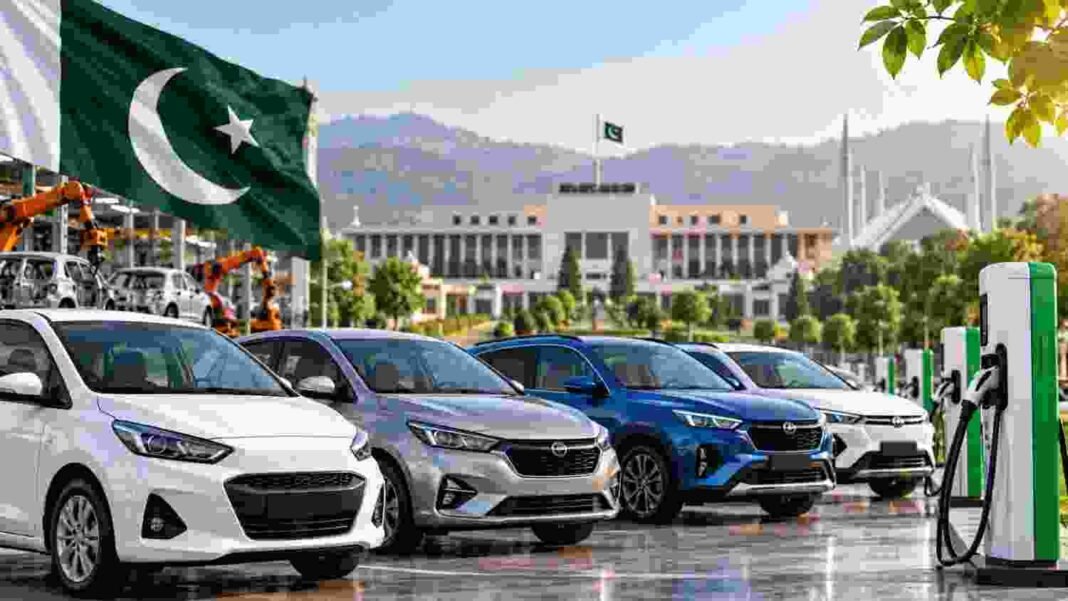
Electric vehicles will also receive major attention under the New Auto Policy. Haroon Akhtar said the government wants to accelerate the transition toward electric mobility and provide incentives for electric two-, three- and four-wheel vehicles.
The government has already approved significant proposed tax relief for some new-energy vehicles. Reports say the draft framework includes lower taxes for certain electric vehicles to help reduce their prices in Pakistan.
Meanwhile, smaller electric vehicles could receive additional incentives. The initial policy draft also proposes a 1% concessional sales tax on parts used for locally manufactured electric vehicles.
As a result, the government hopes the New Auto Policy will encourage manufacturers to introduce more affordable EV models. Policymakers also want companies to invest in local assembly and eventually increase local value addition.
Charging infrastructure remains another important part of the transition. Haroon Akhtar Khan said Pakistan’s electric vehicle plans include around 3,000 charging stations across the country.
The government also wants to support plug-in hybrids and range-extended electric vehicles. These options could help drivers who remain concerned about limited charging facilities, especially outside major cities.
The government is also reviewing duties and taxes on different vehicle categories. The New Auto Policy seeks to balance consumer affordability with protection for local manufacturers and auto-parts producers.
Prime Minister Shehbaz Sharif approved an initial draft of the five-year framework earlier in September and directed officials to incorporate additional changes. However, officials were still completing legal work before the formal launch.
Haroon Akhtar said the policy took longer because Pakistan’s automotive market has changed significantly. Electric vehicles, greater competition and changes in tariff policy required the government to review its earlier approach.
In addition, policymakers want existing manufacturers to increase production. The government hopes stronger demand, new investment and localization will help Pakistan’s automotive sector expand its manufacturing capacity.
Still, lower-income consumers will judge the New Auto Policy mainly by the prices they see in showrooms. Tax incentives and greater competition could help, but final prices will also depend on production costs, exchange rates, taxes and manufacturers’ pricing decisions.
For now, the government says affordability remains at the center of its strategy. It wants consumers to access more affordable conventional and electric vehicles while encouraging manufacturers to invest locally.
If officials implement these measures successfully, the New Auto Policy could reshape Pakistan’s car market through stronger competition, greater localization, and wider EV adoption. However, the final impact on consumers will become clearer after the government formally announces the complete policy and manufacturers respond to its incentives.