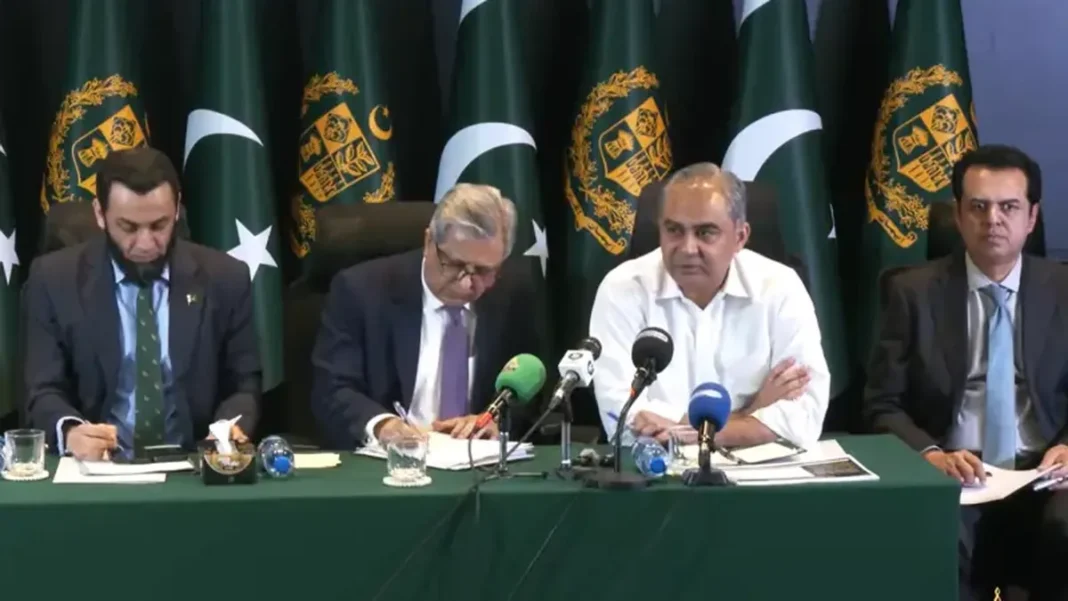
DOHA: Interior Minister Mohsin Naqvi said on Monday that Pakistan “never gave up” in its efforts to mediate between the United States and Iran during their war earlier this year. He was addressing the 8th Global Security Forum in Doha. The Naqvi Qatar forum address put Islamabad’s diplomacy in the spotlight.
The forum, held under the title “The Future of Alliances”, has drawn officials and dignitaries from more than 100 countries, according to Qatar News Agency.
“The last few months have been very difficult for our region. The conflict involving Iran and the United States created serious risks not only for the Middle East, but for the entire world,” Naqvi told the gathering.
He said Pakistan chose the path of peace at a critical moment and made every possible effort to reduce tensions. Naqvi has been personally involved in the mediation and has travelled to Iran several times since the war began.
“There were moments when the situation was extremely tense, but we never gave up,” he said. “We continued talking, listening and working to build trust. And I can tell you from my experience: peace is not achieved in one meeting; it requires patience, trust and continuous efforts.”
Naqvi Qatar forum remarks highlight Munir’s role
Naqvi singled out the “remarkable role” of Chief of Defence Forces and Chief of Army Staff Field Marshal Syed Asim Munir in Pakistan’s efforts to bring the two sides together.
Munir visited Iran in August accompanied by Naqvi as part of Pakistan’s push for regional peace and stability. The interior minister made another trip to Tehran in September, which Iranian officials described as part of bilateral engagements.
The minister then recalled the June 18 signing of the Islamabad Memorandum of Understanding between Iran and the US. Pakistan signed the 14-point MoU as a mediator. The document provided a framework for ending the war that began with US-Israeli strikes on Iran on February 28.
The MoU was followed by the Lake Lucerne Summit in Switzerland, organised by mediators Pakistan and Qatar. “There, I saw something I will never forget,” Naqvi said. He recalled that Qatar’s Prime Minister Mohammed bin Abdulrahman Al Thani and Field Marshal Munir worked for “more than 16 hours without a single break”.
“No cameras, no announcements; only two men who refused to let the talks fail,” he said, adding that the two mediating countries shared a single aim: to stop further conflict.
Al Jazeera’s live coverage of the forum independently confirmed Naqvi’s account of the marathon Switzerland session and his praise for Qatar’s diplomacy.
Pakistan’s mediation recognised in Washington
The Doha remarks fit a wider diplomatic record. According to Hum News English, the White House later described Pakistan as the main intermediary in the US-Iran negotiations, while US Secretary of State Marco Rubio called Islamabad Washington’s “primary interlocutor”.
The same reporting notes that the Islamabad MoU was electronically endorsed by US President Donald Trump, Iranian President Masoud Pezeshkian and Prime Minister Shehbaz Sharif as mediator. The framework covered de-escalation and the reopening of the Strait of Hormuz, whose disruption had threatened global energy supplies.
Pakistan’s mediation also extended to the strait itself. Islamabad backed its immediate reopening while keeping contact with Tehran, Washington and other regional stakeholders. Feature Pakistan has followed the regional fallout closely, including Russia’s top diplomat visiting Tehran as Hormuz tanker tensions persisted and US embassies across the Middle East issuing security alerts.
‘A pact for defence, not for war’
Naqvi also used the forum to defend the Pakistan-Saudi Arabia-Turkiye defence arrangement, describing it as a pact for defence rather than war. The comments echoed Pakistan’s stated position that the agreement strengthens regional stability. The defence relationship itself remains central to Islamabad’s security posture, as reflected in Pakistan’s stated support for Saudi Arabia’s defence.
He praised Qatar’s own peace efforts, saying the Gulf state had “done so much”. “In the diplomacy of our time, when others chose sides, Qatar chose to keep talking. Pakistan has seen this closely because we have worked beside you,” he said.
“We do not want credit for stopping wars,” Naqvi added, in remarks also reported by Hum News English. “We want a future where wars do not start.”
Frequently asked questions
What did Naqvi say at the Qatar forum?
He said Pakistan “never gave up” mediating between the US and Iran, praised Field Marshal Munir’s role, and recalled 16-hour talks in Switzerland between Qatar’s prime minister and Pakistan’s army chief.
What was the Islamabad MoU?
A 14-point memorandum signed on June 18 between Iran and the US, with Pakistan as mediator, setting a framework to end the war that began with February 28 strikes on Iran.