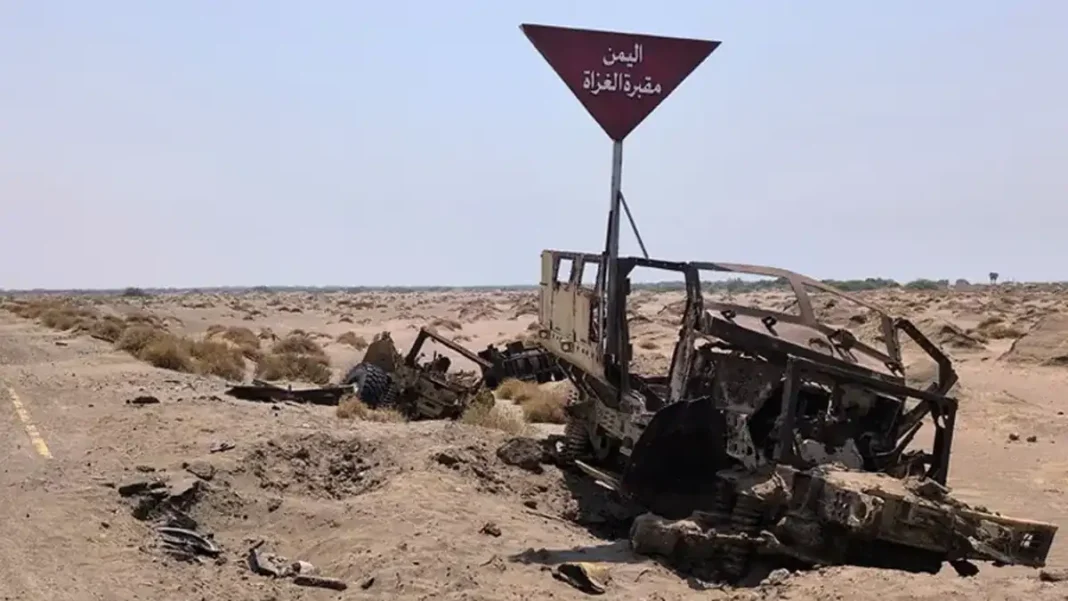
Houthis Claim Shabwa Camp Strike as Death Toll Climbs to 53
ADEN: Yemen’s Houthis have claimed responsibility for the Houthi Shabwa camp strike, Monday’s missile attack on a government forces training camp in Shabwa province that killed at least 53 people and wounded 200, local authorities said.
Houthi military spokesman Yahya Saree said the group carried out six military operations over 48 hours using ballistic missiles, cruise missiles and drones. He named targets across Saudi Arabia, including King Khalid International Airport in Riyadh, Saudi Aramco facilities in Yanbu on the Red Sea coast and the Shaybah oil field near the United Arab Emirates border.
Other strikes targeted Abha International Airport, radar installations and the Khamis Mushait air base in the southwest, along with a naval camp and radar site at Bir Askar in the south, Saree said.
Houthi Shabwa camp strike marks sharp escalation
Saree claimed the three-stage attack on Riyadh airport achieved “accurate and direct” strikes as retaliation for more than 200 Saudi airstrikes on Houthi-held areas in the previous 48 hours, vowing to continue operations “towards the Saudi interior” until attacks on Yemen cease.
Local sources, speaking on condition of anonymity, said the Houthis fired three ballistic missiles at security forces during a training exercise. Video from the province, verified by Reuters, showed injured people and bloodied bodies scattered across the ground.
The attack comes amid intensifying fighting between the Houthis and Yemen’s Saudi-backed internationally recognised government, which have traded attacks since the group advanced in September toward the Bab el-Mandeb Strait, the strategic shipping chokepoint at the mouth of the Red Sea.
Riyadh issues aerial threat alerts
Saudi authorities on Monday issued brief phone alerts to Riyadh and nearby Kharj residents, warning of a “hostile aerial threat”. Civil defence confirmed the National Early Warning Platform had issued the warning for the capital.
Amid the repeated cross-border strikes, government agencies in Riyadh instructed employees to work from home from Monday to Thursday, according to a worker and two consultants who spoke to AFP. The 99-storey Kingdom Centre, which houses the regional office of the International Monetary Fund, asked employees to stay away until further notice, and companies in the King Abdullah Financial District issued similar directives.
US embassies urge heightened vigilance
The worsening security situation prompted US embassies across the Gulf, Israel, Iraq, Lebanon and Jordan to urge Americans on Monday to exercise heightened vigilance. The alert warned of flight cancellations, airspace closures and travel disruptions, noting that Riyadh’s international airport remained closed, and urged citizens to prepare contingency plans.
Egypt delays vote, investment summit postponed
Egypt’s parliament postponed until October 26 a vote on authorising the armed forces to support Saudi Arabia if requested, adjourning a second closed-door session on Monday to discuss President Abdel Fattah el-Sissi’s request.
El-Sissi had said on Saturday that Egypt would take “any measure” necessary to protect its Gulf allies. The Egyptian Social Democratic Party, however, instructed its lawmakers to abstain, citing economic pressures, risks to Suez Canal revenue and insufficient information on the mission’s scope.
The conflict has also disrupted Saudi Arabia’s business calendar: organisers postponed the flagship Future Investment Initiative conference, known as “Davos in the Desert”, until 2027. The event had been scheduled for October 26 to 29, with executives including Goldman Sachs chief David Solomon, Standard Chartered chief Bill Winters and Citigroup chief Jane Fraser expected to attend.
Semafor reported that major financial firms had privately conveyed safety concerns to Saudi Public Investment Fund governor Yasir Al-Rumayyan.
What the escalation means for Pakistan
The update marks a sharp rise from initial reports of the Shabwa attack, which Feature Pakistan covered earlier when officials put casualties at about 40. The near-tripling of the toll, with the Houthis’ public claim of responsibility, makes it one of the deadliest single attacks in Yemen this year.
For Pakistan, the stakes are direct. The Houthis’ targeting of Saudi oil facilities at Yanbu and Shaybah adds fresh volatility to global crude markets, which feeds into domestic fuel prices already under strain. Pakistani travellers have also felt the disruption: PIA earlier suspended flights to Riyadh as strikes on Saudi airports continued. The attacks follow a pattern of strikes on Saudi airports that killed three people in an earlier round, while Pakistan’s Foreign Office has said forces under the Makkah alliance remain in a defensive posture in Yemen.
FAQs
How many people were killed in the Shabwa camp strike?
At least 53 people were killed and 200 wounded, according to local authorities cited by Dawn — a sharp rise from initial reports of about 40 casualties.
What did the Houthis claim about the attack?
Houthi military spokesman Yahya Saree claimed six military operations over 48 hours, targeting Riyadh airport, Aramco facilities in Yanbu, the Shaybah oil field, Abha airport, the Khamis Mushait air base and sites at Bir Askar.
Why did Egypt postpone its vote on supporting Saudi Arabia?
Egypt’s parliament delayed the vote until October 26 after a second closed-door session. Opposition lawmakers cited economic pressures, risks to Suez Canal revenue and a lack of information on the mission’s scope.
What is the Future Investment Initiative?
Saudi Arabia’s flagship annual investment conference, known as “Davos in the Desert”. Its 10th edition, due October 26 to 29, has been postponed to 2027 over security concerns.