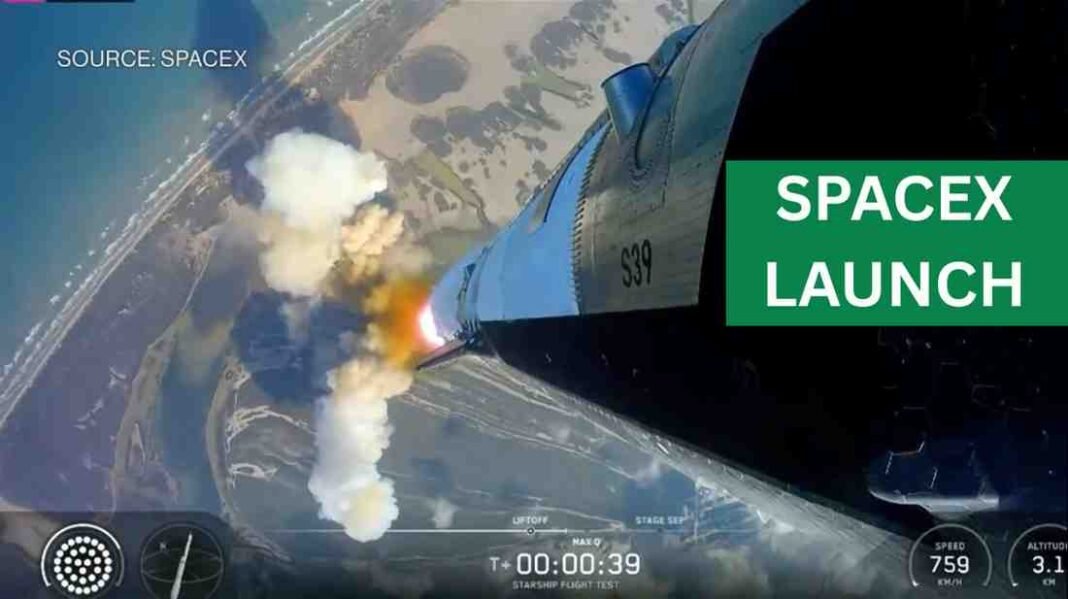
SpaceX flew the first version of its upgraded Starship rocket on Friday evening, and the test went largely to plan. The flight was the twelfth for the Starship program. It also marked the debut of the third-generation vehicle that Elon Musk’s company calls Version 3, or V3. According to UPI and other outlets, the rocket met every goal SpaceX had set for it.
The launch vehicle stands more than 400 feet (about 123 metres) tall, which makes it the most powerful rocket ever built.
It lifted off from the new Orbital Launch Pad 2 at Starbase in Texas. This was also the first time SpaceX fired a rocket from that pad, which took years to finish. Minutes after liftoff, the upper stage separated from the Super Heavy booster and pressed on toward space.
A Test That Went to Plan
After separation, the Super Heavy booster made a controlled descent toward the Gulf of Mexico, as SpaceX expected on a first flight with no tower catch.
The upper stage, meanwhile, carried the heart of the mission. It deployed all 20 Starlink test capsules along with two modified Starlink units fitted with cameras.
About an hour after launch, the ship completed its planned fiery splashdown in the Indian Ocean. Then it broke apart on schedule, exactly as the company intended.
In short, the debut delivered. SpaceX wanted to prove the new hardware and the new pad in one flight, and it did.
What V3 Is and Why This Flight Mattered
This was the first Starship flight since October 2025, when the eleventh test closed out a turbulent year for the programme. SpaceX had hoped to fly V3 sooner.
However, the company spent months packing dozens of upgrades into the vehicle to make it more reliable for NASA’s Moon missions. Musk also pushed the timeline from April into May.
The launch did not come easily. SpaceX scrubbed its first attempt on Thursday after a string of last-minute technical holds. Engineers flagged issues that included a propellant line on the ship and a sensor on the launch tower, according to CNN. So the company stood down, fixed the problems, and tried again the next evening.
The Bigger Picture: A Record IPO
The timing could hardly be sharper. Earlier this week, on 20 May, SpaceX made its IPO prospectus public. The company confirmed plans to list on the Nasdaq under the ticker SPCX, with a market debut as early as 12 June.
Analysts expect the offering to raise around $75 billion at a valuation near $1.75 trillion. If those numbers hold, it would become the largest IPO in history.
SpaceX plans to spend the money on further development, its growing artificial intelligence ambitions, and debt tied to Musk’s xAI and his social platform X. In other words, Friday’s flight may be one of the last Starship tests to fly without a stock price reacting to every success or setback.
Years of Work and a Long Road Ahead
SpaceX has poured years of effort and billions of dollars into Starship. The rocket sits at the centre of Musk’s plan to make humans a multi-planet species. In the near term, it will fly NASA astronauts to the Moon under the Artemis programme.
Over the longer term, Musk wants it to carry people to Mars. For now, the company leans heavily on Starlink, its satellite internet service, which has passed 10 million subscribers.
To keep that business growing, SpaceX needs Starship to start lofting larger and more advanced satellites into orbit. Friday’s successful debut moves it a clear step closer.