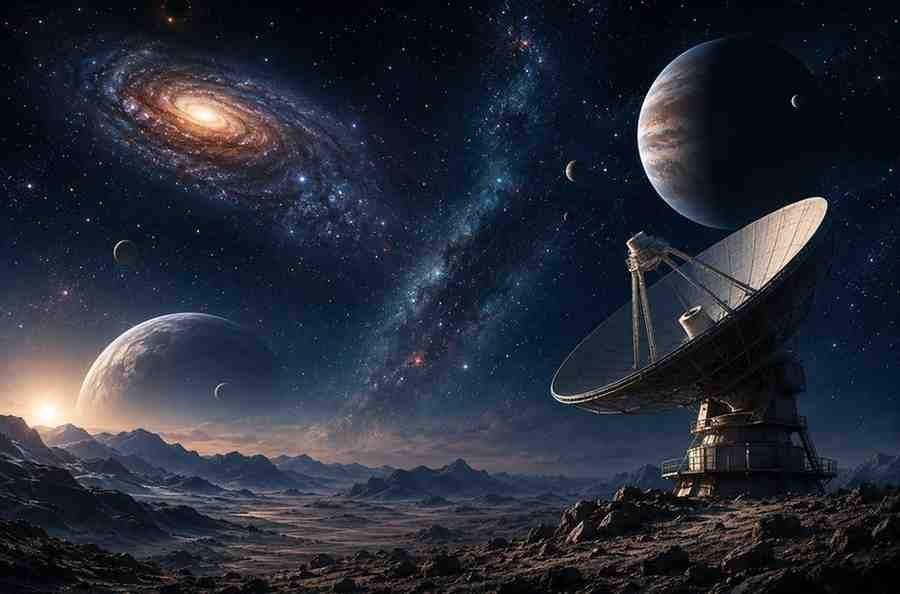
The search for alien life continues to capture global attention because it challenges one of humanity’s oldest questions: Are we alone in the universe?
Scientists, astronomers, and space agencies have searched for answers for decades. Meanwhile, movies, books, and scientific discoveries continue fueling curiosity about intelligent civilizations beyond Earth.
Modern science no longer treats the possibility of life beyond Earth as pure fantasy. Instead, researchers now study planets, stars, and atmospheric signals using advanced telescopes and space technology.
As a result, the discussion about alien life has become more serious than ever before.
How Scientists Search for Alien Life
Scientists use several methods to search for possible life forms in space. First, they study planets that orbit distant stars. Experts call these planets exoplanets.
Modern telescopes can now detect the sizes, temperatures, and atmospheres of these worlds. Consequently, scientists can estimate whether a planet may support water and life.
The James Webb Space Telescope has significantly improved this research. It studies distant planets with extraordinary detail and helps scientists identify gases linked to biological activity.
Researchers also listen for radio signals from deep space. For decades, scientific programs have scanned the sky for unusual patterns that could indicate intelligent communication.
However, no confirmed signal from intelligent alien life has appeared so far.
The Drake Equation and Alien Life Possibilities
In 1961, American astronomer Frank Drake introduced the famous Drake Equation.
The formula attempts to estimate how many intelligent civilizations may exist in the Milky Way galaxy.
The equation considers several important factors, including:
- The number of stars formed each year
- The percentage of stars with planets
- The number of habitable planets
- The chances of life developing.
- The possibility of intelligent civilizations surviving long enough to communicate
Although scientists cannot calculate an exact number, the equation suggests that intelligent alien life may exist somewhere in the galaxy.
At the same time, researchers admit that the universe remains extremely large and difficult to explore completely.
Why Scientists Believe Alien Life May Exist
Scientists continue discovering planets that resemble Earth. Some orbit inside “habitable zones,” where temperatures may allow liquid water to exist.
Water remains one of the strongest indicators of possible life because nearly all known life on Earth depends on it.
In addition, researchers have discovered organic molecules in space. These molecules serve as building blocks for life.
Mars also continues attracting attention. Scientists believe ancient Mars may once have contained rivers, lakes, and a thicker atmosphere. Therefore, some researchers think microbial alien life may have existed there billions of years ago.
Meanwhile, moons like Europa and Enceladus contain massive underground oceans beneath thick ice layers. Scientists believe these hidden oceans may provide environments suitable for microbial organisms.
Why Humans Still Have No Proof of Alien Life
Despite decades of research, scientists still lack direct evidence of intelligent extraterrestrial civilizations.
Several explanations may explain this mystery.
Space Is Too Large
The universe contains billions of galaxies and trillions of planets. Therefore, humanity has explored only a tiny fraction of space.
Signals from distant civilizations may take thousands of years to reach Earth. Consequently, scientists may not have searched long enough.
Civilizations May Not Survive
Some experts believe advanced civilizations may destroy themselves before achieving long-term survival.
Wars, environmental disasters, risks from artificial intelligence, or resource collapse could prevent civilizations from lasting long enough to communicate.
Alien Life May Be Very Different
Scientists often search for life forms similar to humans. However, extraterrestrial organisms may behave differently or communicate in ways we do not yet understand.
As a result, humans may overlook signs of alien life simply because current technology cannot recognize them.
Could Alien Life Be Microbial Instead of Intelligent?
Many scientists believe humanity may first discover microscopic organisms rather than advanced civilizations.
Simple microbial life requires fewer conditions for survival. Therefore, bacteria-like organisms may exist on planets or moons with water and energy sources.
NASA and other space agencies continue studying Mars and icy moons to search for microbial evidence.
Even finding simple organisms would completely change human understanding of biology and the universe.
It would also confirm that alien life can develop outside Earth.
How Modern Technology Changed the Search
Technology has transformed space research dramatically over the past few decades.
Scientists now use artificial intelligence, advanced telescopes, and robotic probes to study distant worlds more efficiently.
The James Webb Space Telescope can analyze the atmospheres of exoplanets. Some gases may indicate biological processes.
In addition, powerful radio observatories continuously scan deep space for unusual signals.
Private companies also contribute to space exploration. Companies like SpaceX continue to reduce the cost of space travel and increase interest in interplanetary missions.
As technology improves, researchers may discover stronger clues related to alien life in the future.
What Would Happen If Humans Discover Alien Life?
The discovery of extraterrestrial life would become one of the most important moments in human history.
Scientists would immediately study the biological structure, environment, and communication methods of the newly discovered organisms.
Religious, philosophical, and scientific discussions would also intensify worldwide.
At the same time, governments would likely create strict international protocols for handling contact with intelligent civilizations.
However, experts believe scientists would first announce findings carefully because extraordinary claims require strong evidence.
Therefore, researchers would verify every detail before confirming any discovery related to alien life.
Why Public Interest in Alien Life Keeps Growing
Interest in extraterrestrial civilizations continues to grow as space exploration enters a new era.
People now see real images from distant galaxies, black holes, and exoplanets. Consequently, the universe feels more accessible than ever before.
Social media, documentaries, and scientific discoveries also keep the topic alive.
At the same time, many people wonder whether intelligent civilizations may already exist somewhere far beyond Earth.
The possibility of discovering alien life continues inspiring curiosity because it connects science, imagination, and humanity’s future in space.
Final Thoughts on Alien Life
Humanity still has no confirmed proof of extraterrestrial civilizations. However, science now provides stronger reasons to continue searching.
Advanced telescopes, planetary discoveries, and deep-space research continue expanding human understanding of the universe.
Although researchers may not discover intelligent civilizations soon, scientists increasingly believe life-friendly environments exist beyond Earth.
The search for alien life, therefore, remains one of the most important scientific missions of modern history.
Whether humans discover microbes on Mars or signals from distant civilizations, the answer could permanently change humanity’s understanding of existence itself.