

Managing money wisely has become more important than ever in Pakistan. Rising expenses, inflation, and changing financial needs have encouraged people to look for safer ways to protect and grow their savings.
When people start saving money, one common question comes to mind: Savings Account vs Fixed Deposit in Pakistan, which option is better?
Both options help people earn returns on their money, but they serve different financial goals. A savings account offers flexibility and easy access, while a fixed deposit provides a fixed return for a specific period.
Before choosing any account, it is important to understand how savings accounts work, what features banks offer, and which options are suitable for different financial goals. Our detailed guide on Best Savings Accounts in Pakistan: A Complete Guide for Smart Savers explains everything beginners need to know before opening a savings account.
Choosing between these two depends on your income, financial goals, emergency needs, and investment plans.
Understanding the difference between a savings account and a fixed deposit can help you make a smarter financial decision and avoid keeping your hard-earned money in the wrong place.
What Is a Savings Account?
A savings account is a basic banking facility that allows individuals to deposit money, earn profit, and withdraw funds whenever needed.
Most banks in Pakistan offer savings accounts for salaried individuals, business owners, students, and families.
A savings account is designed for people who want security with quick access to their money.
For example, if someone saves money for monthly expenses, emergencies, education fees, or short-term goals, a savings account can provide convenience.
Major banks in Pakistan offer different types of savings accounts, including conventional and Islamic savings accounts.
What Is a Fixed Deposit?
A fixed deposit, also known as a term deposit, allows customers to invest money for a fixed period and earn a predetermined return.
In this option, the customer agrees to keep money deposited for a specific duration, such as three months, six months, one year, or longer.
Banks usually offer better returns on fixed deposits because customers cannot freely withdraw money before maturity without certain conditions.
A fixed deposit works better for people who have extra money and do not need immediate access to it.
For example, someone with Rs. 500,000 saved for future goals may choose a fixed deposit to earn higher returns instead of keeping the money idle.
Savings Account vs Fixed Deposit in Pakistan: Key Differences
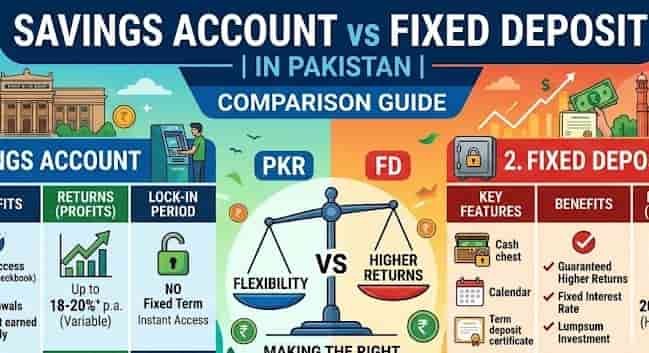
The main difference between a savings account and a fixed deposit is flexibility and return.
A savings account focuses on easy access, while a fixed deposit focuses on earning higher returns.
| Feature | Savings Account | Fixed Deposit |
|---|---|---|
| Access to Money | Easy withdrawal anytime | Locked for a fixed period |
| Return | Usually lower | Usually higher |
| Risk Level | Low | Low |
| Best For | Emergency savings | Long-term savings |
| Profit Rate | Variable | Fixed for agreed period |
| Liquidity | High | Lower |
Which Gives Higher Profit: Savings Account or Fixed Deposit?
Generally, fixed deposits offer higher returns compared to savings accounts.
The reason is simple. Banks can use fixed deposit funds for a longer period because customers commit to keeping their money deposited until maturity.
Savings accounts provide more flexibility, so banks usually offer comparatively lower returns.
However, profit rates change according to market conditions, bank policies, and economic factors.
Before choosing any option, customers should compare current profit rates from different banks.
Check our updated guide on Best Bank Profit Rates in Pakistan 2026 to compare the latest KIBOR, SBP policy rate, savings returns, and potential profit on different deposit amounts.
When Should You Choose a Savings Account?
A savings account is better when you need regular access to your money.
You should consider a savings account if:
You Need Emergency Funds
Emergency money should always remain easily available.
Medical expenses, job loss, family emergencies, or unexpected payments can happen anytime.
Keeping three to six months of expenses in a savings account can provide financial security.
You Receive Monthly Income
Salaried people usually need money for rent, bills, groceries, and daily expenses.
A savings account helps manage monthly cash flow without restrictions.
You Are Building Your First Savings
People who are starting their financial journey should begin with a savings account.
It creates a habit of saving money and understanding personal finance.
When Should You Choose a Fixed Deposit?
A fixed deposit works better when you have extra money that you do not need immediately.
You should consider a fixed deposit if:
You Have Surplus Savings
If you already have an emergency fund and extra money is available, a fixed deposit can help generate additional income.
You Want Guaranteed Returns
Many people prefer fixed deposits because they provide predictable returns.
This option suits individuals who prefer stability over high-risk investments.
You Have a Specific Financial Goal
Fixed deposits can help with goals like:
- Buying a vehicle
- Wedding expenses
- Education planning
- Future purchases
Savings Account vs Fixed Deposit in Pakistan for Middle-Class Families
For many Pakistani families, the best approach is not choosing only one option.
A balanced strategy works better.
For example:
A family earning Rs.100,000 monthly may keep emergency savings in a bank account while placing extra savings into fixed deposits.
This approach provides both safety and growth.
Keeping all money in a savings account may reduce growth because inflation decreases purchasing power over time.
On the other hand, putting all money into fixed deposits may create problems during emergencies because funds become less accessible.
Common Mistakes People Make With Savings
Many people save money but fail to manage it properly.
Some common mistakes include:
Keeping All Money in One Place
Smart financial planning requires diversification.
Emergency money, short-term savings, and long-term investments should have different purposes.
Ignoring Inflation
Money kept without growth loses value over time.
Inflation reduces purchasing power, which means today’s savings may buy fewer things in the future.
Choosing Without Comparing
Different banks offer different rates and facilities.
Always compare profit rates, account requirements, and additional benefits before making a decision.
The choice between a savings account and a fixed deposit depends on your financial situation.
A savings account is better for emergency funds, daily money management, and short-term needs.
A fixed deposit is better for extra savings, planned goals, and earning higher returns.
The smartest approach is often a combination of both. Keep enough money accessible through a savings account and invest additional funds through fixed deposits or other suitable options.
Good financial planning is not about saving more money only. It is about putting your money in the right place at the right time.
Frequently Asked Questions (FAQs)
1. Which is better, a savings account or a fixed deposit in Pakistan?
The better option depends on your financial goals. A savings account is suitable for people who need regular access to their money and want a safe place for emergency funds. A fixed deposit is better for people who have extra savings and want higher returns by keeping their money invested for a fixed period.
2. Does a fixed deposit give more profit than a savings account in Pakistan?
Yes, fixed deposits usually offer higher returns compared to savings accounts because banks keep the money for a specific period. However, profit rates vary depending on the bank, deposit amount, and duration of the fixed deposit.
3. How much money should I keep in a savings account in Pakistan?
Most financial experts recommend keeping three to six months of living expenses in a savings account as an emergency fund. The exact amount depends on your monthly expenses, income stability, and personal financial needs.
4. Can I withdraw money from a fixed deposit before maturity in Pakistan?
Yes, many banks allow early withdrawal from fixed deposits, but some conditions may apply. The customer may receive a lower profit rate or face certain charges depending on the bank’s policy.
5. Is money safer in a savings account or fixed deposit?
Both options are considered relatively safe because they are offered by regulated banks. A savings account provides more flexibility, while a fixed deposit provides better return stability.
6. Which option is better for beginners: savings account or fixed deposit?
Beginners should usually start with a savings account because it helps build saving habits and provides easy access to money. After creating an emergency fund, they can consider fixed deposits or other investment options.
7. Can I open both a savings account and a fixed deposit in Pakistan?
Yes, many people use both options together. They keep emergency money in a savings account and invest extra savings in fixed deposits to earn better returns.
8. What is the minimum amount required for a fixed deposit in Pakistan?
The minimum amount varies from bank to bank. Some banks allow fixed deposits with smaller amounts, while others require a higher minimum deposit depending on the account type and duration.
9. Are Islamic fixed deposits available in Pakistan?
Yes, Islamic banks in Pakistan offer Shariah-compliant fixed deposit options based on Islamic banking principles. Customers should review the terms and profit-sharing mechanism before selecting any product.
10. Should I keep all my savings in a bank account?
Keeping all savings in one place may not be the best strategy. A smart approach is to maintain emergency funds in a savings account and use suitable investment options for long-term financial growth.