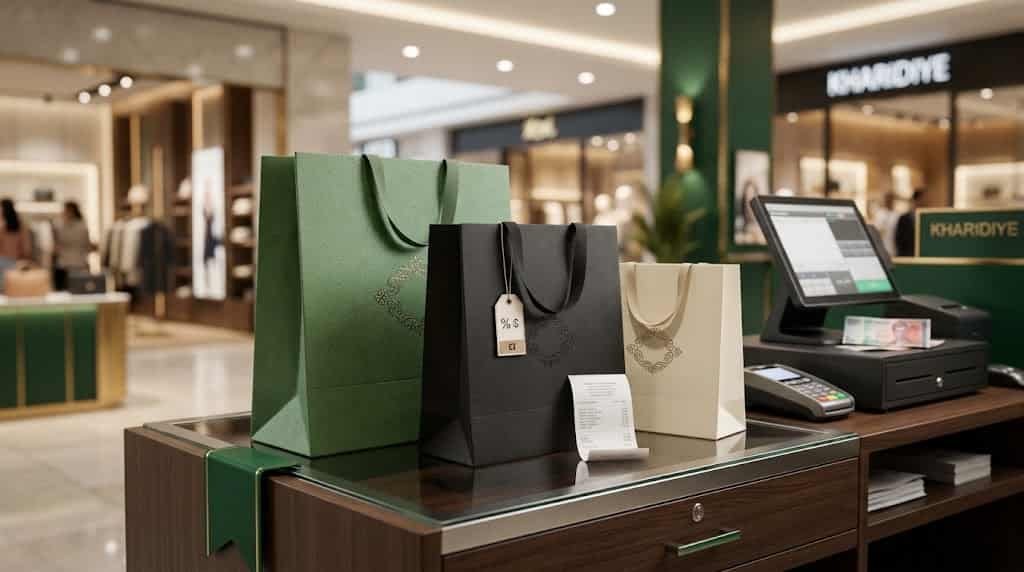
You walk into a well-known clothing store in Pakistan.
You select a shirt, dress or suit, stand in a queue and finally pay a bill of several thousand rupees.
Then comes a small but increasingly familiar question:
“Sir/Madam, shopping bag chahiye? Rs30 extra.”
Most customers simply say yes.
After spending Rs5,000, Rs10,000 or even more, who wants to argue over Rs30 or Rs50?
But stop for a moment.
The bag you are paying for often has the retailer’s name and logo printed prominently across it.
You pay for the bag.
You carry it through the shopping mall.
You take it through the market.
You carry it to your car.
Other people see the brand.
In other words, you may have paid a business for the privilege of carrying its advertising.
A recent decision from a Peshawar consumer court has now put this everyday practice under a very different light.
A Rs30 Shopping Bag Ended Up Costing Rs50,000
The case began with something that happens every day across Pakistan.
A customer, Shafaq Aamir, purchased clothing worth Rs7,000 from a well-known clothing retailer’s outlet in Peshawar on December 20, 2025.
Her receipt included another charge:
Rs30 for a shopping bag.
The amount itself was tiny compared with the Rs7,000 purchase.
However, there was an important detail.
The shopping bag carried the company’s promotional logo.
Instead of ignoring the Rs30 charge, the customer challenged it before the Consumer Protection Court under the Khyber Pakhtunkhwa Consumers Protection Act, 1997.
The retailer did not deny charging for the bag.
Its position was that it had no obligation to provide a free bag and that customers could choose whether they wanted to purchase one.
The consumer court did not accept that argument in the circumstances of this case.
The court focused on a very simple point:
The bag was also promoting the retailer’s brand.
The court found that the company was charging the consumer for a bag while simultaneously using that bag for its own promotion.
It declared the practice an unfair trade practice under the applicable consumer law.
The result was significant.
The court ordered the retailer to return the customer’s Rs30.
It also awarded her Rs25,000 in compensation.
Another Rs25,000 fine had to be paid to the government.
A Rs30 dispute had therefore resulted in Rs50,000 in compensation and fine, in addition to refunding the original Rs30.
This Case Is Not Really About Rs30
That is the most important point for Pakistani consumers.
Nobody goes to court because Rs30 will make or break a household budget.
The issue is the principle behind the Rs30.
A customer has already purchased the company’s product.
The retailer then needs to hand that product to the customer in a practical way.
If the retailer provides a bag carrying its own large logo, brand name, website or marketing message, that bag does more than carry the customer’s clothes.
It also advertises the business.
The Peshawar court specifically recognised this promotional element when deciding the case.
That raises a question millions of Pakistani shoppers can understand:
Why should a consumer pay to advertise a company from which they have already purchased goods?
Your Local Shop Often Gives You a Bag
Think about your neighbourhood.
You visit a local grocery shop and buy household items.
The shopkeeper normally gives you something in which to carry your purchase, subject of course to applicable environmental restrictions.
You visit a pharmacy.
Your medicines usually come in some form of packaging.
You buy food from a takeaway restaurant.
The business provides packaging so you can carry the product.
Now walk into an expensive fashion outlet.
You may spend Rs8,000 on one dress.
The cashier then asks for another Rs30, Rs50 or even more for a bag.
This naturally feels strange to many consumers.
The customer has already given the company business.
Why should basic carrying packaging become another source of revenue—particularly when that packaging carries the company’s own branding?
The Brand Gets Something From That Bag Too
A branded shopping bag is not always just packaging.
It can be mobile advertising.
Imagine hundreds of customers walking around a busy shopping mall carrying bags with the same fashion brand printed across them.
Other shoppers see those bags.
People notice the logo.
The brand becomes more visible.
That is marketing value.
Companies normally pay for billboards, social media advertising, television commercials, influencer campaigns and other promotional channels.
A branded shopping bag can also perform a promotional function.
The unusual part is that, in this situation, the customer may be paying for that branded item.
The Peshawar consumer court addressed exactly this point.
It observed that the logo-bearing bag promoted the retailer while its cost was recovered from the consumer.
That became central to the court’s finding of unfair trade practice in the circumstances of the case.
What If the Bag Has No Logo?
This is where consumers should avoid misunderstanding the judgment.
The decision does not necessarily mean that every type of reusable bag sold by every business everywhere in Pakistan must always be free.
The facts matter.
A retailer may sell a durable reusable cloth bag as a separate product.
A customer might voluntarily purchase a premium tote bag designed for repeated use.
Environmental rules may also encourage businesses to move consumers away from disposable plastic.
Those situations can be different from charging a customer for basic packaging that prominently advertises the retailer itself.
The Peshawar ruling specifically involved a branded shopping bag carrying the retailer’s promotional logo.
That distinction matters.
Punjab Consumers Have Another Important Protection
The issue has become even more important because Punjab has already introduced a separate restriction concerning plastic shopping bags.
The Punjab Environmental Protection Agency announced that commercial establishments cannot separately charge customers for plastic shopping bags from September 6, 2026.
The restriction covers shops, retail outlets, restaurants, hotels and other commercial establishments.
Businesses that violate the restriction can face penalties.
However, Punjab’s rules make an important distinction.
Retailers can still charge for reusable or recyclable alternatives such as cloth or other environmentally friendly bags.
Therefore, consumers should understand the difference between two issues.
One is environmental regulation of plastic bags.
The other is consumer protection when a business charges you for a bag that also serves as its advertising.
The Peshawar judgment deals with the second issue.
Punjab’s restriction gives consumers an additional argument when businesses separately charge them for plastic shopping bags.
“But We Are Trying to Reduce Plastic”
Brands often have a legitimate environmental reason for discouraging unnecessary shopping bags.
Pakistan has a serious plastic-waste problem.
Encouraging customers to reuse bags is sensible.
Charging for reusable bags can also encourage shoppers to bring their own bags.
But environmental responsibility should not become a convenient excuse for shifting ordinary business costs to consumers.
If a company genuinely wants to reduce waste, it has several options.
It can ask customers whether they need a bag.
It can encourage customers to bring reusable bags.
It can offer environmentally friendly packaging.
It can sell a durable reusable bag as a clearly identified separate product where permitted.
Or it can provide simple packaging as part of the cost of doing business.
What deserves scrutiny is when a company charges a customer for packaging and then turns that same packaging into prominent advertising for itself.
Imagine If Every Business Started Doing This
The principle becomes clearer if we take it further.
Imagine buying shoes and paying separately for the shoe box.
Imagine buying a television and being charged for the manufacturer’s branded cardboard box.
Imagine ordering takeaway food and receiving separate charges for every branded container carrying the restaurant’s logo.
Imagine buying medicine and paying separately for the pharmacy’s branded paper bag.
At some point, consumers would reasonably ask:
What exactly is included in the price I am already paying?
Packaging is a normal part of selling many physical products.
Businesses naturally include numerous operating costs when setting prices.
They pay rent.
They pay salaries.
They pay electricity bills.
They pay for counters, receipts, labels, packaging and marketing.
A customer normally sees the final product price rather than receiving a separate bill for every operating expense.
That is why a separate charge for basic branded carrying packaging attracts attention.
Rs30 Looks Small Until Millions of Customers Pay It
Another reason consumers ignore bag charges is that the amount appears insignificant.
Rs30.
Rs50.
Maybe Rs100.
But small charges become large when multiplied across thousands or millions of transactions.
Suppose, purely as an illustration, a retail chain sells 10,000 shopping bags for Rs30 each.
That equals:
Rs300,000.
At 100,000 bags:
Rs3 million.
At one million bags:
Rs30 million.
These are only mathematical examples, not figures for any particular retailer.
But they demonstrate why consumers should not automatically dismiss a charge simply because the individual amount is small.
Consumer protection often concerns small amounts multiplied across large numbers of customers.
“It Is Only Rs30” Is Exactly Why These Practices Continue
Imagine standing at a crowded checkout counter.
There are ten people waiting behind you.
The cashier asks for Rs30 for the bag.
Are you really going to stop everything and argue?
Most people will not.
Businesses know that small charges create little resistance.
The customer thinks:
“I’ve already spent Rs7,000. What difference will another Rs30 make?”
But consumer rights do not disappear because the amount is small.
In fact, the Peshawar case demonstrates the opposite.
The original dispute concerned only Rs30.
The consumer challenged the principle.
The court examined it.
And the resulting compensation and fine were dramatically larger than the original charge.
What Should You Do the Next Time a Brand Charges You for a Bag?
Do not start an argument with the cashier.
The employee behind the counter may simply be following company policy.
Instead, ask calmly:
“Is this bag charge compulsory?”
Then ask:
“Does this bag carry your company’s logo or advertising?”
If you do not need a bag, refuse it.
If you are charged, keep the receipt.
The receipt can become extremely important because it proves that the business separately charged you for the bag.
You can also photograph the bag, particularly if the company’s branding or promotional material appears on it.
Record the outlet name, location and date.
These simple pieces of evidence can matter if you later decide to make a complaint.
Always Ask for a Receipt
Pakistan’s consumers often make another mistake.
They throw away the receipt immediately.
Do not do that when you believe a retailer has charged you unfairly.
The receipt can show:
- What you purchased
- How much you paid
- Whether the bag appeared as a separate charge
- When the transaction occurred
- Which outlet processed the purchase
In the Peshawar case, the purchase receipt helped establish that the customer had paid an additional Rs30 for the carrying bag.
Evidence is much stronger than simply saying:
“They charged me.”
Can You Refuse a Branded Bag?
You can certainly ask whether another option is available.
If a retailer wants you to pay for a reusable bag, ask whether you can carry the product in your own bag.
You can also ask whether the retailer provides basic packaging without promotional branding.
The Peshawar judgment itself observed that the retailer could otherwise have provided an ordinary bag.
This creates an important distinction.
If a company wants to sell you a separate reusable product, that is one issue.
If it wants you to pay for something that simultaneously acts as the company’s advertisement, consumers now have a strong reason to question the practice.
Where Can Punjab Consumers Report Plastic Bag Charges?
Punjab consumers have a particularly straightforward option regarding separately charged plastic shopping bags.
The Punjab Environmental Protection Agency has asked consumers to report violations through its 1373 helpline.
Businesses violating the provincial plastic-bag order can face fines ranging from Rs5,000 to Rs50,000.
Authorities have also warned that serious violations can lead to business premises being sealed and criminal proceedings.
Again, this specific Punjab measure concerns plastic shopping bags.
Reusable environmentally friendly alternatives can fall under different rules.
Consumers Should Not Feel Embarrassed About Asking Questions
There is a cultural problem here too.
Many Pakistani customers feel embarrassed to question small charges.
They worry that people will think:
“You can spend Rs10,000 on clothes but you are arguing over Rs30?”
That misses the point.
Consumer rights do not depend on whether you are rich or poor.
A company should be able to explain every charge it adds to your bill.
If the charge is lawful and justified, the company can explain it.
If it cannot explain the charge clearly, the consumer has every right to ask questions.
You are not asking for charity.
You are paying for a commercial transaction.
Expensive Brands Should Set a Higher Standard
Large retailers have sophisticated marketing departments, professionally designed stores, online platforms and nationwide operations.
Consumers therefore reasonably expect professional standards.
If a local shopkeeper can think about how the customer will carry purchased goods, major retailers can do the same.
Businesses are entitled to earn profits.
They are entitled to promote their brands.
They can also encourage environmentally responsible behaviour.
But consumers should not unknowingly finance a company’s advertising simply because questioning Rs30 feels inconvenient.
Transparency benefits both sides.
A retailer that clearly explains its bag policy avoids confusion.
A consumer who understands the charge can make an informed choice.
Consumers Also Have Responsibilities
Consumer protection should not become an excuse for waste.
Customers should not demand multiple disposable bags when they do not need them.
If you already have a reusable shopping bag, use it.
If two products can safely fit into one bag, there is no reason to demand three.
Reducing plastic waste benefits everyone.
The strongest consumer position is therefore balanced:
Businesses should treat customers fairly, and customers should use packaging responsibly.
Consumer rights and environmental responsibility can exist together.
What This Peshawar Decision Could Mean for Other Brands
One consumer court judgment should not automatically be described as a nationwide blanket ban applying identically to every bag and every retailer.
Pakistan has federal and provincial laws, while the exact facts of each transaction can differ.
However, the Peshawar ruling sends an important message.
A retailer may face a consumer challenge when it charges customers for a shopping bag that simultaneously carries and promotes the retailer’s own brand.
Other Pakistani retailers should pay attention.
A policy may have existed for years.
Thousands of customers may have accepted it.
That does not necessarily prevent one customer from challenging it under applicable consumer law.
One Customer Can Make a Difference
Perhaps the most important lesson from this case is not about shopping bags at all.
It is about consumer awareness.
One customer noticed a Rs30 charge.
She kept the evidence.
She questioned the practice.
She approached the consumer court.
The court examined the issue and ruled on it.
Now millions of Pakistani consumers can discuss a practice that many previously accepted without question.
That is how consumer protection becomes meaningful.
A law sitting in a book does little for ordinary people unless consumers know that it exists and are prepared to use the mechanisms available to them.
Before You Pay for Your Next Shopping Bag, Ask One Question
The next time you shop at a major Pakistani clothing, footwear, cosmetics or lifestyle brand and the cashier asks you to pay separately for a bag, look at it.
Does it prominently display the company’s logo?
Does it advertise the retailer?
If it does, ask yourself:
“Why am I paying to advertise the brand I just gave my business to?”
That question does not automatically determine the legal outcome of every transaction.
But after the Peshawar consumer court’s decision, it is certainly a question worth asking.
Consumers should also remember that Punjab has separately prohibited businesses from charging for plastic shopping bags, while allowing charges for certain reusable and environmentally friendly alternatives.
So do not fight with the cashier.
Do not create a scene.
Ask politely.
Check your receipt.
Understand what you are paying for.
Keep evidence if you believe a charge violates applicable rules.
And use the proper consumer or regulatory channel where necessary.
Thirty rupees may seem insignificant.
Your right to fair treatment as a consumer is not.