Makkah Pact Nations Condemn Houthi Attacks on Saudi Arabia
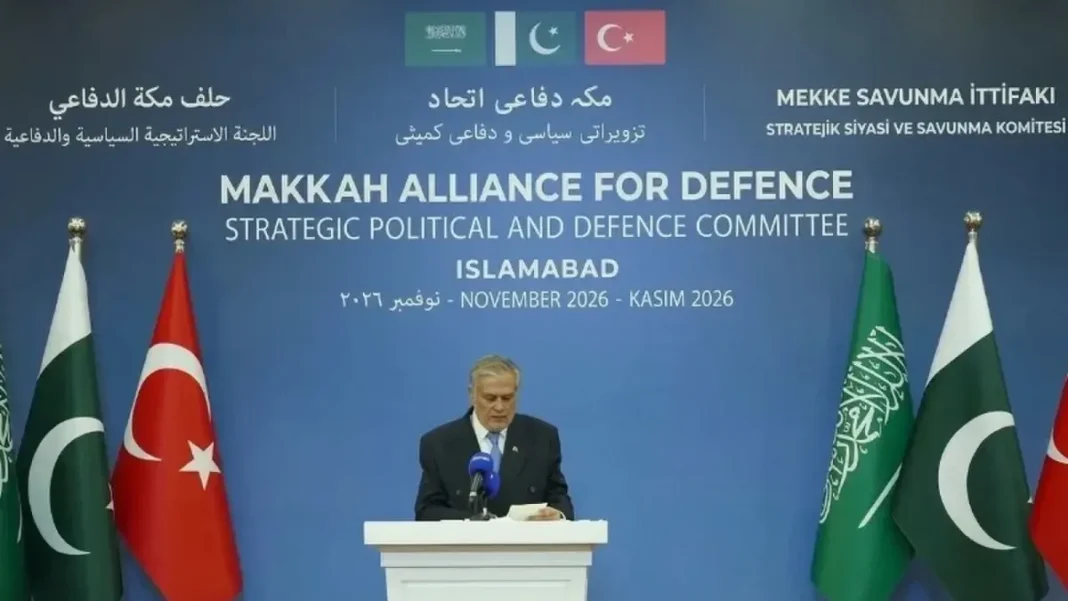
Pakistan, Saudi Arabia and Turkiye condemned Houthi attacks on Saudi Arabia on Friday, as the Makkah pact nations met in Islamabad and reaffirmed their collective resolve to defend the kingdom’s security. The meeting of the alliance’s top decision-making body reviewed the regional security situation and pledged closer cooperation on defence, technology and training.
Deputy Prime Minister and Foreign Minister Ishaq Dar briefed the media after the meeting. He said the Strategic Political and Defence Committee, known as the SPDC, reviewed the evolving regional security situation and reaffirmed the three countries’ determination to work together for peace, security and stability.
The three sides condemned the “persistent and heinous” attacks by Yemen’s Houthis on civilians and civilian infrastructure in Saudi Arabia. Dar said they reaffirmed their “collective resolve” to keep working for the kingdom’s security, sovereignty and territorial integrity under the pact’s collective defence provisions.
Friday’s session lasted about two and a half hours. The committee’s third session runs over two days in Islamabad, Friday and Saturday, and brings together the foreign and defence ministers and military chiefs of the three countries. Islamabad and Rawalpindi observed a local holiday on Friday, and traffic curbs were in force around the capital’s Red Zone.
Dar represented Pakistan with Defence Minister Khawaja Asif and Chief of Defence Forces and Chief of Army Staff Field Marshal Asim Munir. Saudi Arabia sent Defence Minister Prince Khalid bin Salman, Foreign Minister Prince Faisal bin Farhan and Chief of General Staff Gen Fayyadh bin Hamed Al-Ruwaili. Turkiye’s team included Foreign Minister Hakan Fidan, Defence Minister Yasar Guler and Chief of General Staff Gen Selcuk Bayraktaroglu.
Makkah pact nations agree to deepen defence cooperation
The three countries also agreed to strengthen cooperation in defence industries, joint technological development, training and capacity building, Dar said. The aim is to lift the collective capabilities of their armed forces so they can answer shared security concerns together.
They also reviewed progress on decisions taken at the last meeting and expressed satisfaction with the pace of work on the alliance secretariat in Saudi Arabia. The alliance is setting up a permanent secretariat in Riyadh, and retired Lt Gen Nauman Mahmood has been named its first secretary general for a three-year term.
The three sides also agreed to keep consulting on de-escalation and peaceful settlement of disputes. The meeting was also expected to focus on finalising standard operating procedures and an implementation mechanism, a Pakistani official said.
The pact, and why this meeting matters
The three countries signed the Makkah Joint Defence Agreement on August 7 in Makkah. Prime Minister Shehbaz Sharif, Saudi Crown Prince Mohammed bin Salman and Turkish President Recep Tayyip Erdogan signed the pact, which treats an armed attack on any one member as an attack on all three. The pact runs for 10 years, and a member that wants to leave must give three months’ notice.
Turkiye completed its ratification on Friday, when President Erdogan formally approved the agreement, after parliament passed the bill on November 5. All three members have now completed accession, though Asif described the alliance’s framework as still at a “nascent stage”.
The committee’s first session was held in Istanbul on August 31, followed by an emergency meeting in Riyadh on October 5. That meeting condemned attempts to target Makkah and Madinah and attacks on Saudi cities, civilians and economic infrastructure, and agreed to move towards practical implementation of the collective defence commitments, the Foreign Office said in a briefing.
Defence Minister Khawaja Asif had said on Thursday that the conflict in Yemen would be on the agenda of the Islamabad meeting. “Any threat to Saudi Arabia is a threat to Pakistan and Turkiye according to the pact, which is absolutely clear,” he said.
The condemnation follows a series of Houthi strikes on Saudi targets, including an attack on a refinery in Jazan that killed one person and halted operations. A second attack on a PIF tower in Riyadh injured 11 people.
For Pakistan, the meeting also tests a careful balance between keeping channels open with Iran and deepening defence ties with Riyadh and Ankara. It brokered a June accord that briefly halted fighting between the United States and Iran, though the truce later collapsed and mediation remains fragile, Asif said. Turkiye has stressed the defensive character of the agreement and stayed cautious about any combat role in Yemen.
Recent Pakistani deployments, including JF-17 aircraft, drones and HQ-9 air defence systems, were made under bilateral cooperation that predates the alliance and will now sit inside the trilateral framework, Dawn reported, citing a security source. The alliance has yet to publicly define its doctrine, the composition of forces, command arrangements or procedures for a collective military response.
Frequently asked questions
What is the Makkah Joint Defence Agreement?
It is a defence pact signed on August 7, 2026, by Pakistan, Saudi Arabia and Turkiye. Under the pact, an armed attack on any one member is treated as an attack on all three, and the other members must help through available means, including military support. The pact runs for 10 years.
What did the three countries agree in Islamabad?
They condemned Houthi attacks on Saudi civilians and infrastructure, reaffirmed their commitment to collective defence and mutual solidarity, and agreed to deepen cooperation in defence industries, joint technology, training and capacity building. They also reviewed progress on the alliance secretariat in Riyadh.
Who attended the SPDC meeting?
Pakistan was represented by Foreign Minister Ishaq Dar, Defence Minister Khawaja Asif and Field Marshal Asim Munir. Saudi Arabia sent Prince Khalid bin Salman, Prince Faisal bin Farhan and Gen Fayyadh bin Hamed Al-Ruwaili. Turkiye sent Hakan Fidan, Yasar Guler and Gen Selcuk Bayraktaroglu.
Has Turkiye completed ratification of the pact?
Yes. President Recep Tayyip Erdogan formally approved the agreement on Friday, after Turkiye’s parliament ratified it on November 5. That completed the accession process for all three members, though the alliance’s framework is still at what Asif called a “nascent stage”.
What happens next?
The committee’s session continues on Saturday, November 28. The three countries still have to finalise standard operating procedures, an implementation mechanism and the working of the secretariat in Riyadh. No joint force composition or command arrangement has been announced yet.