Pakistan, Bangladesh Sign Essential Goods Trade Deal
Pakistan and Bangladesh have signed an essential goods trade deal under which the two countries will supply each other with essential commodities, farm products and agricultural inputs on a government-to-government basis.
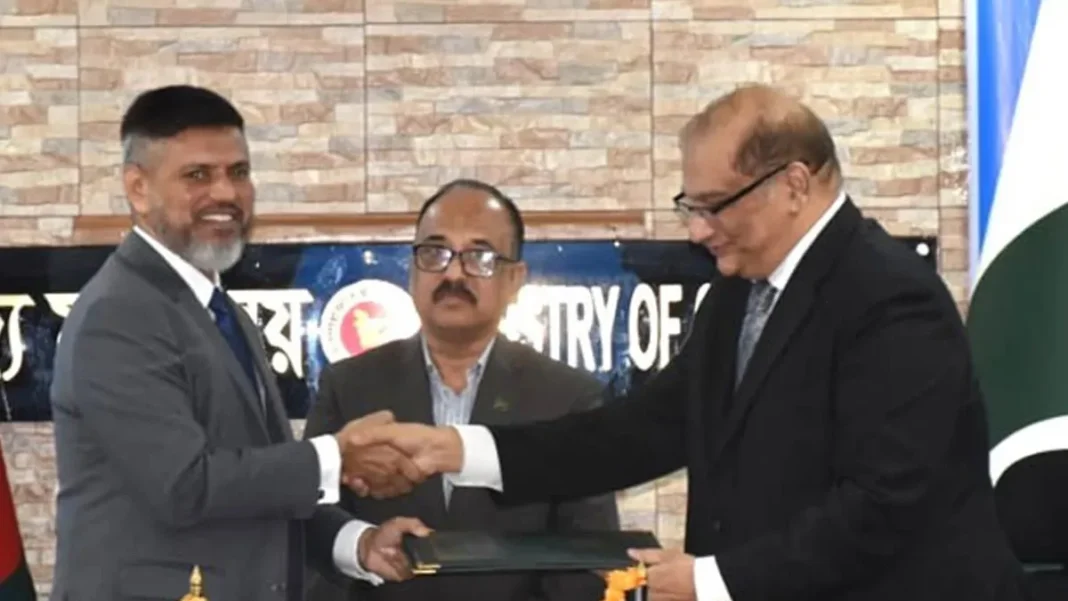
The memorandum of understanding was signed at the Ministry of Commerce in Dhaka on Sunday, November 29, 2026. It was signed between the Trading Corporation of Pakistan (TCP) and the Trading Corporation of Bangladesh (TCB).
Pakistan’s High Commissioner to Bangladesh, Imran Haider, signed the agreement on behalf of the TCP. TCB Chairman Brigadier General Mohammad Foyshol Azad signed for Bangladesh.
What the essential goods trade deal covers
Under the agreement, Pakistan and Bangladesh will be able to import and export essential commodities, agricultural products and agricultural inputs. The deal sets up a direct institutional mechanism for buying and supplying those goods according to each country’s needs. The goods covered include rice, wheat, sugar, edible oil and pulses, along with sesame, potatoes, onions, lentils, chickpeas, tea, pineapples, jackfruit, dates and fertilisers. The agreement runs for five years and renews automatically for another five unless either side opts out.
The Pakistan High Commission said the arrangement is expected to strengthen food security, improve supply chain resilience, support stability in domestic markets and create economic opportunities that benefit both sides.
Bangladesh Commerce Ministry Secretary Sharf Uddin Ahmed Choudhury attended the signing ceremony, along with officials from the ministry and the Pakistan High Commission.
Why it matters for Pakistan
The deal gives Pakistan a second, state-run channel for food and farm supplies. Trade through the TCP can be arranged directly between the two state corporations, rather than relying only on private traders.
Food prices have stayed in focus at home. The FPCCI has urged private wheat imports as flour prices bite, and Pakistan’s regional trade deficit has widened by 26pc. A government-to-government channel with Bangladesh adds another source of supply when markets turn tight.
For Bangladesh, the agreement opens a direct route to Pakistani goods as well. No specific product, volume or first shipment date has been agreed yet. Those will be settled through written proposals as needs arise.
A thaw that has gathered pace
The agreement is the latest step in a warming of ties that began after Sheikh Hasina’s government fell in August 2024. Relations had reached a low point during her rule, and they have improved steadily under the interim administration in Dhaka.
The thaw has continued even as Bangladesh deals with unrest at home, where two people were killed in clashes ahead of Sheikh Hasina’s expected return, and unrest has gripped her hometown of Gopalganj.
In December 2024, Prime Minister Shehbaz Sharif met Bangladesh’s Chief Adviser, Professor Muhammad Yunus, on the sidelines of the D-8 Summit in Cairo. The two leaders agreed to expand cooperation across several areas.
Foreign Minister Ishaq Dar later visited Dhaka, the first visit by a Pakistani foreign minister to Bangladesh in 13 years. The two countries have also agreed in principle to allow visa-free entry for holders of diplomatic and official passports.
The signing came four days after Shehbaz Sharif hosted a dinner at the Prime Minister’s House for Bangladesh Parliament Speaker Hafiz Uddin Ahmad Bir Bikram and his delegation. The prime minister said regular exchanges between parliaments could anchor closer cooperation, and he stressed the need to build institutional links and people-to-people contacts.
Earlier this month, Pakistan offered to share its experience of managing the global energy crisis with Bangladesh. Petroleum Minister Ali Pervaiz Malik discussed fuel supply with Bangladesh’s Adviser on Finance, Rashid Al Mehmood Titumir.
High Commissioner Haider said relations between the two countries were moving in a positive direction, with growing cooperation in trade and commerce. He said the agreement would strengthen economic engagement and turn goodwill between the two countries into practical cooperation.
Haider also called on Bangladesh’s Commerce, Industries, Textiles and Jute Minister, Khandakar Abdul Muktadir, and thanked him for his support in reaching the agreement.
What happens next
The two trading corporations will now work through the new mechanism to arrange supplies as needs arise on either side. Traders and officials in both countries will watch which commodities move first, and whether the channel grows into regular shipments.
The deal also adds to a wider pattern. FoodAg 2026 closed deals worth $168 million for Pakistan’s farm and food exporters, and the government has been pushing farm exports as a way to narrow the trade gap.
Frequently asked questions
What did Pakistan and Bangladesh agree?
The two countries signed a memorandum of understanding between the Trading Corporation of Pakistan and the Trading Corporation of Bangladesh for the supply of essential commodities, agricultural products and inputs on a government-to-government basis.
Who signed the agreement?
Pakistan’s High Commissioner to Bangladesh, Imran Haider, signed on behalf of the TCP. TCB Chairman Brigadier General Mohammad Foyshol Azad signed for Bangladesh. The signing took place at the Ministry of Commerce in Dhaka on November 29, 2026.
Which goods does the deal cover?
The deal covers essential commodities, agricultural products and agricultural inputs. Goods can move in both directions, depending on each country’s needs.
How will the deal work?
The two state trading corporations will use a direct institutional mechanism to arrange procurement and supply. The Pakistan High Commission said the arrangement should strengthen food security, improve supply chain resilience and support stability in domestic markets.
Why is the deal significant?
It turns the recent political thaw between Pakistan and Bangladesh into practical trade cooperation. Ties have improved since Sheikh Hasina’s government fell in August 2024, with high-level visits, a parliamentary exchange and now a formal trade mechanism.