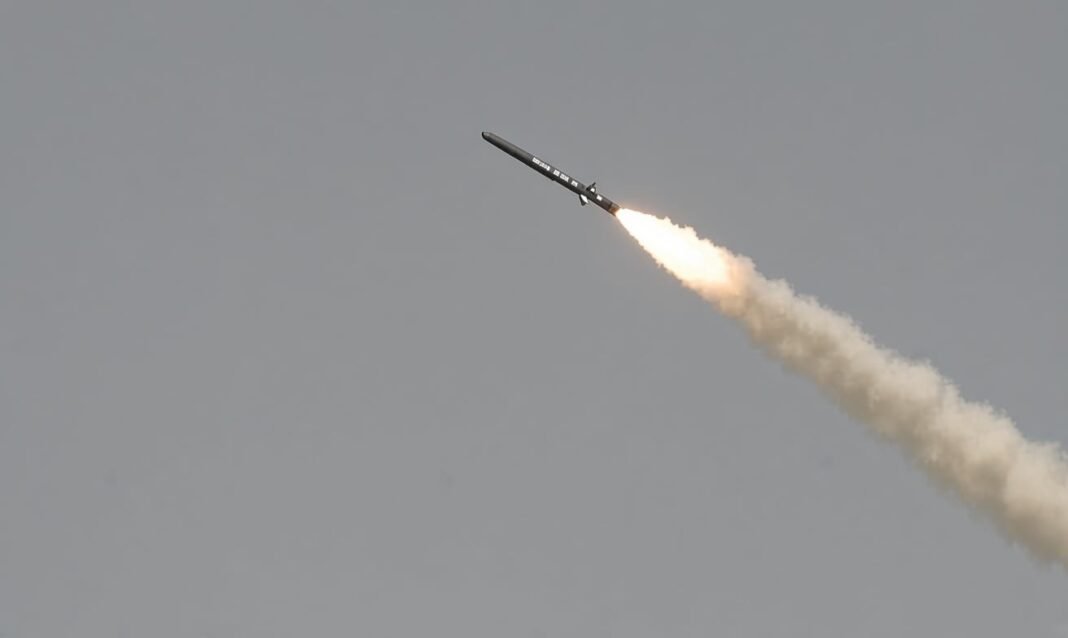
RAWALPINDI: Pakistan successfully test-fired the Fatah-2 extended range (ER) hypersonic ballistic missile on Tuesday. The military’s media wing announced the launch, describing it as a successful validation of the weapon system’s technical parameters.
The Inter-Services Public Relations (ISPR) said the Fatah-2 hypersonic missile is equipped with advanced navigation and state-of-the-art avionics. The missile can engage targets with high precision, the ISPR said, and its unique trajectory and manoeuvrability allow it to defeat enemy missile defence systems.
Fatah-2 hypersonic missile: what the ISPR said
According to the military’s statement, the extended range of the Fatah-2 ER will further enhance the army’s reach and its capability of engaging deep targets.
The test launch was witnessed by the Army Rocket Force Command chief, Lt Gen Nauman Zakaria, along with senior army officers, scientists and engineers. The ISPR said the ARFC commander appreciated the dedication and technical prowess of the scientists and engineers behind the system.
President Asif Ali Zardari, Prime Minister Shehbaz Sharif, and the chief of defence forces congratulated the scientists and engineers on the successful test launch of the extended range version of the Fatah-2 weapon system, the ISPR added.
Second test in under a week
The launch marks the second Pakistani strategic-weapons test in days. Last week, the indigenously developed extended version of the Fatah-IV ground-launched cruise missile also underwent a successful test launch, Dawn reported.
The two tests together point to an active phase of weapons validation by the Army Rocket Force Command, the formation that now oversees Pakistan’s land-based missile arm. Lt Gen Nauman Zakaria’s presence at the Fatah-2 ER launch underlines the command’s central role in the programme.
Why the test matters
Hypersonic weapons — missiles that travel at more than five times the speed of sound — are among the hardest targets for conventional air defences. By combining high speed with manoeuvrability, the Fatah-2 ER is designed to penetrate missile shields that can intercept slower, predictable ballistic missiles.
The test also comes at a tense regional moment. The Houthi strikes on Riyadh’s airport — including the intercepted ballistic missile fired towards the Saudi capital on Monday night and the extended closure of the airport after the weekend strikes — have kept the region’s air-defence debate in the headlines. The disruption has already reached Pakistan’s travellers, with several Lahore-Gulf flights cancelled amid the tensions. Pakistan has publicly aligned itself with Saudi Arabia’s defence while insisting its own forces are not taking part in strikes.
At home, the military’s messaging has been consistent: the test is about validating technology, not signalling. The ISPR framed the launch as a technical exercise, with the emphasis on parameters met rather than adversaries named. That posture matches the military’s wider public stance this month, from denying Pakistani jets struck the Houthis to the government’s claim of holding credible evidence of contacts between the PTI and the TTP.
What happens next
Pakistan’s missile testing programme typically runs in cycles, with several systems validated in succession before the focus shifts. If the pattern holds, more announcements from the Army Rocket Force Command could follow in the coming weeks.
For analysts, the details to watch are the system’s declared range and the pace at which the extended-range variant moves from testing to operational deployment — neither of which the ISPR disclosed in Tuesday’s statement.
FAQs
What is the Fatah-2 ER missile?
The Fatah-2 extended range is a hypersonic ballistic missile developed for the Pakistan Army. The ISPR says it combines advanced navigation and state-of-the-art avionics with a manoeuvrable trajectory designed to defeat enemy missile defences.
Who witnessed the Fatah-2 test launch?
The launch was witnessed by Army Rocket Force Command chief Lt Gen Nauman Zakaria, senior army officers, and the scientists and engineers who developed the system.
Who congratulated the team after the test?
According to the ISPR, President Asif Ali Zardari, Prime Minister Shehbaz Sharif, and the chief of defence forces congratulated the scientists and engineers on the successful launch.
Was this Pakistan’s first missile test this month?
No. Days earlier, Pakistan successfully tested the extended-range version of the Fatah-IV ground-launched cruise missile, making the Fatah-2 ER the second strategic-weapons test in under a week.