HRCP Minorities Report Flags Rights Violations Across Pakistan
The HRCP minorities report for 2026 concludes that religious minorities in Pakistan continue to face violations of their fundamental rights, despite a wave of new legislation meant to protect them. The Human Rights Commission of Pakistan released its seventh annual report on freedom of religion, titled “Sanctuary Denied: Freedom of Religion or Belief in 2025/26”, at a launch event in Lahore on Thursday.
The report documents the misuse of blasphemy laws, forced marriages and conversions, hate speech and discriminatory practices against minority communities. It warns that the state’s approach to religious minorities is becoming more exclusionary, not less.
HRCP Minorities Report Documents Blasphemy Law Misuse
Scores of people accused of blasphemy remain stuck in legal limbo, the report says, while the alleged perpetrators of an “organised entrapment network” have yet to face investigation. HRCP’s Punjab vice-chair, Raja Ashraf, said blasphemy accusations had become “a means of exploiting and endangering vulnerable people”. Arafat Mazhar of the research collective Shehri Pakistan urged the public to leave such cases to lawyers and courts instead of turning each accused person into a symbol.
The report highlights the case of Kamran Gill, a Christian medical practitioner from Sheikhupura. A mob set his dispensary on fire on October 9 after allegations that he had shared blasphemous content on social media. The incident happened just six days before the report’s launch.
Ahmadis, Christians and Hindus Under Pressure
The report records attacks on the Ahmadi community, including two in Chenab Nagar in October 2025 and June 2026, and notes “increasingly overt attempts to exclude Ahmadis” from public and commercial life.
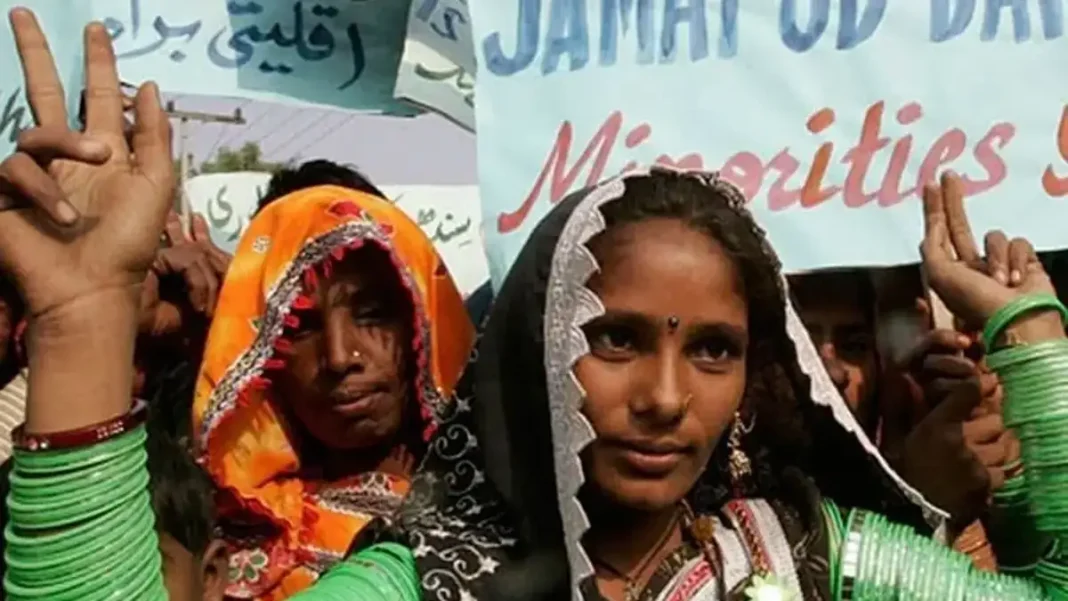
Girls from Christian and Hindu communities continue to face abduction and forced marriage, with poverty and weak police responses making the problem worse. Discriminatory hiring, controversial curriculum changes and the sidelining of minority concerns in mainstream media further weaken the promise of equal citizenship.
HRCP director Farah Zia warned that the state’s posture toward minorities was growing more exclusionary. Former HRCP chairperson Hina Jilani put it more bluntly: “Democracy should have no concept of ‘minority’ and ‘majority’.”
What HRCP Welcomed, and What It Wants Next
The commission did credit the government on two points. It welcomed the passage of the National Commission for Minorities Act 2025, and it praised Punjab and Balochistan for raising the minimum marriageable age to 18. Punjab’s move came through legislation passed earlier this year, and the HRCP now wants Khyber Pakhtunkhwa to follow with a law setting the minimum marriageable age at 18 for both men and women.
That demand lands in complicated political terrain. Khyber Pakhtunkhwa is currently under governor’s rule after parliament endorsed the move, which raises a practical question: which authority in the province will take up the legislation the HRCP is asking for?
The report also flags a broken promise. The National Commission for Minorities Act was passed months ago, but the commission itself has still not been constituted, with no chairperson or members appointed and no rules framed. The HRCP called on the federal government to act without further delay.
Beyond that, the commission wants annual, disaggregated data on blasphemy cases, mob violence, forced conversion complaints and prison conditions, so official claims can be checked. It wants Section 295-C investigations handled by senior officers, action against incitement to violence, mandatory training for police and the FIA on freedom of religion, and stronger protection for rights defenders, lawyers and journalists. Other demands include ending recruitment practices that confine minorities to sanitation work, overhauling the Evacuee Trust Property Board, monitoring seminaries linked to forced conversions, and holding conversions in court or before a government official.
It also urges full implementation of the Supreme Court’s 2014 judgment on religious freedoms and protection of minority places of worship. Pakistan’s rights record has repeatedly drawn outside scrutiny; UN experts have already pressed Islamabad over arbitrary detentions this month, and this report adds a domestic voice to the same concerns.
Frequently Asked Questions
What is the HRCP minorities report 2026?
It is the Human Rights Commission of Pakistan’s seventh annual report on freedom of religion, titled “Sanctuary Denied: Freedom of Religion or Belief in 2025/26”. Released in Lahore on October 15, 2026, it documents blasphemy law misuse, forced conversions, attacks on Ahmadis and discrimination against minorities.
What is the HRCP asking Khyber Pakhtunkhwa to do?
The commission wants the KP government to pass legislation setting the minimum marriageable age at 18 for both men and women, matching laws already adopted in Punjab and Balochistan.