Introduction
Getting your first credit card is one of those small adult milestones that feels bigger than it looks. A credit card can help you shop online safely, book flights and hotels, handle emergencies, and build a credit history that lenders will check for years to come when you apply for a car loan, a mortgage, or even a rental apartment.
But the process raises questions the first time: who is eligible, what documents you need, how banks decide, and what happens if they say no. This guide answers all of that in plain language, walking you through each step from checking eligibility to making your first responsible purchase, whether you are in the United States or the United Kingdom.
Who Can Get a Credit Card?
Credit card issuers do not hand cards to just anyone. They lend you money every time you swipe, so they want reasonable confidence you will pay it back. The basic eligibility rules are similar in the US and the UK, with a few local differences.
Age and residency
In both the United States and the United Kingdom, you must be at least 18 years old to apply for a credit card in your own name. In the US, applicants under 21 face an extra hurdle: under the CARD Act, you must show independent income or have a co-signer to be approved. In the UK, you generally need a UK address and the right to live in the country, since lenders check your address history as part of the application.
Income and affordability
You do not need a high salary to get a credit card, but you do need some form of income. Lenders ask about your annual income because they must check that you can afford the repayments. In the UK, this affordability check is a formal regulatory requirement. Income can come from a job, self-employment, a pension, benefits, or even a student loan and part-time work. What matters is that the numbers add up: your income should comfortably cover your existing bills plus potential card payments.
A bank account helps
Most issuers expect you to have a current or checking account, partly because your monthly card bill is usually paid by direct debit or bank transfer. If you do not have one yet, opening a basic bank account first is a sensible step before applying for credit.
What Lenders Check Before Approving You
Before you apply, it helps to know what lenders check, so you can fix weak spots in advance and improve your odds.
Your credit history and credit score
This is the big one. In the US, lenders check your FICO score (300 to 850) and your reports from Equifax, Experian, and TransUnion. A score of 670 or above is considered good and opens most mainstream cards; above 740 unlocks the best rates. Never borrowed before? You may have a thin file or no score, which limits you to starter cards rather than mainstream ones.
In the UK there is no single universal score. Experian, Equifax, and TransUnion each hold a file on you, and lenders apply their own criteria to them. Being on the electoral roll, paying bills on time, and keeping borrowing modest all strengthen your file. Check your reports for free before you apply.
Existing debts and commitments
Lenders look at how much you already owe: large loan balances, maxed-out cards, or recent missed payments make a decline likely. In the US, your credit utilization ratio (how much of your available credit you use) is a major scoring factor; keeping it under 30 percent, ideally under 10 percent, signals responsible borrowing.
Address stability and identity
Frequent address changes or a short time at your current address can make lenders cautious, because it is harder to verify you and, frankly, harder to find you if payments stop. In the UK, registering to vote at your address is one of the simplest ways to strengthen your application, because it confirms your identity and address to lenders.
Documents and Information You Will Need
Most applications are completed online in ten to fifteen minutes. Before you start, gather the following so you are not hunting for paperwork halfway through:
- Proof of identity: a driving licence or passport. In the US, you will also need your Social Security number; in the UK, your National Insurance number is sometimes requested.
- Proof of address: a recent utility bill, bank statement, or tenancy agreement showing your name and current address.
- Income details: your employer’s name and your gross annual income, or evidence of self-employment income, pension, or benefits. Some lenders ask for recent payslips.
- Housing costs: your monthly rent or mortgage payment, since this feeds into the affordability check.
- Employment details: your job title, employer, and how long you have worked there.
Have these ready and the form itself becomes straightforward.
Choosing the Right Card for Your Situation
Not all credit cards are designed for the same person. Applying for the wrong type is one of the most common reasons first applications fail, so match the card to your situation.
If you have no credit history: starter cards
With a thin file, mainstream rewards cards will likely decline you. Instead look at secured cards (a refundable deposit sets your limit), student cards, and credit-builder cards with low limits and simpler approval. Six to twelve months of responsible use builds the history you need for better cards.
If you have fair or average credit
With a developing but imperfect history, choose cards marketed to people building or rebuilding credit. They carry higher rates and fewer perks but approve more readily. Skip premium travel or cashback cards for now; each decline leaves a mark on your file.
If you have good credit
A solid history unlocks cashback cards, rewards cards, and long 0 percent introductory offers. Compare any annual fee against rewards you will realistically earn; a fee only makes sense if the benefits clearly outweigh it.
Watch the costs, not just the perks
Flashy sign-up bonuses get the headlines, but the numbers that matter most are the APR (the interest rate), any annual fee, foreign transaction fees if you travel, and late payment charges. If you are not sure what APR really means, read our plain-English guide to what APR on a credit card is before you compare offers. A simple card with a low rate and no fee often beats a complicated rewards card for everyday use.
How to Apply for a Credit Card: Step by Step
Once you have picked a suitable card, the application itself is simple. Here is exactly what to do.
Step 1: Compare your shortlist
Do not apply for the first card you see advertised. Compare two or three side by side: APR, likely starting limit, fees, and introductory offers. Read the summary box of key terms lenders must show, so there are no surprises.
Step 2: Check your eligibility first
Many issuers and comparison sites offer an eligibility checker or pre-qualification tool: answer a few questions and see your approval odds as a percentage or rating. This uses a soft credit check that does not affect your score. Only apply in full where your odds look strong.
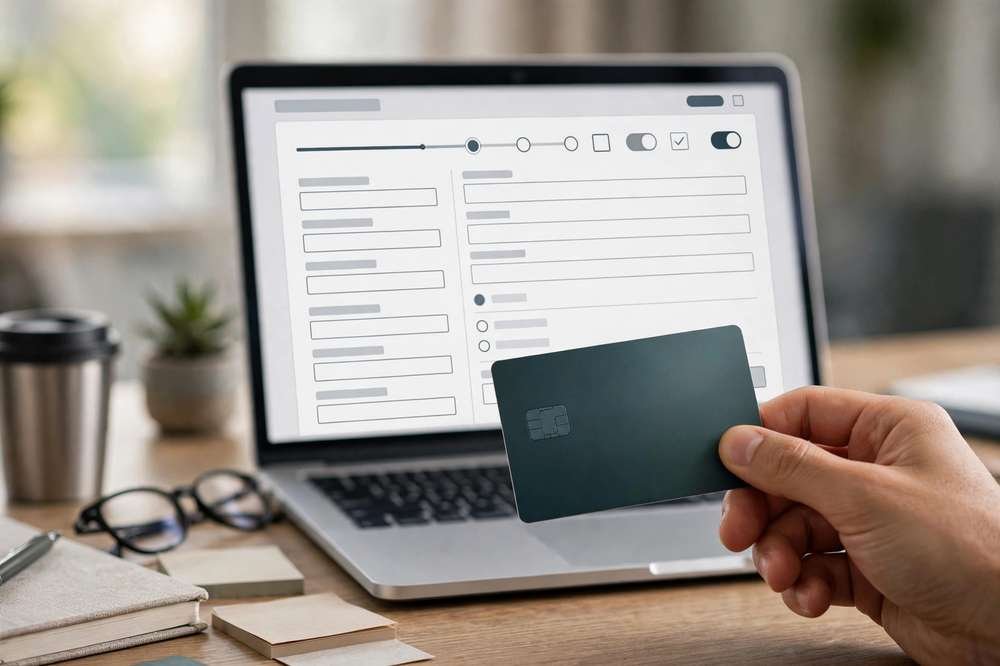
Step 3: Complete the application form
Fill in the online form carefully with the documents and details you gathered earlier. Double-check your name, address history, income figures, and contact details. Small errors, like a mistyped address or an old postcode, are a surprisingly common cause of delays and declines. The form usually takes ten to fifteen minutes.
Step 4: Submit and wait for the decision
Submitting triggers a hard credit check recorded on your file. Many applicants get an instant on-screen decision; others are told the application is under review, which is normal and not a sign of rejection.
Step 5: Verification, if requested
Sometimes the issuer asks for extra proof, such as a photo of your ID or a recent payslip, uploaded through a secure link. Respond promptly. Verification delays are the main reason applications drag on, and most are resolved within a few days once documents arrive.
Step 6: Receive and activate your card
Approved cards typically arrive by post within five to ten working days, with the PIN following separately for security. Some issuers let you add the card to a mobile wallet immediately while you wait. Activate the card as instructed, sign the back, and set up a direct debit to pay at least the minimum, ideally the full balance, each month.
How Long Does Approval Take?
It varies. Straightforward online applications with a clean credit file are often approved instantly. Applications needing manual review or extra documents can take three to ten working days. If you have not heard anything after a week, contact the issuer for an update rather than submitting a second application elsewhere, because each new application means another hard check on your file.
What to Do If Your Application Is Declined
A decline is disappointing but not permanent, and there is no blacklist. Ask the lender for the main reason, then fix the issue before doing anything else.
First, do not immediately apply elsewhere; a cluster of applications looks desperate and lowers your odds. Wait three to six months. Second, check your credit reports for errors such as wrong addresses or wrongly recorded missed payments, and dispute them. Third, fix the likely cause: build a thin file with a secured or credit-builder card, pay down existing debt to lower utilization, or wait until your income position improves.
Some issuers offer a reconsideration process where you can explain your circumstances to a reviewer. It does not always work, but a polite call costs nothing, especially if your file has improved since you applied.
Tips for First-Time Cardholders
Getting the card is only half the journey. Using it well is what builds your financial future.
- Pay in full every month. You never pay interest, and you build a spotless payment history.
- Keep spending low relative to your limit. Using a small fraction of your available credit looks responsible.
- Never miss a payment. Set up a direct debit for at least the minimum payment so a forgotten bill cannot damage your record.
- Treat it like a debit card. Only charge what you could pay for in cash today. This is much easier when the card fits inside a monthly spending plan — see our guide on how to budget.
- Review your statements monthly so fraud is caught early.
- Avoid cash withdrawals. Cash advances attract high interest from day one, plus extra fees.
Frequently Asked Questions
Can I get a credit card with no credit history?
Yes. Secured, student, and credit-builder cards are designed for this. Start with a low limit; six to twelve months of responsible use builds the history mainstream cards need.
Does applying hurt my credit score?
Eligibility checkers use soft checks and do not affect your score. A full application triggers a hard check that may dip your score a few points temporarily; the effect fades within months, so space out applications.
What credit score do I need?
There is no fixed cutoff, because each lender sets its own bar. As a rough guide, in the US a FICO score of 670 or above opens most standard cards. In the UK, a clean file with no missed payments and stable address history matters more than any single number.
Can students get credit cards?
Yes, both countries have student cards with relaxed criteria. In the US, under-21s need independent income or a co-signer. In the UK, student cards usually require you to be in full-time education with a student bank account.
How many credit cards should I have?
One well-managed card is enough to build credit. Add a second only for a clear reason, such as better rewards or a 0 percent balance transfer offer.
Final Thoughts
Getting a credit card comes down to three things: understanding what lenders want, choosing a card that fits your situation, and applying carefully. Check your credit file, use an eligibility checker, gather your documents, and apply for one suitable card at a time. If declined, fix the weak spot and try again later. Done right, your first card becomes the foundation of a strong credit history that serves you for decades.