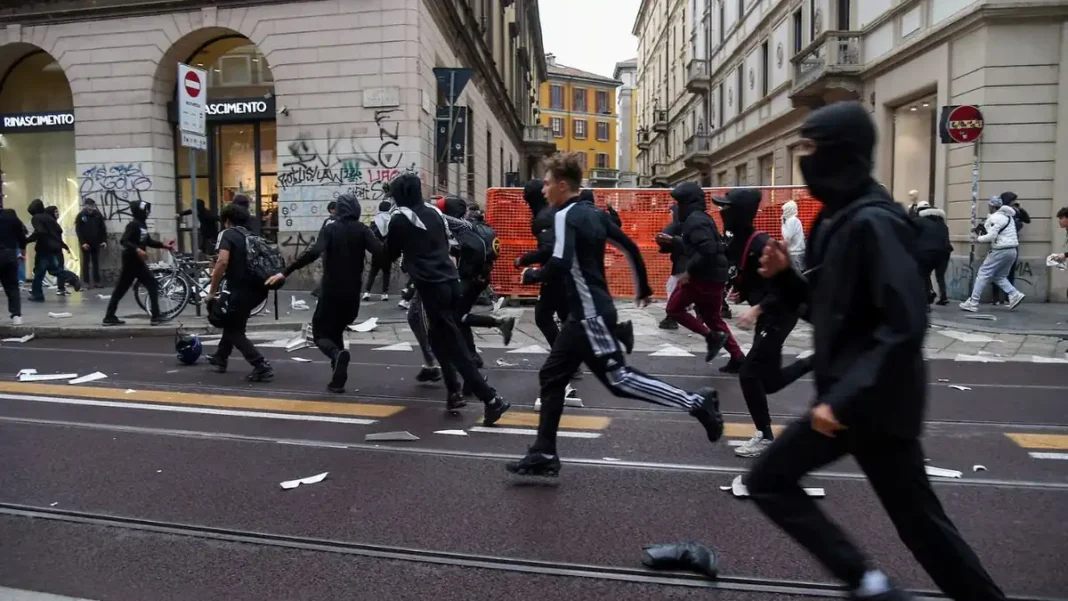
MILAN: Milan cost of living protests turned violent for a second consecutive day on Sunday, as masked demonstrators clashed with police, looted shops and set rubbish bins on fire in the city centre.
Several hundred hooded protesters gathered near Piazza Duomo, in the heart of Italy’s economic capital. They threw stones, bottles and fireworks at police, smashed shop windows and erected barricades, according to the ANSA news agency. Officers in riot gear responded with tear gas and water cannons to push the crowds back.
The unrest marked a repeat of Saturday’s clashes, which had broken out on the sidelines of an authorised demonstration against the high cost of living. Similar scenes were reported in the northern cities of Turin, Bologna, Brescia and Bergamo.
Milan cost of living protests: hundreds detained
Italian police said more than 200 people had been taken into custody since Saturday, with ANSA reporting that 271 young people were detained in Milan on Sunday alone. A police report released on Sunday put the number of arrests at 28, while other reports said 32 people were arrested, including 23 minors, with dozens more referred to judicial authorities.
The clashes left 141 police officers injured, according to police figures cited by local media. At least four officers and 20 demonstrators were reported injured in Milan, with half of those detained said to be minors.
Prime Minister Giorgia Meloni condemned the violence and called a security meeting for Monday to address the unrest. She expressed solidarity with law enforcement and urged opposition parties to condemn the violence unequivocally, while acknowledging that thousands of people had demonstrated peacefully.
Deputy Prime Minister Matteo Salvini said his League party would resubmit a parliamentary proposal requiring organisers of demonstrations deemed risky to provide financial guarantees covering potential damage.
Milan mayor Giuseppe Sala said the protesters’ grievances were understandable but that violence against officers and extensive damage to the city were unjustifiable. Bologna mayor Matteo Lepore similarly condemned the unrest and urged young people to distance themselves from those using demonstrations as a pretext for violence.
Echoes of France
The scenes in Italy closely resembled the unrest across the border in France. On Saturday, hundreds of thousands of people marched in some of France’s most violent protests in years, driven by anger over higher costs and weaker public services. President Emmanuel Macron addressed the nation, drawing a line between peaceful demonstrators and those who destroyed and looted.
France’s prime minister has since called for partial curfews in cities hit by rioting and looting, and said the government was ready to impose a state of emergency if needed. Feature Pakistan reported on the French curfew proposal and on Macron’s response to the violence as the unrest unfolded over the weekend.
The weekend’s troubles were not limited to France and Italy. In Belgium, several hundred mostly young protesters clashed with police in central Brussels on Saturday during demonstrations over education costs, with officers using tear gas and water cannons after a car was overturned.
A separate, peaceful march in Rome
Away from the northern cities, a separate demonstration in Rome organised by the CGIL trade union and civil society groups focused on wages, precarious employment, housing, public healthcare and education. Organisers described an increasingly unaffordable cost of living. That march passed off peacefully, underlining the divide between the weekend’s lawful demonstrations and the violence on their fringes.
What happens next
Meloni’s security meeting on Monday will set the government’s immediate response, with the League’s proposal on financial guarantees for risky demonstrations likely to feature. Police remain deployed in Milan’s cathedral district, and further protests have been called in several cities.
The deeper question is whether the cost-of-living anger driving these demonstrations can be addressed before the street confrontations become a regular weekend fixture. With France, Italy and Belgium all hit by unrest in the same 48 hours, European governments are facing a shared test of public order and economic policy at once.
Frequently asked questions
What caused the Milan protests?
The demonstrations were called over poor public services and the rising cost of living. Violence broke out on the fringes of the protests on Saturday and continued into Sunday.
How many people were detained?
Police said more than 200 people were taken into custody across northern Italy since Saturday, with 141 officers reported injured.
What has the Italian government said?
Prime Minister Giorgia Meloni condemned the violence and called a security meeting for Monday. Her deputy, Matteo Salvini, wants organisers of risky demonstrations to provide financial guarantees for potential damage.