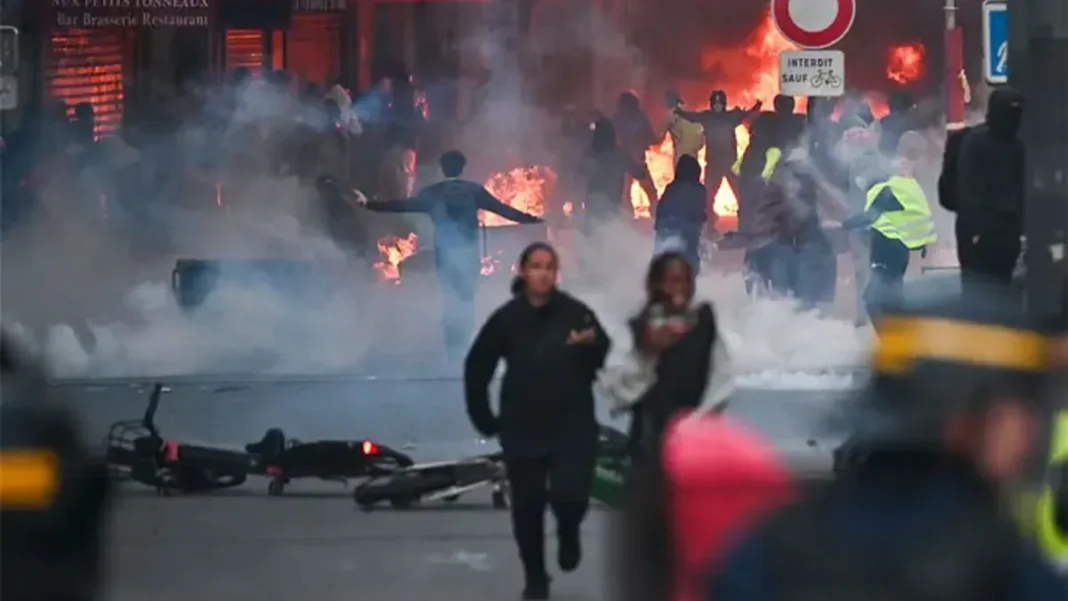
More than 500,000 people took to the streets across France on Saturday. They were protesting rising living costs. Indeed, it was one of the country’s worst days of unrest in years. The France protests Macron violence debate sharpened on Sunday. President Emmanuel Macron addressed the nation. He condemned the “unbridled” violence. However, he stopped short of declaring a state of emergency or a curfew.
One demonstrator died in the unrest. In addition, nearly 2,400 people were arrested. Moreover, around 1,000 police officers and gendarmes were injured.
What happened on Saturday
In fact, the marches marked the coming together of a month-long student movement with wider anger over prices. People gathered in scores of cities across the country.
In Paris, AFP reporters said police fired tear gas and stun grenades at hundreds of people in a square. According to AFP reporters, the gathering had been called on social media. It was not approved by the authorities. Bottles and rocks were thrown at officers. Subsequently, officers made several arrests.
Shops were looted around Republique square, with anti-riot police deployed for a second day. Meanwhile, violence also broke out in the south-eastern city of Lyon. There, police stopped a group of young people who tried to smash the windows of a luxury clothing store. Meanwhile, images of burning town halls spread around the world.
France protests Macron violence: the emergency-power question
Macron said there must be a clear distinction between protesters with “legitimate demands” and “those who destroyed, smashed, and looted”. “Those who have destroyed must pay,” he said. He promised the government would be “uncompromising”. Specifically, the target was “agitators from ultra-left fringe groups, joined by numerous delinquents”. They had “unleashed unbridled violence in our cities”, he said.
A state of emergency in France allows measures such as curfews and the closure of public spaces. It was last used in 2005. That followed the deaths of two teenagers, Zyed Benna and Bouna Traore. Consequently, their deaths set off weeks of riots. Macron has resisted the step before. In July 2023, 17-year-old Nahel was fatally shot by police in Nanterre. Despite calls from the right, Macron again stopped short of declaring one. For example, around 40,000 officers were deployed at the time. In addition, nearly 900 people were arrested in a single night.
Macron said top officials would take “decisions in coordination with mayors to protect our cities, public buildings, and businesses”. He added that “seeing the streets of our cities ransacked in this way is unbearable”. He also pledged support for businesses that suffered. Furthermore, he promised “full transparency” over the response of the security forces.
The government blames far-left groups and criminals for the violence. In addition, some opposition politicians have called for the sacking of Interior Minister Laurent Nunez. Macron said he had asked Nunez to “draw all necessary lessons”. The focus was intelligence gathering and anticipation. He added that he expected “clear answers”. Meanwhile, a far-right leader called for Macron himself to step down.
Indeed, rising prices are straining household budgets well beyond France. For example, in Peshawar, a recent survey found families sliding into debt as inflation bites. Moreover, street agitation as political pressure is a familiar sight in many democracies. This is true including Pakistan, where political standoffs have repeatedly played out on the streets.
Trump blames immigration
Meanwhile, US President Donald Trump entered the debate with a post on his Truth Social platform. He blamed immigration for the unrest.
“France is burning! The immigration of people from an entirely different world, people with hatred in their hearts, has shattered that once great country,” Trump wrote. “Close your Borders and take control, before it is too late!”
Trump’s comments on foreign affairs regularly draw attention in Pakistan too. A similar debate followed, as seen in the debate over his envoys’ remarks on Kashmir. In fact, protest as a political tool also has a long record in Pakistan, from street marches to hunger strikes.
FAQs
How many people joined the France protests?
More than half a million people joined marches in scores of cities on Saturday. Specifically, the marches marked the convergence of a month-long student movement with broader anger over living costs.
Why did Macron not declare a state of emergency?
Macron condemned the violence as “unbridled” but stopped short of a state of emergency or curfew. The step, which allows curfews and the closure of public spaces, was last used in 2005. He also declined it during the 2023 riots after the Nahel shooting. Instead, he asked the interior minister to draw lessons on intelligence and anticipation.
What did Donald Trump say about the France protests?
Trump blamed immigration for the unrest in a Truth Social post. He wrote that “France is burning”. He also urged the country to “close your Borders and take control, before it is too late”.