

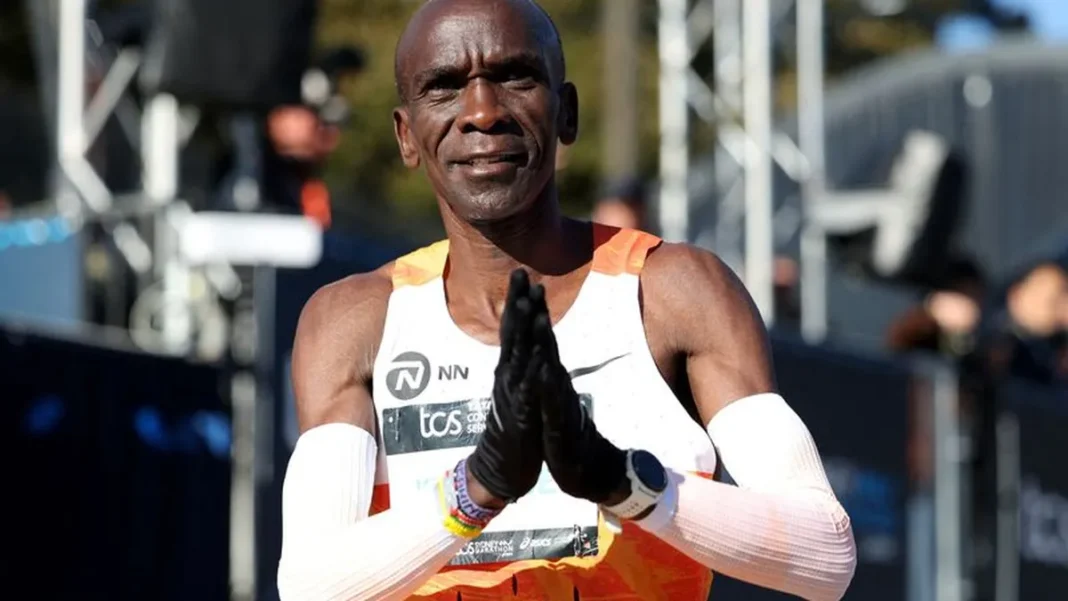
Kenya’s Eliud Kipchoge won the Melbourne Marathon on Sunday in a course record of two hours, nine minutes and 10 seconds, claiming his first marathon victory in three years.
The 41-year-old twice Olympic champion finished clear of the field to record the 17th marathon win of his career. Australian Thomas Do Canto placed second in 2:10:35, while his compatriot Reece Edwards finished third in 2:14:33.
Kipchoge last won a marathon in Berlin in 2023. Since then, younger runners have taken several major titles, and questions had grown about how long he could stay at the front. On Sunday, he answered those questions with a controlled and patient race.
Pace change after 30 kilometres decides the race
Kipchoge stayed with the leading group for most of the morning. Then, after the 30-kilometre mark, he increased the pace and moved away. That change broke the race open, and no rival could respond.
After the finish, Kipchoge said his body still felt strong enough to compete with the next generation. He explained that he raised the pace after 30 kilometres to test himself and to chase the course record, and he said the plan had worked well.
The win also fits into a wider project. Kipchoge is attempting to run a marathon on all seven continents over two years. He launched that campaign at the Cape Town Marathon in May, and Melbourne gave the project a winning stop in Australia.
French wins the women’s race
New Zealand’s Camille French won the women’s race in 2:28:25. Australia’s Sinead Diver followed in second place in 2:28:49, and Ireland’s Nichola Sheridan took third in 2:29:13.
The women’s field stayed closer for longer, but French held her form in the final stages. Her winning margin was 24 seconds, which is a narrow gap over the full marathon distance.
Why this win matters at 41
Marathon runners often peak in their early thirties. Kipchoge, however, continues to win at 41, against fields that include athletes more than a decade younger than him. His longevity rests on discipline, careful pacing and an ability to judge effort over 42 kilometres.
Sunday’s time was not his fastest ever, yet the context made it significant. It was a course record, it ended a three-year wait for a win, and it came as part of a demanding seven-continent schedule. Each of those points supports his claim that he can still compete with the leading group.
Next, attention will turn to the remaining stops in his continental campaign. If he maintains this form, more course records could come under threat. For now, Melbourne has given distance running a clear headline: the oldest leading name in the field is still winning races.
Frequently asked questions
What was Kipchoge’s winning time in Melbourne?
Kipchoge finished in two hours, nine minutes and 10 seconds. The time set a new course record for the Melbourne Marathon.
When did Kipchoge last win a marathon before Melbourne?
His previous marathon victory came in Berlin in 2023. The Melbourne win was his 17th over the distance.
Who won the women’s Melbourne Marathon?
Camille French of New Zealand won the women’s race in 2:28:25, ahead of Sinead Diver and Nichola Sheridan.
What is Kipchoge’s seven-continent project?
Kipchoge aims to run a marathon on all seven continents over two years. He began the campaign in Cape Town in May, and Melbourne was the Australian stop.