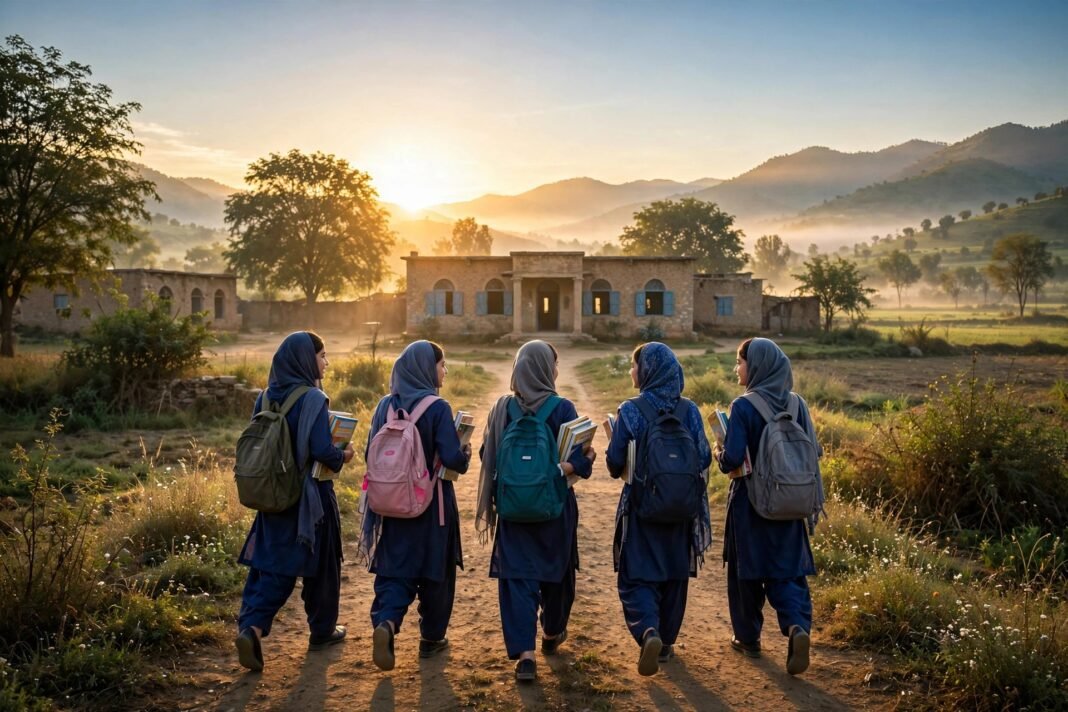
Pakistan’s Constitution promises every child free and compulsory education. For girls, that promise remains the most consequential — and the most broken — guarantee in the country’s fundamental rights chapter. Millions of Pakistani girls have never entered a classroom, and millions more leave before finishing school. This article explains what the law actually guarantees, why the gap persists, and what is changing.
What the Constitution Says
Article 25-A — inserted by the 18th Constitutional Amendment in 2010 — declares: “The State shall provide free and compulsory education to all children of the age of five to sixteen years in such manner as may be determined by law.” It sits in the fundamental rights chapter, which means it is enforceable: a citizen can approach the courts when the state fails to provide it. The word “compulsory” matters — the obligation runs both ways, and the state cannot plead poverty as an excuse for denying a fundamental right.
Article 25 guarantees equality before the law and prohibits discrimination on the basis of sex — while expressly allowing special provisions for the protection of women and children. Read together, Articles 25 and 25-A mean the state owes girls not just theoretical access to schooling but active measures to remove the barriers that keep them out.
Article 35 directs the state to protect the family, the mother and the child — the constitutional hook for policies on girls’ health, safety and development around schooling.
Pakistan is also bound internationally: the UN Convention on the Rights of the Child and the Convention on the Elimination of All Forms of Discrimination Against Women (CEDAW) both obligate the state to ensure girls’ equal access to education.
The Scale of the Gap: Numbers That Should Alarm
- 25.1 million children aged 5–16 are out of school in Pakistan — roughly 35 percent of that age group (UNICEF’s current education overview). Girls are disproportionately represented, particularly in Sindh and Khyber Pakhtunkhwa, where out-of-school girls outnumber boys.
- 21 percent of young women were married before age 18, and 3 percent before 15 (UNICEF, 2018). Early marriage is one of the strongest predictors of a girl leaving school permanently.
- 53.7 percent of girls aged 15–19 had never been to school at all (research data from 2018) — a figure that captures how completely the system misses adolescent girls.
- Enrolment collapses with each level: roughly 54 percent at primary, 21 percent at middle, 13 percent at secondary (UNICEF, 2018). For most Pakistani girls, completing 12 years of schooling remains, in researchers’ words, “a pipe dream.”
- Pakistan spends about 0.8 percent of GDP on education (Pakistan Economic Survey 2024–25) — among the lowest ratios in the region, and far below what universal enrolment would require.
Why Girls Stay Out: The Barriers
Distance and safety
The absence of a nearby secondary school ends more girls’ education than any other single factor. Parents who might send a daughter to the primary school in the village will not send her kilometres away on unsafe roads. The lack of safe transport is a policy problem with a policy solution — and several provinces now run stipend and transport schemes precisely for this reason.
Missing facilities
Schools without boundary walls, usable toilets, or clean drinking water lose girls at puberty at alarming rates. A missing toilet is an education policy issue: it determines whether an adolescent girl stays in school.
Teacher shortages — especially women teachers
In conservative areas, parents will not send daughters to schools staffed only by men. Recruiting and retaining women teachers is one of the highest-leverage interventions available — and a demand the law’s “special provisions” clause directly supports.
Child marriage
Marriage ends schooling for the overwhelming majority of girls who experience it. After marriage, husbands or in-laws frequently forbid continued attendance; household labour, childcare and early pregnancy make return practically impossible. Enforcing the legal minimum marriage age is therefore, directly, an education policy.
Poverty and child labour
For poor families, a daughter’s labour — domestic work, sibling care, field work — has immediate economic value that schooling does not. This is why conditional cash transfers and stipends for girls’ attendance (such as Punjab’s and KP’s girls’ stipend programmes) show measurable results: they change the household’s economic calculation.
Social attitudes
In some communities, educating a daughter past primary level is still seen as unnecessary or even harmful to her marriage prospects. Propaganda against girls’ education — which has at times gone viral online — directly contradicts Article 25-A, and courts have recognised that discouraging girls’ schooling violates constitutional guarantees.
What the State Is Doing — and Must Do
Provincial governments run the schools, and several have genuine programmes: girls’ stipends tied to attendance, free textbooks, recruitment drives for women teachers, and school construction in underserved districts. The federal Ehsaas/BISP-linked education stipends add a further layer. But 0.8 percent of GDP cannot fund universal 5-to-16 schooling — the constitutional promise requires a fiscal commitment Pakistan has never made.
What the law demands, concretely:
- Schools within safe reach — particularly middle and secondary schools for girls, with transport where distances are unavoidable.
- Functional facilities — boundary walls, toilets, water: the non-negotiable minimum for retaining adolescent girls.
- Women teachers recruited, trained, posted — and protected — in rural districts.
- Enforcement of the marriage-age laws, because every prevented child marriage is a girl who may stay in school.
- Stipends that reach the poorest households, where the decision to educate a daughter is an economic one.
- Accountability for ghost schools and absent teachers — the quiet corruption that steals girls’ education without a headline.
What Families Can Do Now
Legal rights are enforced from below as much as from above. If you are a parent, a brother, a community elder:
- Enrol her and keep her enrolled. The drop from primary to middle school is where most girls are lost — plan past grade 5 from the start.
- Demand the facilities. Parent-teacher councils and school management committees have legal standing; use them to press for toilets, boundary walls and teacher attendance.
- Use the stipend programmes. If your province offers a girls’ attendance stipend, claim it — that is what it is for.
- Delay marriage. Every year of schooling completed before marriage transforms a girl’s lifetime earnings, health and bargaining power — and her children’s prospects in turn.
- Report violations. Denial of admission, demands for illegal fees, and harassment of schoolgirls can be reported to district education authorities, the provincial ombudsperson, and helplines 1043 (Punjab) and 1099 (national).
Why It Matters Beyond the Girl Herself
The research consensus is unusually clear: educating girls is the highest-return investment a developing country can make. Educated women earn more, marry later, have fewer and healthier children, and — decisively — educate their own children. Pakistan’s 25.1 million out-of-school children are not just a statistic about today; they are a forecast about the next generation’s poverty, health and productivity.
Article 25-A made education a fundamental right sixteen years ago. Rights, as constitutional scholars remind us, are supposed to be trump cards — they override considerations of cost and convenience. Pakistan has yet to play this one. Until it does, the gap between the Constitution’s promise and the classroom’s reality remains the country’s most expensive broken guarantee — and closing it begins with treating every out-of-school girl as what she is: a citizen being denied her fundamental right.