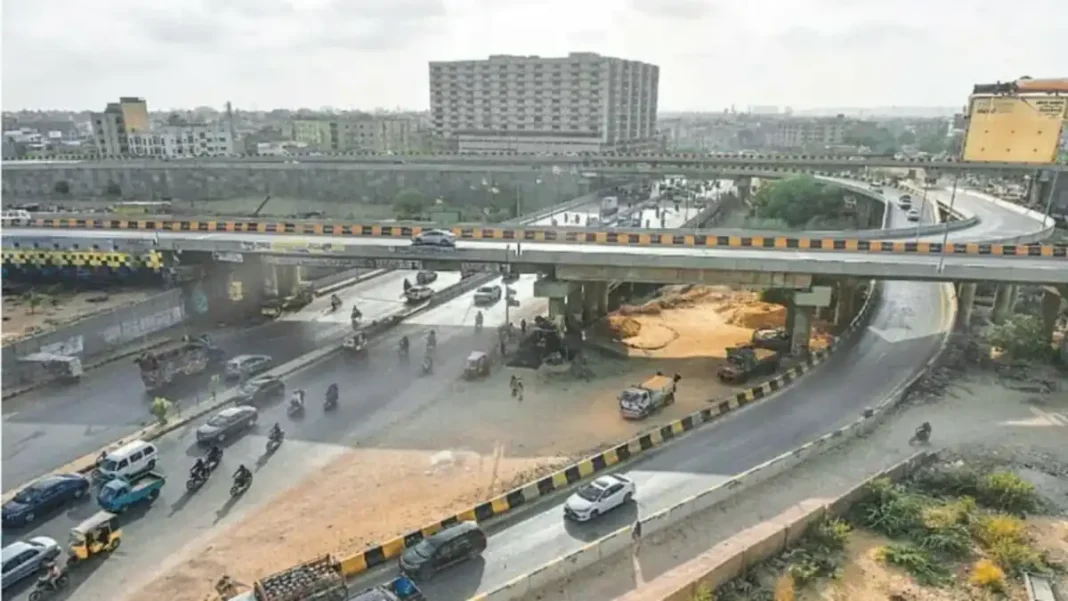
Civil Society Rejects Karachi Port Elevated Corridor
Experts, non-governmental organisations and civil society members, including Clifton and Defence residents, have rejected the proposed Karachi Port elevated corridor from Qayyumabad, saying it would damage privacy, health and the environment in crowded neighbourhoods.
They spoke at a press conference organised by the Karachi Citizens Forum at the Pakistan Medical Association House. The proposed corridor is 16.5 kilometres long and four lanes wide, designed to bypass inner-city traffic and link Karachi Port’s East Wharf to the recently inaugurated Shahrah-i-Bhutto.
In May, PPP Chairman Bilawal Bhutto-Zardari performed the groundbreaking of the Rs65 billion project, to be built under the public-private partnership model. At Saturday’s presser, forum convener Nargis Rahman set out the route and objections.
She said the route runs from East and West Wharf and the South Asia Pakistan Terminals deep sea port, over Chinna Creek to Boat Basin, then on an elevated structure along Khayaban-i-Jami, covering Schon Circle, Punjab Chowrangi, Delhi Colony and Altamash Hospital, to Sunset Boulevard in DHA and the Shahrah-i-Bhutto Expressway via Korangi Road.
“The elevated expressway’s proximity to densely populated DHA and Clifton raises serious concerns over privacy, continuous noise pollution, environmental degradation and public health, and 24-hour heavy vehicle movement may harm residents’ well-being, safety and economic stability,” she added.
Why residents oppose the Karachi Port elevated corridor
Speaking on the occasion, Amber Alibhai of Shehri-Citizens for a Better Environment said that with all the flawed constructions taking place all over the city, “Karachi is already on its last legs and this project is like putting another nail in its coffin.”
Mohammad Toheed of the Karachi Urban Lab said the government already did great damage building the Malir Expressway, now Shahrah-i-Bhutto. “Now to make that project look useful it has brought in this project, which is another disaster,” he said, adding that the public was not consulted on such decisions taken behind closed doors.
Zahid Farooq, joint director of Urban Resource Centre, said they are not against development. “But development at what cost,” he asked. “A public consensus was required, but a small public hearing was arranged after a notice in a small newspaper, so most people did not even know about it. The government is building distances between itself and the people,” he said.
Architect Arif Belgaumi noted that Clifton and Defence are densely populated, with many families and office buildings. “With occupancy rising, you need more hospitals, schools, parks, markets and mosques, not an elevated expressway overhead carrying some 13,000 heavy vehicles every 24 hours,” he said. “The congestion will make the place unliveable,” he added.
What the corridor would mean for Clifton and DHA
Syed Jamal Macdi, a DHA resident, said the government was spending heavily at the cost of people and the environment. “The port comes under the federal government. After the 18th Amendment, provinces should fix their own issues,” he said, adding that the project would damage the mangroves.
Rasha Tarek, a forum member and Clifton Block 5 resident, said Clifton has schools, parks, Boat Basin and the food street. “An elevated corridor will not let Clifton stay the same,” she said.
Humaira Khan, president of the Clifton Defence Community and Clifton Block 5 Residents Association, alleged the government had organised a “fake” Sindh Environmental Protection Agency meeting to approve the project. “All the people there were their own people,” she claimed. “If this project comes up, Clifton and DHA will turn into Mauripur,” she warned.
Dr Aliya Rehman, Sana Zuberi, PMA Secretary General Dr Abdul Ghafoor Shoro and forum co-convener Dr Qaiser Sajjad also spoke at the press conference.
The dispute now turns on consultation. Supporters present the corridor as a port link that will take heavy traffic off city streets. Critics say a corridor carrying 13,000 heavy vehicles a day over homes, schools and hospitals is a different bargain, one residents were never properly asked about.
Karachi’s infrastructure decisions have drawn similar scrutiny before. A Karachi industrial park was approved as a federal special economic zone, while LPG dealers shut shops in Lahore and other cities as consumers scrambled for cooking fuel. Power supply to cities in Sindh and Punjab was also disrupted when a pylon was destroyed in Nasirabad.
What is the proposed corridor?
It is a 16.5-kilometre, four-lane elevated road linking Karachi Port’s East Wharf to Shahrah-i-Bhutto, passing over Chinna Creek, Boat Basin, Khayaban-i-Jami and Sunset Boulevard in DHA.
How much will it cost?
The project was launched with a Rs65 billion price tag under the public-private partnership model, with groundbreaking performed in May by PPP Chairman Bilawal Bhutto-Zardari.