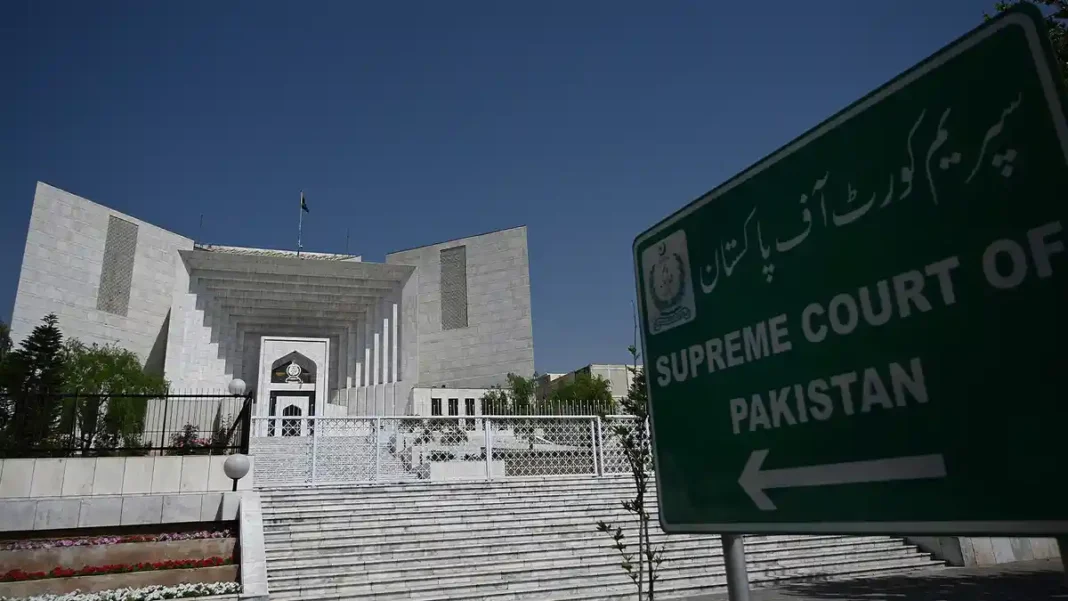
UAE Court Decree Not Enforceable in Pakistan, Rules SC
The Supreme Court has ruled that a decree issued by the Abu Dhabi Court of Appeal cannot be directly enforced in Pakistan under Section 44-A of the Code of Civil Procedure. The UAE court decree ruling came by a 2-1 majority, and the court set aside the orders of the Lahore High Court and a district court.
The court held that the federal government’s 2007 notification recognises only the UAE’s Federal Court of Appeal as a superior court for this purpose. A decree from a local court of an individual emirate, even one exercising appellate jurisdiction, does not qualify.
The decision was announced on 19 November. It settles a question that had divided the judges who first heard the case, and it will shape how foreign commercial judgments from the Gulf are treated in Pakistani courts.
How the court split
The majority comprised Justice Munib Akhtar and the referee judge, Justice Muhammad Shafi Siddiqui, while Justice Irfan Saadat Khan authored a dissenting opinion. The matter had been referred to Justice Shafi Siddiqui after Justice Akhtar and Justice Khan, who constituted the original division bench, delivered conflicting opinions. The bench had reserved its decision on 10 February 2026.
Justice Munib Akhtar held that the Abu Dhabi Court of Appeal belonged to the emirate’s local judicial system and could not be equated with the UAE’s Federal Court of Appeal for the purposes of Section 44-A. Referee judge Justice Muhammad Shafi Siddiqui agreed with this interpretation and endorsed Justice Akhtar’s conclusion that the Abu Dhabi court’s decree could not be directly executed in Pakistan under the existing legal framework.
The Supreme Court has handed down other significant rulings this year, including one on whether prison terms run consecutively or concurrently. The courts remain busy, and the 190m case hearing has been fixed for November 25.
Why the 2007 notification matters
The court observed that the federal government’s notification issued on 6 March 2007 recognised only the UAE’s Federal Court of Appeal as a superior court for the purpose of enforcing foreign decrees in Pakistan. The United Arab Emirates is a federation comprising seven emirates, with separate federal and local judicial systems.
Under the UAE Constitution, the federal and local judicial systems operate separately, and decisions of local courts cannot automatically be treated as federal judicial decisions. The court held that decisions of local courts of individual emirates could not be treated as judgments of federal courts merely because they exercised appellate jurisdiction.
Section 44-A of the Code of Civil Procedure allows a decree from a superior court of a reciprocating territory to be executed in Pakistan as if it had been passed by a district court here. The section only works where the foreign court is a superior court of a territory the federal government has notified. The ruling turns on that narrow point: the notification names the federal court, not the emirate courts.
The UAE court decree: the dispute behind the ruling
The dispute originated from a commercial agreement signed in 2011 between a Pakistani company, Engineering Kinetics (Private) Limited, and an Abu Dhabi-based company for the manufacture and installation of pipes. Following a dispute over the agreement, the Abu Dhabi Court of First Instance passed a decree against the Pakistani company on 17 June 2014, directing it to pay damages. The Abu Dhabi Court of Appeal upheld the decision on 20 January 2015.
The decree-holder then asked a district court in Lahore to execute the UAE judgment in Pakistan under Section 44-A. The Pakistani company objected, arguing that the Abu Dhabi Court of Appeal did not qualify as a superior court under the 2007 notification.
The district court dismissed the objections, while the Lahore High Court also upheld the subordinate court’s decision on 25 November 2022. The company then challenged both orders before the Supreme Court, which has now set them aside.
What the ruling means for businesses
For Pakistani firms that trade with the Gulf, the ruling draws a clear line. A judgment from a federal UAE court can be enforced in Pakistan under Section 44-A, but a judgment from an emirate’s local court cannot, even if that court heard the case on appeal. The decree-holder would need to file a fresh suit in Pakistan instead.
The ruling also matters for the Lahore High Court, whose order has been set aside. The High Court had earlier acquitted a man in a separate 295-B case, and its orders are regularly tested on appeal. In this case, the Supreme Court’s reading of the 2007 notification was the deciding factor.
For the parties in the UAE decree case, the next step is a fresh suit if the decree-holder still wants to recover the damages in Pakistan.
Frequently asked questions
Can a UAE court decree be enforced in Pakistan?
Only a decree from a court the federal government has recognised as a superior court can be enforced directly under Section 44-A of the CPC. The Supreme Court has ruled that the 2007 notification recognises only the UAE’s Federal Court of Appeal, not the Abu Dhabi Court of Appeal.
Why did the Supreme Court refuse this decree?
The court held that the Abu Dhabi Court of Appeal belongs to the emirate’s local judicial system. Under the UAE Constitution, federal and local judicial systems operate separately, so a local court’s decision cannot be treated as a federal judgment.
Who decided the case?
Justice Munib Akhtar and referee judge Justice Muhammad Shafi Siddiqui formed the 2-1 majority. Justice Irfan Saadat Khan dissented. The decision was announced on 19 November after the bench reserved judgment on 10 February 2026.
What was the dispute about?
Engineering Kinetics (Private) Limited, a Pakistani company, signed a 2011 agreement with an Abu Dhabi-based firm for the manufacture and installation of pipes. The Abu Dhabi courts ordered the Pakistani company to pay damages in 2014, a decision upheld on appeal in 2015.
What should the decree-holder do now?
The decree-holder would need to file a fresh suit in Pakistan instead of seeking direct execution under Section 44-A, since the Supreme Court has ruled that only a decree from a recognised superior court can be enforced directly.