Dubai Preferred Investment Destination Fades for Pakistanis
Dubai is losing its place as a preferred investment destination for Pakistani investors. A stable rupee and the prospect of lower interest rates are making the Pakistan Stock Exchange (PSX) the more attractive option.
That is the view of Topline Securities. The brokerage says local investors have become the main buyers in the market, and they are absorbing foreign selling.
Dubai has long been the first place many Pakistani investors looked to put money outside the country. Now the returns at home are starting to look better.
What Topline Securities expects
Topline expects the State Bank of Pakistan (SBP) to hold its policy rate at 12 per cent through the first half of 2027. It then expects a cut of 100 basis points, taking the rate to 11 per cent in the second half of the year.
Lower borrowing costs would support local shares, the brokerage says. Cheaper finance tends to lift the sectors that gain most from an economic recovery.
The forecast builds on the rate path the State Bank has already set. The Monetary Policy Committee raised the policy rate by 50 basis points to 12 per cent on 26 October 2026, and the new rate took effect the next day. Nine of the ten committee members backed the rise, which followed a period when the rate had stood at 11.5 per cent. The committee cited high global energy prices and a worse inflation outlook, driven by the intensifying Middle East conflict.
Inflation in Pakistan eased to 9.61 per cent in October. The committee will meet again on 14 December 2026, when it will have November price data in front of it.
Growth outlook behind the call
Topline expects Pakistan’s economy to grow by 3.5 to 4 per cent in the fiscal year 2027. It then expects growth of 4 to 4.5 per cent in the fiscal year 2028.
The brokerage also expects inflation to ease from April 2027. That would create room for the State Bank to start cutting rates, which is the core of its case for local shares.
The view is a forecast, not a promise. Rates depend on inflation, energy prices and the regional situation, and all three can move quickly.
Which shares could gain
Topline names five groups that could benefit from the shift. They are banks, cement makers, pharmaceutical firms, oil and gas exploration and production companies, and automobile makers.
These sectors tend to gain when borrowing gets cheaper and demand picks up. Banks benefit as credit grows, cement and car makers gain from stronger spending, and drug makers gain from steadier demand.
Investors should still weigh the risks. A rate cut helps borrowers but trims the return on savings, and share prices can fall as well as rise.
The PSX backdrop
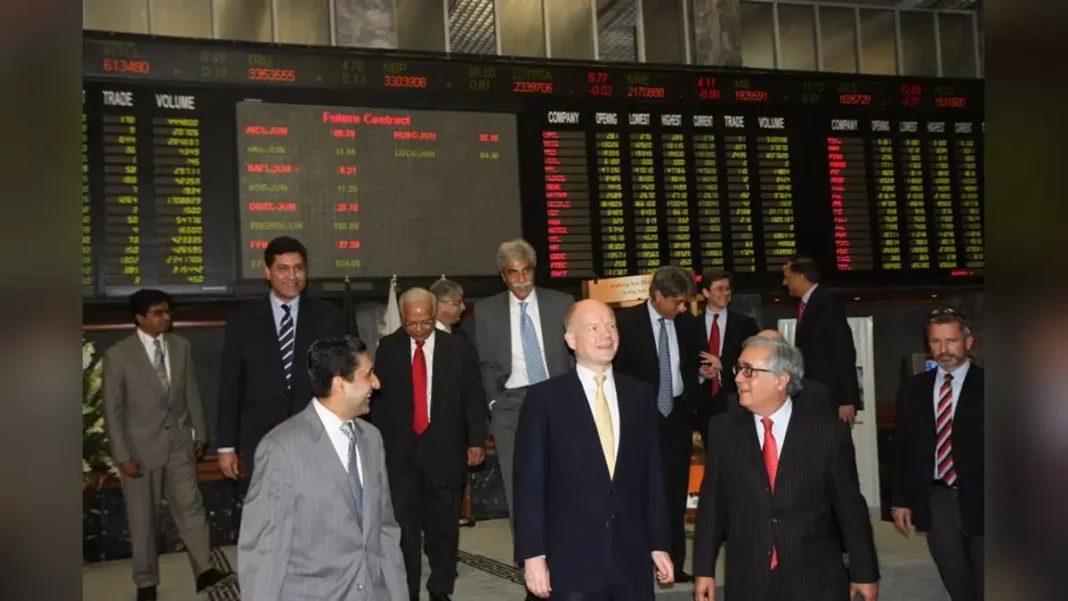
The market backdrop gives the call some support. The KSE-100 index closed a volatile week at 177,383, down 491 points or 0.28 per cent for the week. The benchmark had gained 478 points on Thursday to close at 176,772, a day after it fell 1,223 points.
Local buying has held the market up while foreign investors sold. That matches the picture Topline describes, with domestic investors taking the other side of foreign selling.
The market also welcomed a Federal Constitutional Court ruling this week that delivered infrastructure cess relief worth Rs43 billion for 11 firms. Roshan Digital Account inflows have hit $14.43 billion, a separate sign that overseas Pakistanis are keeping funds connected to home.
The picture is not all positive. Pakistan’s foreign loans doubled to $5.89 billion in the first four months of the fiscal year, a reminder that the economy still leans on external borrowing.
Why Dubai was a preferred investment destination for Pakistanis
Pakistanis have long ranked among the largest foreign buyers of property in Dubai. Pakistan was the second-largest foreign investor in Dubai property in 2023, and it slipped to fourth place in 2025, according to Dawn.
Rising tensions in the Gulf had already slowed those flows earlier in 2026, as buyers worried about the safety of money parked in the emirate. The new Topline view adds a different reason to stay home: the local market now offers a better return on its own terms.
Dubai is not finished as an investment market. The argument is about relative appeal, not collapse. For Pakistani investors, the choice is now between a familiar foreign market and a home market that looks cheaper and better supported.
That choice will be tested at the next rate decision in December. If the State Bank holds at 12 per cent, the case for local shares stays intact. If inflation surprises, the wait for cheaper money could get longer.
Frequently asked questions
Why is Dubai losing appeal for Pakistani investors?
Dubai is losing appeal because a stable rupee and expected interest rate cuts are making the Pakistan Stock Exchange more attractive. Topline Securities says local investors are now the main buyers in the market and are absorbing foreign selling.
What does Topline Securities expect the State Bank to do?
Topline expects the State Bank to hold the policy rate at 12 per cent in the first half of 2027 and then cut it by 100 basis points to 11 per cent in the second half. The rate currently stands at 12 per cent after a rise on 26 October 2026.
Which sectors could benefit from lower rates?
Banks, cement makers, pharmaceutical firms, oil and gas exploration and production companies, and automobile makers could benefit. These sectors tend to gain from economic recovery and cheaper financing.
How has the PSX performed lately?
The KSE-100 index closed the week at 177,383, down 491 points or 0.28 per cent in a volatile week. It had gained 478 points on Thursday to close at 176,772, a day after falling 1,223 points.
Does this mean Dubai property is now a bad investment?
No. The Topline view is about relative preference, not about Dubai failing as a market. Pakistanis were still the fourth-largest foreign investors in Dubai property in 2025, and any investment decision depends on personal circumstances, time horizon and risk appetite.
—