


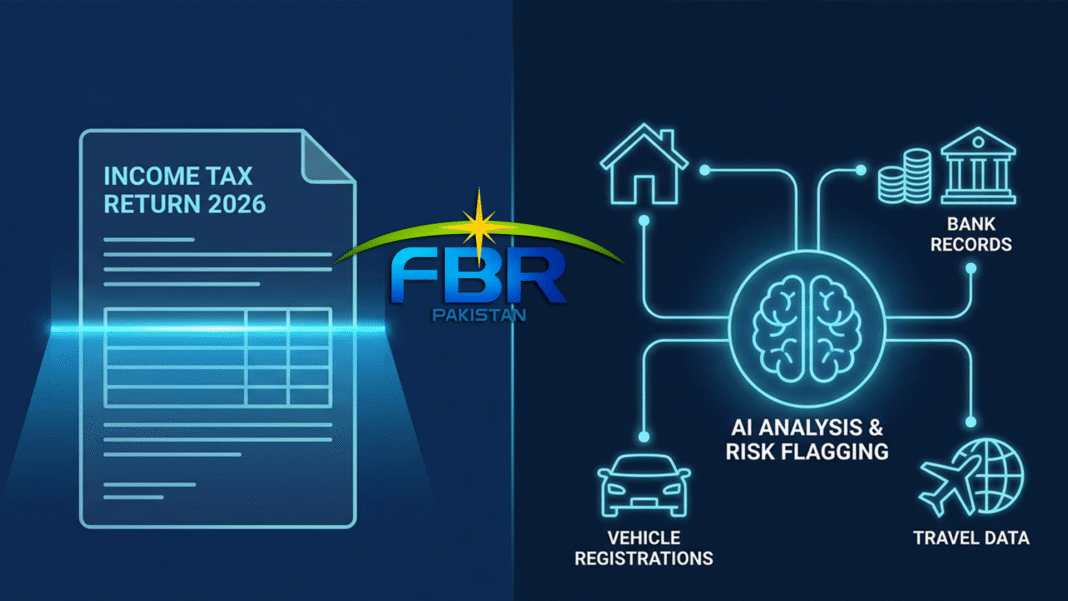
FBR to Use AI to Cross-Check Tax Returns Against Bank and Property Data
The FBR AI monitoring system has entered a new phase: the Federal Board of Revenue has expanded its use of artificial intelligence and data analytics to check tax declarations and identify discrepancies in what taxpayers report.
Under the system, tax returns will be compared with information from government and other sources, including property transactions, bank records, vehicle registrations and travel data. The AI will also compare taxpayers with similar profiles to identify unusual patterns or inconsistencies in their declarations.
The FBR said the system was first tested on selected income tax and sales tax returns. It has now been extended to Income Tax Returns for Tax Year 2026 and subsequent sales tax returns.
How the FBR AI monitoring system works
The system builds a profile of each filer from multiple data points and looks for mismatches. A declared income that does not fit with property purchases, banking activity or vehicle ownership registered in the same name would trigger a risk flag.
Profiling also runs sideways. The AI compares a taxpayer against others with similar profiles, so a filer whose numbers stand out from their peer group can be picked up even when individual records look consistent on their own.
What happens when you are flagged
An AI-generated risk flag does not automatically mean a taxpayer has committed tax evasion or fraud. The FBR has made that point explicitly.
Instead, cases flagged by the system may be selected for further examination, audit or assessment proceedings under the applicable law. The AI therefore decides which cases get a closer look, while the legal process around assessment remains unchanged.
Why data matching matters now
The expansion lands at a busy moment for the tax system. Returns for Tax Year 2026 are being filed now, and the FBR has spent years trying to widen the tax net in a country where documented taxpayers remain a small share of the population.
Manual audit selection has long been criticised for being patchy and open to favouritism. A data-driven risk engine promises the opposite: consistent rules, applied to every return, with the reasoning traceable to records rather than an officer’s discretion.
National Faceless Center link
The initiative will complement the National Faceless Center (NFC) established in Islamabad, which uses computerised risk-based systems to select and allocate audit cases. Together, the two systems move the audit pipeline away from face-to-face interaction between officials and taxpayers.
The FBR said the approach is intended to reduce discretionary intervention and bring greater consistency and transparency to the audit process.
What filers should do
With Tax Year 2026 returns covered from the start, filers need to make sure their declared income matches the story told by their records. Large unexplained differences between bank credits and declared income, property bought in the family name without visible funding, and frequent travel that sits oddly against low declared earnings are exactly the patterns the system is built to spot.
FAQs
Is the FBR’s AI system already active?
Yes. It was tested on selected income and sales tax returns and has now been extended to Income Tax Returns for Tax Year 2026 and subsequent sales tax returns.
Does an AI risk flag mean I have evaded tax?
No. The FBR says a flag is not a finding of evasion or fraud. Flagged cases are selected for examination, audit or assessment under the law.
Which records does the AI compare returns against?
Property transactions, bank records, vehicle registrations and travel data, among other government and third-party sources.
What is the National Faceless Center?
The NFC in Islamabad uses computerised risk-based systems to select and allocate audit cases, reducing face-to-face contact between taxpayers and officials.