He spent his life rushing toward the wounded. He died inside the very vehicle of his mercy: an ambulance.
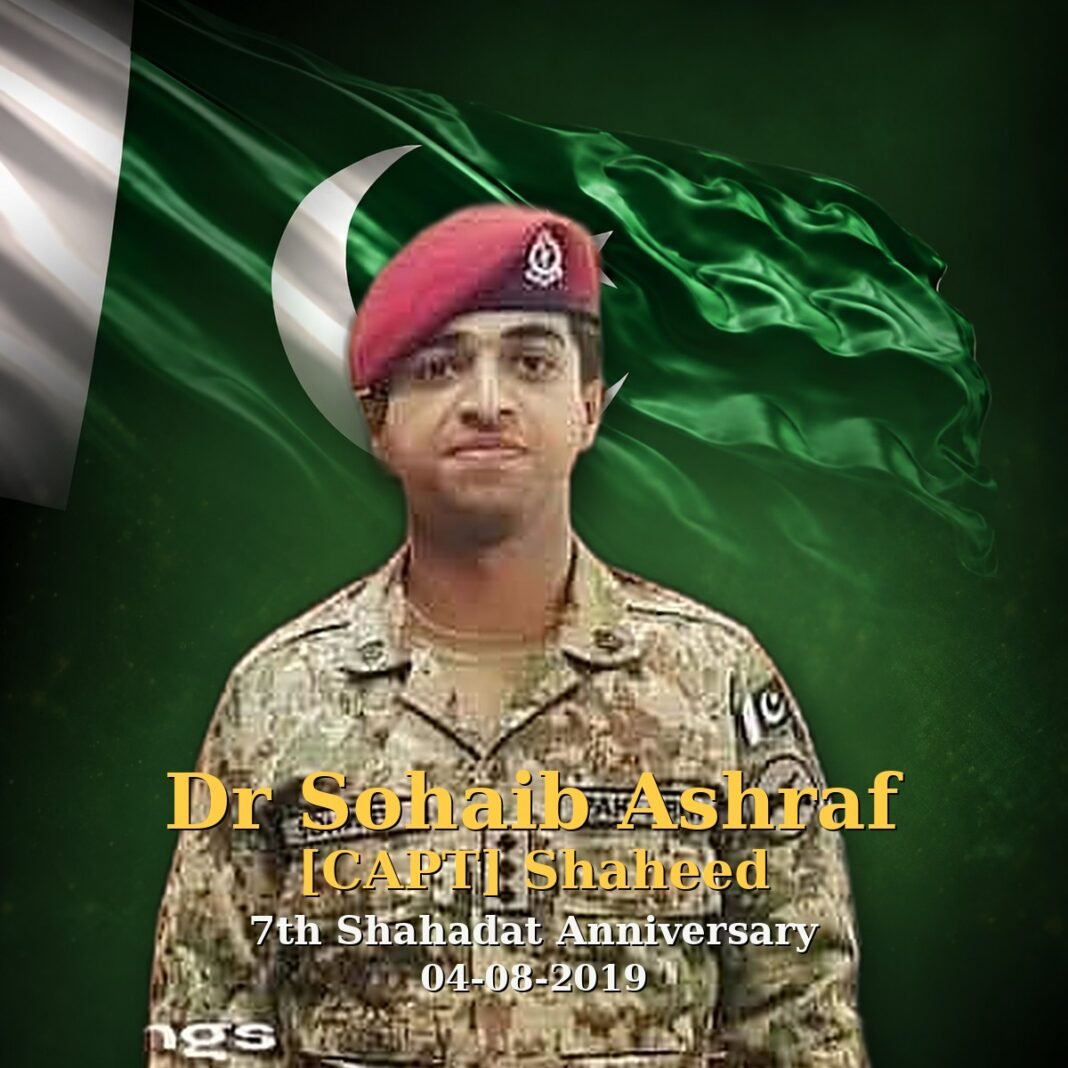
Captain Dr Sohaib Ashraf Shaheed of the Pakistan Army belonged to a special breed of soldier. An officer of the Army Medical Corps — IC 56, 37th MBBS, 144 Medical Battalion — he wore the uniform not to take life but to preserve it. He remained true to that calling until his very last breath.
On 4 August 2019, he was moving with a military convoy in an ambulance. In a cruel twist of fate, the ambulance lost its course and fell into a river. Rescue efforts followed. But the bodies of Captain Dr Sohaib Ashraf and Sepoy Sadat Shaheed, who was with him, were never recovered from the water.
The Healer in Uniform
Like every AMC officer, Dr Sohaib had chosen a path of double service: to his country, and to humanity. Medical officers of the Pakistan Army deploy wherever the troops go — through deserts, mountains, and hostile terrain — because a soldier’s life often depends on how quickly a doctor can reach him. Dr Sohaib understood that duty, and he embraced it fully.
He asked no exemption from the hardships of field service because he was a doctor. If anything, his calling demanded more of him, not less.
Those who knew him also knew a quieter truth: he was the only son of his parents. Every parent’s hopes, every family’s future, rested on his young shoulders. Yet when duty called him to the field, he went without hesitation — as Pakistan’s officers always do.
The Original Tribute
The tribute shared on the seventh anniversary of that day reads:
Today is 7th shahadat anniversary of Capt Dr Sohaib Ashraf Shaheed IC 56/37th MBBS ex 144Med Bn, along with Sepoy Sadat Shaheed. On 4 Aug 2019, they were moving with convoy in an ambulance, unfortunately ambulance fell in the river, their bodies haven’t recovered yet. Capt Dr Sohaib Ashraf Shaheed was only son of parents.
No Grave — Only a River
For his parents, the pain is doubled. They lost their only son — and they never received his body to lay to rest. That is a wound no time fully closes. There was no funeral with full military honours over a coffin. Only the river, the rescue efforts, and the terrible finality of “not recovered.”
Seven years on, the absence remains as absolute as it was on the day the ambulance went into the water.
It is worth dwelling on what it means for a doctor to die in an ambulance. The ambulance is the doctor’s instrument of mercy — the vehicle that carries the healer to the wounded. That Captain Dr Sohaib Ashraf met his end inside one, on duty with a convoy, is a symmetry the nation cannot help but notice: he died within the very symbol of the calling he had chosen, doing the very work he had trained for.
And there is Sepoy Sadat, named beside him in the tribute — the soldier who was with the doctor that day, who shares his fate and his remembrance. In the Army’s telling, they are never separated: the healer and the soldier, together in the ambulance, together in the river, together in memory.
Armies are remembered for their fighters. They are sustained by their healers. Every soldier who goes into danger does so knowing that behind him stands a chain of medical care — the field dressing, the ambulance, the field hospital, the surgeon — and that chain begins with officers like Captain Dr Sohaib Ashraf. The courage to advance depends, in no small measure, on the confidence that someone will come for you if you fall.
Dr Sohaib was that someone.
Pakistan remembers Captain Dr Sohaib Ashraf with pride: a healer, a soldier, a son who gave everything. His sacrifice stands beside that of every shaheed who has ever worn the green uniform — and the nation will never forget him.