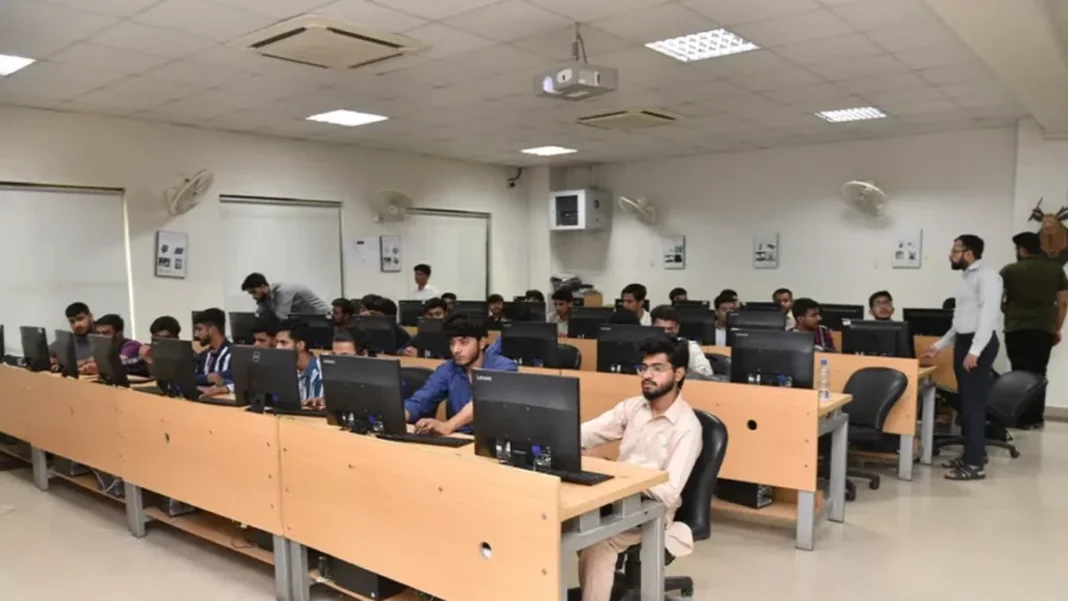
Poor Links, Few Trainers: Why AI Training Is Not Reaching Rural Pakistan
The Ministry of Information Technology and Telecommunication has named the reasons AI training in Pakistan is not reaching rural and underserved areas: limited training facilities, poor connectivity, a shortage of qualified instructors and low awareness. The ministry’s assessment comes in a document that also lays out how the government plans to fix the gap.
According to the document, the government plans to improve access to advanced technology education through regional training hubs, online and hybrid learning programmes, partnerships with universities and industry, and targeted scholarships for women and disadvantaged groups.
AI Training Pakistan: The Barriers in Detail
Connectivity sits at the top of the list. Rural areas with weak or no internet cannot run online courses, which rules out the cheapest way to scale training. The shortage of qualified instructors compounds the problem: even where classrooms exist, there are too few people able to teach machine learning, data science and related subjects. Low awareness means many potential learners never hear about the programmes at all.
The ministry said it is already running training programmes in AI, cloud computing, cybersecurity, data science and software development through its attached departments and executing agencies. More than 900,000 training sessions were delivered through various DigiSkills courses during fiscal year 2025-26.
Existing initiatives include DigiSkills, Code4AI, the National Artificial Intelligence Initiative and the AI SEEKHO Program, which aims to train more than 100,000 people in artificial intelligence and natural language-based application development. Code4AI targets 7,500 people in AI-driven full-stack development, covering programming languages, machine learning, deep learning, blockchain and quantum computing.
The Targets: One Million Graduates, 10,000 Instructors
Under the AI Policy 2025, the government aims to train one million new and existing IT graduates in IT and related technologies over the next five years. The policy also targets training 10,000 instructors in emerging technologies by 2027, which would directly address the instructor shortage the ministry has now flagged.
As proposed next steps, the ministry may conduct a nationwide assessment to identify underserved regions and priority skills before preparing a phased expansion plan for the National AI Skills Program. Other proposals include specialised training pathways, stronger partnerships with national and international technology companies, mobile training facilities and regional technology centres to expand access and narrow the digital divide.
The Connectivity Half of the Problem Is Moving Too
The training push does not stand alone. On the same day, IT Minister Shaza Fatima Khawaja told the APT Symposium on Digital Transformation in Islamabad that Pakistan is close to finalising its regulatory framework for Fixed Satellite Services, paving the way for satellite internet in remote areas. She also reported that the mobile internet gender gap has fallen from 38 per cent to 8 per cent in two years, the fastest improvement of any country according to the GSMA, and that three submarine cables have landed in Pakistan in the past two and a half years.
Those two halves fit together. Satellite internet and fibre expansion address the poor connectivity the IT ministry lists as a barrier, while the scholarships for women in the training plan build on the gender-gap progress the minister cited. Training hubs need links; links need trained people to be useful. The PTA’s tightening of digital oversight and the CERT and NTC campaign against scams targeting the elderly show the same digital expansion playing out across regulation and safety, universities are signing cybersecurity training pacts, and consumer tech keeps moving with launches like the Samsung Galaxy M08 and F08.
FAQs
What is blocking AI training in rural Pakistan?
The IT ministry cites four barriers: limited training facilities, poor connectivity, a shortage of qualified instructors and low awareness in rural and underserved areas.
What is the government’s target?
Under the AI Policy 2025, the goal is to train one million new and existing IT graduates over five years and 10,000 instructors in emerging technologies by 2027.
Which programmes already exist?
DigiSkills, which delivered over 900,000 training sessions in FY2025-26, Code4AI targeting 7,500 people in AI-driven full-stack development, the AI SEEKHO Program aiming at 100,000-plus learners, and the National Artificial Intelligence Initiative.