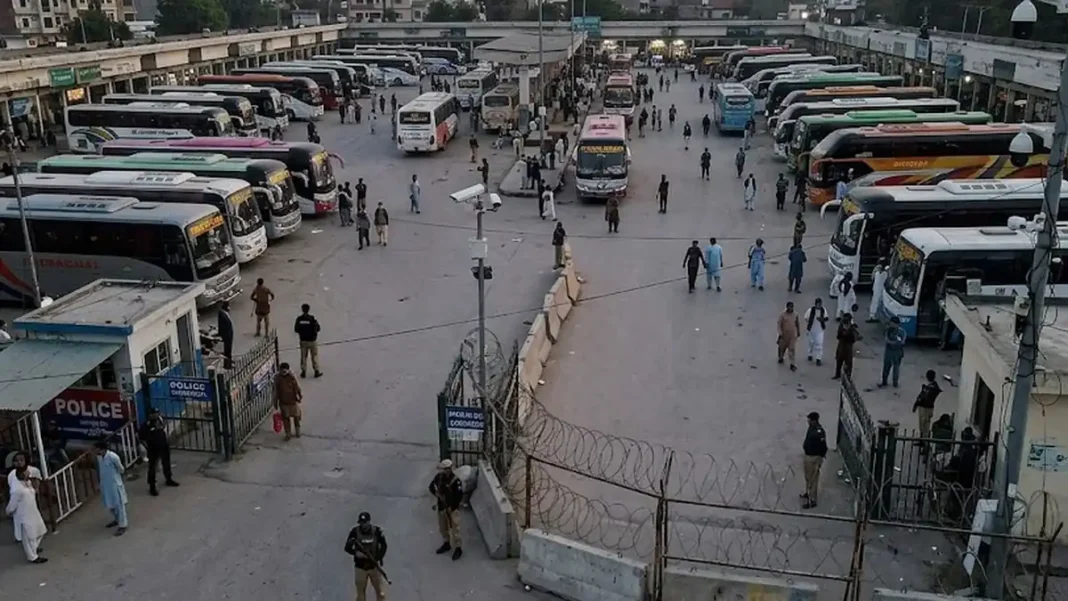
A special inquiry committee has declared Rawalpindi’s Pirwadhai General Bus Stand a security risk, pointing to weak security arrangements, procedural violations, misuse of public funds and financial mismanagement.
The panel handed its report to Rawalpindi Deputy Commissioner Capt. (r) Nadeem Nasir at a meeting attended by the Regional Transport Authority secretary, ADC Social Services Fazail Mudassir and ADC Municipal Services Junaid Alam.
A 1976 terminal under strain
The terminal dates back to 1976, when the authorities set it up across 210 kanals. Today the C-Class facility handles about 40,000 passengers a day, with 65 public service vehicles passing through every hour. Yet it has only 37 operational bays serving 65 transport companies.
The committee recommended upgrading the terminal to B-Class, increasing the number of bays to 80, and preparing a new master plan with a computerised system to manage parking, arrivals and departures.
The money trail
The report lays out the terminal’s finances from fiscal year 2018-19 through 2025-26. In that period the facility generated Rs 668.2 million, not counting rental income from shops, petrol pumps, hotels and canteens.
The authorities spent Rs 170.1 million on development and Rs 67.1 million on operations. The Municipal Corporation deposited Rs 431 million into its general fund. The committee flagged the finances alongside the procedural violations and misuse of public funds it found during its inquiry.
Security gaps
The security findings are stark. The terminal has no boundary wall, its CCTV cameras do not work, passenger screening is inadequate, and there are no proper controls on who enters or leaves.
The committee recommended building a perimeter wall, hiring a private security company, deploying at least 25 guards, repairing the CCTV cameras, setting up a control room and rolling out the Travel Eye system in full. The camera upgrades mirror a wider push across the country — Quetta, for instance, is getting 2,900 surveillance cameras as Balochistan orders a police overhaul.
Read more: Quetta to Get 2,900 Surveillance Cameras as Balochistan Orders Police Overhaul
Unauthorised bays and encroachments
The report also found bays being sublet without authorisation, with multiple transport companies sharing individual bays. Passengers are picked up outside the terminal instead of inside it, and shops and pushcarts have encroached on passageways, blocking the movement of passengers.
Part of a wider Rawalpindi fix
The bus stand findings land amid a broader push to untangle Rawalpindi’s congestion. The same deputy commissioner announced last week that wholesale vegetable, grain and livestock markets would move to the Rawalpindi Ring Road corridor — a plan that specifically named Pirwadhai Adda among the pressure points the city wants to relieve.
Read more: Rawalpindi Ring Road to Get Dedicated Wholesale Markets
Rawalpindi’s traffic infrastructure is under wider pressure. The city’s signal-free corridor plan was recently scaled back to two underpasses as costs climbed, showing how many of these projects are being reworked at once.
Read more: Rawalpindi signal-free corridor scaled back to two underpasses as costs climb
For the 40,000 daily passengers who pass through Pirwadhai, the committee’s recommendations point towards a very different terminal: walled, screened, computerised and properly policed — in a province that made city public transport free earlier this year.
Read more: Maryam Nawaz Announces Free Travel Across Punjab Cities
Frequently asked questions
What did the inquiry committee find at Pirwadhai bus stand?
It declared the terminal a security risk, citing weak security arrangements, procedural violations, misuse of public funds and financial mismanagement.
How busy is the bus stand?
It handles about 40,000 passengers a day and 65 public service vehicles an hour, with only 37 operational bays for 65 transport companies.
What did the committee recommend?
Upgrading the terminal to B-Class, increasing bays to 80, a new master plan with a computerised parking and departures system, a perimeter wall, a private security company with at least 25 guards, repaired CCTV, a control room and the full Travel Eye system.
What security gaps were identified?
No boundary wall, non-functional CCTV cameras, inadequate passenger screening and no proper entry and exit controls.
Source: ProPakistani (via The News)