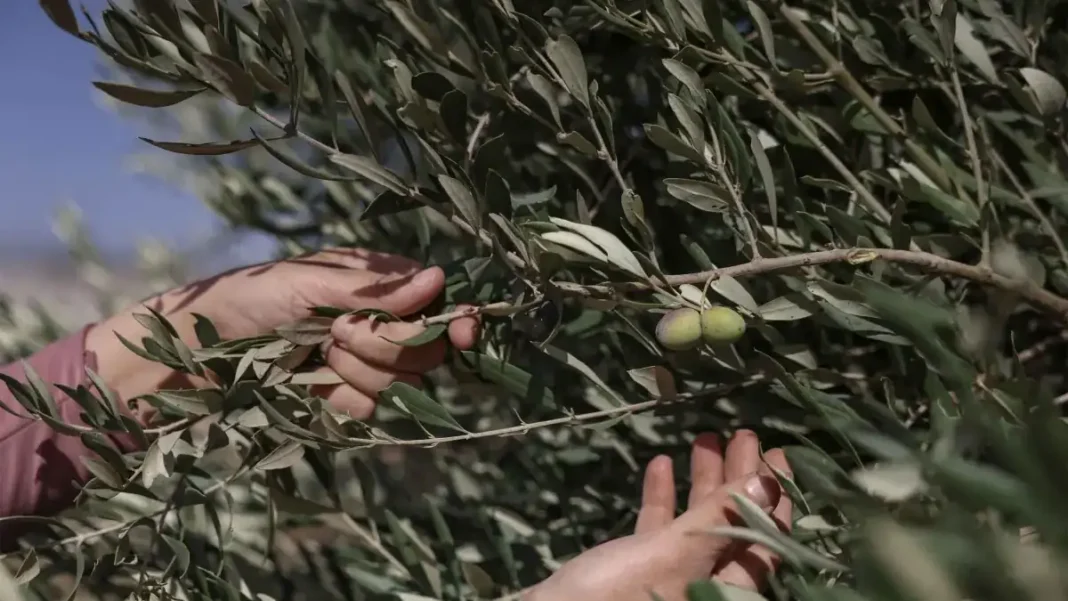
The West Bank olive harvest 2026 officially began on October 15, but few Palestinian farmers are celebrating. Many say they are afraid to enter their own groves as Israeli settler violence rises across the occupied territory.
The Palestinian Authority says “danger areas” for harvesters have grown in recent years as settlements multiplied and expanded. Settler attacks have killed at least 30 Palestinians this year, and more than 45,000 trees, including over 26,000 olive trees, were cut down or damaged in the first half of 2026.
Why the West Bank olive harvest 2026 matters
Olives are the backbone of Palestinian agriculture. The sector accounts for around 8 per cent of GDP and supports more than 60,000 jobs, according to the Palestinian Authority’s agriculture ministry.
For farming families, the harvest is also cultural. The olive tree is a symbol of their connection to the land, and the sale of olives and olive oil is a vital source of income at a time of mounting economic pressure.
That is why the fear hanging over this season cuts so deep. Earlier this year, Israeli settlers set fire to a mosque in the West Bank village of Mikhmas, one of several attacks that have kept tensions high in the territory.
UN calls for protection of farmers
The United Nations has urged Israel to protect Palestinian olive farmers from settler violence. UN spokesperson Stephane Dujarric said humanitarian partners had identified areas where protection efforts were needed so farmers could harvest safely and on time.
Dujarric said partners were seeking flexible funding to respond to the needs of affected Palestinian communities. He added that the Israeli government and security forces were obliged to protect the civilian population, including Palestinians, and to ensure everyone involved in violence was held accountable.
A season overshadowed by fear
The anxiety is grounded in recent events. In September, Israeli bulldozers uprooted olive trees near Ramallah just days before the harvest. Abd Alfattah Tamimi, who owns a grove on village land near the city, watched as a military bulldozer smashed his trees and tore their roots from the ground.
“All our olive trees, including the newly planted ones, were uprooted,” he told Reuters at the time. Israel’s military said it was checking the request for comment. In the past, the military has cited the need to clear land of olive trees to prevent ambushes on troops, a claim Palestinian human rights groups reject.
Then, on October 7, a Palestinian was killed in an Israeli settler attack during the olive harvest, officials said. Tayseer Al-Sheikh, a 64-year-old farmer from Rantis village near Ramallah, told Reuters that fear of settler violence had kept him from his olives for a year.
“For us, the olive tree is life,” he said.
What happens next
The harvest season runs for several weeks. In past years, Palestinian activists and international volunteers have accompanied farmers to groves near settlements, and WhatsApp groups circulate warnings about approaching settlers.
The timing adds to the unease. The harvest coincides with the run-up to Israeli elections, and Palestinian officials fear violence could intensify. It also comes in a week of fast-moving Middle East diplomacy: Colombia opened an embassy in Jerusalem, while Pakistan’s foreign minister called the Houthi attacks on Saudi Arabia unacceptable. The destruction of trees has a parallel environmental cost: a recent study found global deforestation slowed last year everywhere except the Congo basin, a reminder of how quickly tree cover can be lost.
When does the West Bank olive harvest begin?
The harvest officially began on October 15, 2026. It normally runs for several weeks across the West Bank.
Why are Palestinian farmers afraid this season?
Settler violence has surged. At least 30 Palestinians have been killed by settlers this year, and more than 45,000 trees were cut down or damaged in the first half of 2026.
What has the United Nations said?
The UN has urged Israel to protect olive farmers from settler violence. It says humanitarian partners have mapped areas needing protection and are seeking funding to help communities harvest safely.
*Sources: Reuters, UN briefing via EuropaSays*