Dar Calls Houthi Attacks on Saudi Arabia ‘Totally Unacceptable’
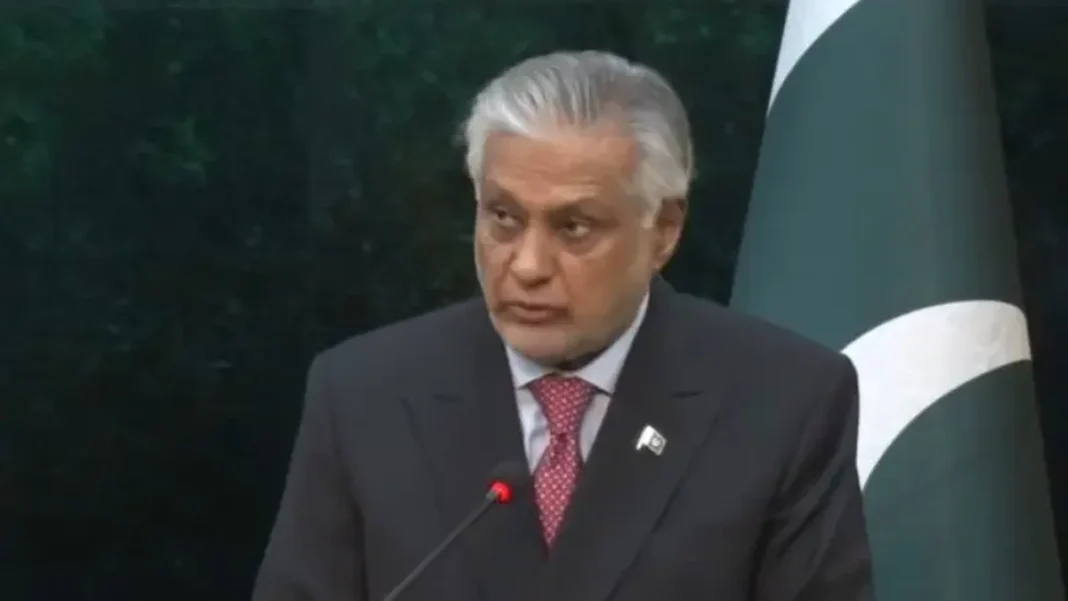
ISLAMABAD: Deputy Prime Minister and Foreign Minister Ishaq Dar on Wednesday said Houthi attacks on Saudi Arabia were totally unacceptable, reaffirming Pakistan’s full solidarity with the kingdom’s sovereignty, territorial integrity and security under the Makkah Joint Defence Agreement.
Dar made the remarks at a joint press conference with Omani Foreign Minister Sayyid Badr Albusaidi in Islamabad, following the eighth session of the Pakistan-Oman Joint Ministerial Commission (JMC).
Dar Houthi attacks Saudi Arabia remarks follow JMC session
The two ministers discussed the situation in the Gulf during their meeting, and Dar said he conveyed Pakistan’s condemnation of the attacks directly. He underscored that attacks against civilians and civilian infrastructure were totally unacceptable, adding that his Omani counterpart fully endorsed the position.
Violations of international law pose a serious threat to regional peace and security, Dar said, and both sides agreed that dialogue and diplomacy were the only way forward to resolve regional conflicts.
The condemnation is Pakistan’s strongest public statement yet on the recent escalation between the Houthis and Saudi Arabia, and it puts the Makkah Joint Defence Agreement at the centre of Islamabad’s response. Under the pact, Pakistan has committed itself to the kingdom’s defence, and Dar’s remarks leave no doubt that the commitment covers the current confrontation.
Pakistan-Oman agreements signed
At the outset of the press conference, Dar said the two sides would sign a protocol relating to the commission, reflecting what he called a shared resolve to further strengthen and expand bilateral cooperation in areas of mutual interest. The two sides would also sign an agreement for mutual visa exemption for holders of diplomatic and official passports, and a number of further bilateral agreements later in the day.
The ministers agreed to hold a business-to-business investment forum in Pakistan. They also emphasised the urgent need for unhindered delivery of humanitarian assistance to the people of Gaza.
Dar said the JMC had reviewed the full spectrum of bilateral relations, with cooperation spanning trade and investment, maritime and logistics connectivity, agriculture, industry, energy, workforce mobility, human resource development, education, IT, media and climate change. The Omani foreign minister thanked Pakistan for its hospitality, appreciated its efforts for regional peace and security, and reaffirmed Muscat’s commitment to the longstanding partnership.
Fuel prices and the common man
One of Dar’s most pointed remarks was about the domestic cost of regional tensions. He said the impact was visible in Pakistan, where energy supply chains had been affected and fuel prices had skyrocketed, adding that the common man could not afford the resulting burden.
The comment connects the Gulf confrontation to Pakistani households. With Brent crude climbing on Hormuz disruption fears, every escalation in the region feeds directly into Pakistan’s import bill and, through it, into petrol and power prices at home. Dar’s framing turns the condemnation into a domestic argument as well: regional instability is not an abstract foreign policy concern, it lands on family budgets.
GCC trade pact and the road ahead
Dar also told reporters that a free trade agreement between Pakistan and the Gulf Cooperation Council would help expand business activities, adding that barring one country, all GCC members had consented to the agreement.
On the bilateral track, he noted that Albusaidi’s visit had previously been delayed because Pakistan was involved in mediation efforts between the United States and Iran. The Omani minister said discussions had continued behind the scenes, and both sides stressed there should be no long gaps between engagements. Dar promised to visit Oman in 2027 for the next JMC session.
Albusaidi, for his part, said Oman remained committed to unhindered navigation through the Strait of Hormuz because of its vitality to the global economy, and commended Pakistan’s role in supporting dialogue between Iran and the United States.
Frequently asked questions
What did Ishaq Dar say about the Houthi attacks?
He said Houthi attacks on Saudi Arabia were totally unacceptable, condemned attacks on civilians and civilian infrastructure, and reaffirmed Pakistan’s full solidarity with the kingdom under the Makkah Joint Defence Agreement.
What is the Pakistan-Oman Joint Ministerial Commission?
It is the bilateral mechanism reviewing the full spectrum of Pakistan-Oman relations. The eighth session in Islamabad covered trade, investment, energy, workforce mobility, IT, education and climate change, and produced a protocol plus a diplomatic passport visa-exemption agreement.
How do Gulf tensions affect Pakistan?
Dar himself noted that regional tensions have disrupted energy supply chains and pushed fuel prices up, burdening ordinary Pakistanis. Pakistan imports most of its oil and LNG, so Gulf instability feeds directly into domestic prices.
What is the Makkah Joint Defence Agreement?
It is the defence pact between Pakistan and Saudi Arabia under which Islamabad has committed to the kingdom’s security and defence. Dar invoked it explicitly while condemning the Houthi attacks.
Tags: Dar Houthi attacks Saudi Arabia, Ishaq Dar, Makkah Joint Defence Agreement, Pakistan Oman JMC, Houthi Saudi escalation, GCC trade pact