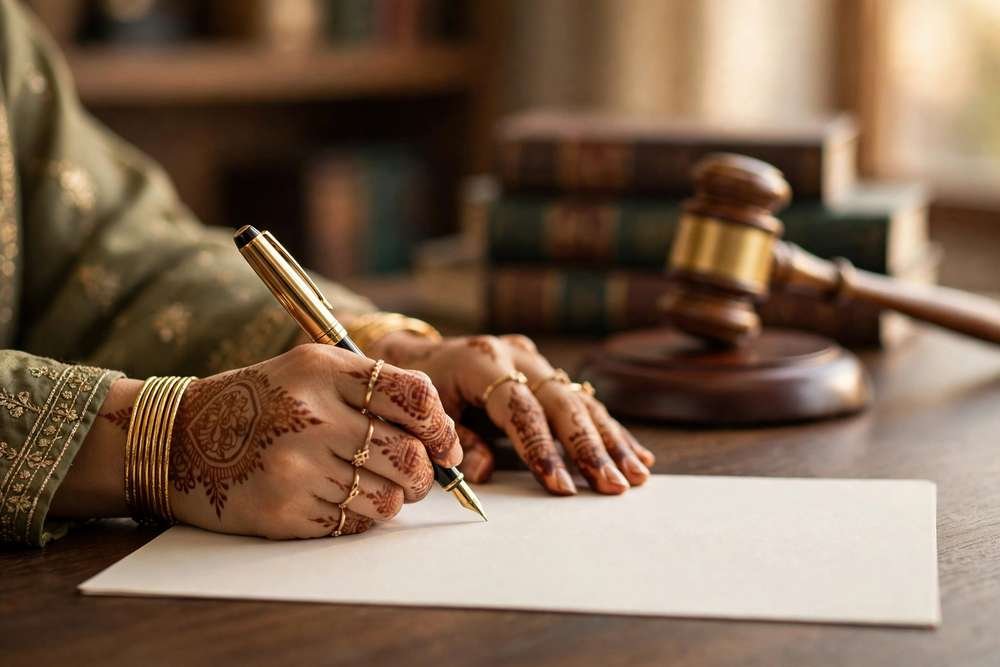
Khula is the legal right of a Muslim wife in Pakistan to end her marriage through the courts — even when her husband refuses a divorce. It is one of the most searched legal topics by women in Pakistan, yet it is surrounded by rumours: that the husband’s permission is needed, that she will automatically lose her children or her haq mehr, or that the case will drag on for years. This guide explains the actual process, step by step, based on current Pakistani law and recent court rulings.
Important note: This article is legal information, not legal advice. Family law in Pakistan has been evolving — court rulings in 2024–2026 changed some rules about haq mehr — so always confirm your situation with a family lawyer before acting.
What Is Khula?
Khula is a wife-initiated dissolution of marriage granted through the Family Court. When a husband agrees to end the marriage, the couple can go for a mutual divorce (talaq). When he does not — whether through cruelty, neglect, or simply refusal — the wife’s route is to file a suit for khula in the family court.
The legal foundation comes from the Dissolution of Muslim Marriages Act 1939 and the Family Courts Act 1964, which gives family courts exclusive jurisdiction over marriage-dissolution suits. Khula is an established Islamic legal right of the wife — it is not a modern invention and it is not “un-Islamic.”
The Khula Process, Step by Step
Step 1: File the Suit
The wife (legally called the plaintiff) files a written plaint for “dissolution of marriage on the basis of khula” in the Family Court — usually the court in the area where she lives. She will need her Nikahnama, CNIC copies of both spouses, details of the haq mehr (dower), and any evidence of mistreatment, neglect, or the husband’s failure to maintain her.
Step 2: Notice to the Husband
The court issues a summons to the husband, who may agree to the dissolution or contest it. If he deliberately avoids the notices, the court can proceed ex-parte (without him).
Step 3: Mandatory Reconciliation Attempt
The court must first attempt sulh — reconciliation — typically through an Arbitration Council under the Muslim Family Laws Ordinance 1961. This is a legal requirement, not optional. If reconciliation fails, the case moves forward.
Step 4: Evidence and Hearing
The wife’s statement is recorded under oath. Evidence may be presented. Here is the key fact many women do not know: the husband’s consent is not required. If the court is satisfied the marriage cannot continue within the limits prescribed by Allah, it can grant the decree without his agreement.
Step 5: The Decree
The court issues the khula decree dissolving the marriage.
Step 6: Registration With the Union Council
This step is frequently missed and it matters: the decree must be registered with the Union Council, which issues the official Divorce Certificate. Without this, the dissolution is not complete in official records — which affects remarriage, legal status, and documentation.
Step 7: Iddat
After khula, the wife observes iddat — three menstrual cycles (roughly 90 days), or until delivery if she is pregnant. Remarriage is only permitted after iddat is complete.
How Long Does Khula Take?
Lawyer websites advertise “30 to 90 days,” but treat that as marketing. Practitioners in Islamabad and Lahore report an average of 3 to 6 months for straightforward cases, and 6 to 12 months for contested ones. Delays come from court workload, the husband’s delay tactics, and repeat adjournments — not from the law itself.
What Does Khula Cost?
There is no single official published schedule of court fees for khula suits. Law firms in major cities quote total costs (lawyer fees plus expenses) roughly between PKR 30,000 and PKR 100,000, depending on the lawyer, the city, and whether the case is contested. Because these are lawyer marketing figures rather than official rates, the honest advice is: budget mainly for the lawyer, get a written fee agreement before hiring one, and compare two or three advocates before deciding.
Haq Mehr in Khula: The Rules Have Changed
This is where the biggest misunderstanding lives. The old belief was that a woman seeking khula automatically forfeits her haq mehr (dower). Pakistani law has moved to a fault-based approach:
- If the khula is forced by the husband’s cruelty, non-maintenance, or misconduct — the wife can keep her full dower. This was established in PLD 2024 FSC 9 and confirmed by an April 2025 Lahore High Court ruling (Justice Raheel Kamran), which held that where the husband’s fault breaks the marriage, the wife’s full dower right is preserved.
- If khula is sought simply from dislike, with no fault on the husband’s side — she may have to return the dower, wholly or in part. A June 2026 Lahore High Court ruling (Justice Mirza Waqas Rauf) ordered the return of only 25% of the dower in such a case.
- Dower remains payable even if rukhsati (consummation) never happened — the Lahore High Court has confirmed this.
- In a husband-initiated talaq — he cannot demand the return of dower or gifts (grounded in Quran 2:229 and Surah An-Nisa).
Because these rules shifted through court rulings in 2024–2026, this is precisely the area where a family lawyer’s advice matters most.
Children and Custody
Another widespread fear: that seeking khula means losing the children. It does not. Custody is decided separately under the Guardians and Wards Act 1890 (Section 17), and the only test the court applies is the welfare of the minor — not which parent ended the marriage.
- Mothers get preferential custody of young children (traditionally sons to about 7, daughters to puberty — though courts often extend this in the child’s interest).
- The father remains the natural guardian and must pay child maintenance regardless of who has custody.
- Visitation rights for the other parent are preserved.
- A 2025 Supreme Court ruling confirmed that a mother’s remarriage does not automatically disqualify her from custody, and courts must hear the child’s own voice.
5 Myths About Khula — Corrected
- “The husband must agree.” False. The court can grant khula without his consent.
- “She automatically loses her children.” False. Custody follows the child’s welfare, not the divorce.
- “She always loses her haq mehr.” False since 2024 — it is fault-based now.
- “Cases drag on for years.” Unusual. Most conclude within months.
- “Khula is un-Islamic or shameful.” False. It is the wife’s established legal right in Islamic jurisprudence.
Free Legal Help for Women
A lawyer is not always affordable — and you are not without options:
- AGHS Legal Aid Cell (Lahore, founded in 1980 by Asma Jahangir) provides free legal representation to women and vulnerable groups.
- PCSW helpline 1043 — the Punjab Commission on the Status of Women runs a toll-free, 24/7 helpline with all-women call agents and legal advisors, covering marriage, divorce, inheritance, and domestic violence.
- Ministry of Human Rights helpline 1099 — free legal aid for human-rights violations.
- Dastak Foundation — 0333-4161610 (Mon–Sat, 9–5), offering shelter and legal aid for domestic violence cases.
Knowing the process is power. If a marriage has become unbearable, Pakistani law gives you a clear, lawful exit — and a support system that exists precisely so you do not have to walk it alone.