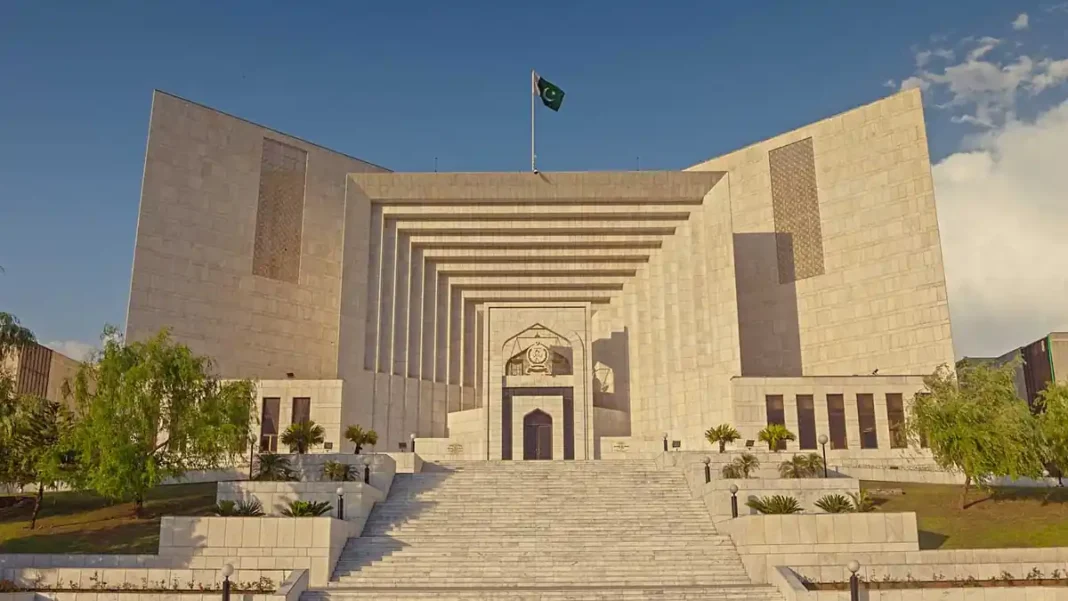
Article 185 of the Constitution of Pakistan gives the Supreme Court its appellate jurisdiction — the power to hear appeals from the High Courts. Every major Article 62/63 battle, from the Panama Papers case to the 2024 lifetime-disqualification ruling, reached the apex court through this article. Here is what it says and how it works.
Quick answer: Under Article 185, the Supreme Court hears appeals from judgments, decrees, final orders and sentences of the High Courts. Appeals lie as of right in specified cases (death-sentence reversals, contempt, high-value property disputes, certified constitutional questions); all other High Court decisions reach the Court only with its leave to appeal.
The Text of Article 185
Article 185(1) states: “Subject to this Article, the Supreme Court shall have jurisdiction to hear and determine appeals from judgments, decrees, final orders or sentences of a High Court.” The remaining clauses then sort those appeals into two streams — those that come as of right, and those that need the Court’s permission.
Appeals as of Right
Article 185(2) lists the cases where an appeal lies automatically:
- Death and life sentences (clauses a–b): where a High Court on appeal reverses an acquittal and sentences the accused to death or life imprisonment, enhances a sentence to death or life on revision, or itself tries and convicts in such a case.
- Contempt (clause c): where the High Court has punished any person for contempt of the High Court.
- High-value civil disputes (clauses d–e): where the amount or value in dispute is not less than Rs 1 million (or such sum as Parliament specifies; older texts read Rs 50,000) and the High Court’s judgment has varied or set aside the judgment of the court below — or where the case involves a property claim of like value.
- Constitutional questions (clause f): where the High Court certifies that the case involves a substantial question of law as to the interpretation of the Constitution. This is the doorway through which most election and disqualification disputes enter the Supreme Court.
Leave to Appeal
Article 185(3) provides that in every other case, an appeal from a High Court judgment, decree, order or sentence lies only if the Supreme Court grants leave to appeal. In practice, the Court grants leave where a case raises an important question of law, where there are conflicting High Court judgments, or where a grave miscarriage of justice is alleged. The vast majority of petitions for leave are declined — the filter keeps the apex court’s docket manageable.
How Article 185 Is Used
Article 185 is the workhorse of the Supreme Court’s docket. Criminal appeals against death sentences, civil appeals in high-value disputes, and constitutional petitions from the High Courts all arrive through it. It is distinct from the Court’s original jurisdiction under Article 184 (disputes between governments, and public-importance fundamental-rights cases under 184(3)) and its advisory jurisdiction under Article 186. Together, Articles 184, 185 and 186 define the three doors into the Supreme Court.
Frequently Asked Questions
What is the appellate jurisdiction of the Supreme Court of Pakistan?
Under Article 185, the Supreme Court hears appeals from the judgments, decrees, final orders and sentences of the High Courts — as of right in the cases listed in clause (2), and otherwise only with leave to appeal under clause (3).
Can every High Court decision be appealed to the Supreme Court?
No. Only the categories in Article 185(2) — such as death-sentence cases, contempt punishments, high-value civil appeals and certified constitutional questions — come as of right. Everything else needs the Supreme Court’s leave, which is granted selectively.
What is the difference between Article 184 and Article 185?
Article 184 gives the Supreme Court original jurisdiction — cases that start in the Supreme Court itself, including public-importance fundamental-rights matters. Article 185 gives it appellate jurisdiction — appeals from decisions already made by the High Courts.
What does “leave to appeal” mean?
It means the Supreme Court’s permission to bring the appeal. The petitioner must first convince the Court the case deserves a hearing; only if leave is granted does the full appeal proceed.
Related Guides
- Article 62 of the Constitution of Pakistan: The Complete Guide — the hub for this cluster
- Article 62 Explained Clause by Clause
- Article 63: Disqualifications for Parliament
- Constitution of Pakistan 1973 — the full document