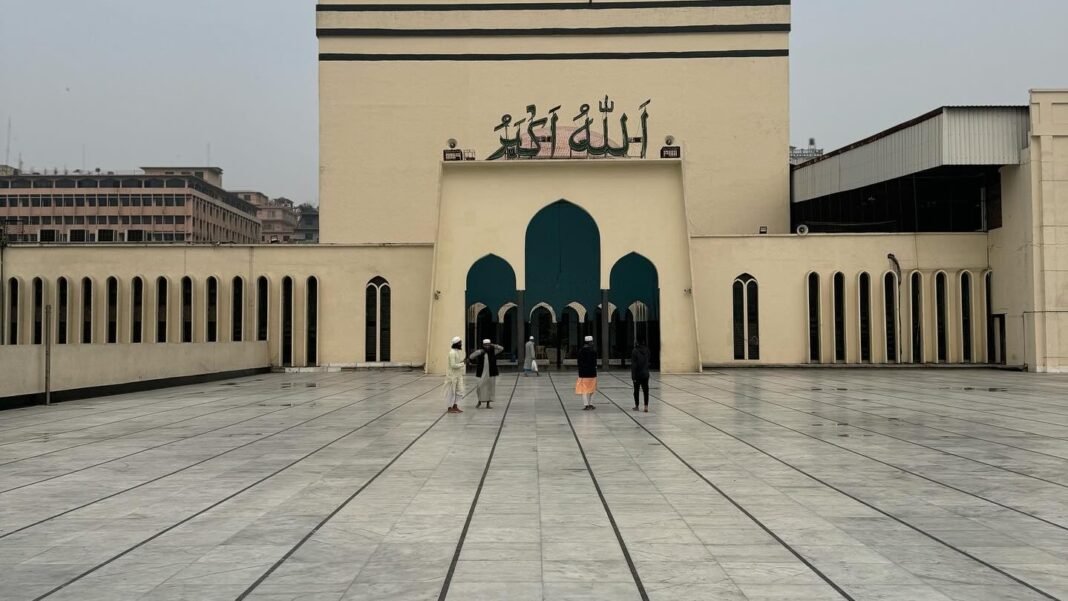
In the heart of Gulshan-e-Iqbal, one of Karachi’s busiest residential districts, stands a mosque unlike any other in the city: Baitul Mukarram Mosque. A bold, domeless modernist cube modelled on the famous Baitul Mukarram of Dhaka, it anchors a 5-acre complex that includes a madrasa, library, dispensary, and student hostel — a working centre of worship, learning, and community service rather than just a beautiful building. Whether you are a Karachi resident who has driven past it on University Road a hundred times or a visitor exploring the city’s religious landmarks, this Baitul Mukarram Mosque Karachi travel guide covers its history and architecture, how to reach it, the best time to visit, nearby places, food, and practical tips for 2026.
Quick Facts
- Location: Block 8, Gulshan-e-Iqbal, Karachi, Sindh — near the Federal Urdu University and the Expo Center Karachi, on University Road
- Coordinates: Around 24.9074° N, 67.0827° E
- Famous For: Its domeless, cube-shaped modernist architecture modelled on Dhaka’s Baitul Mukarram; its madrasa, library, dispensary, and hostel
- Nearest City: Central Karachi — Saddar is about 12 km away; Jinnah International Airport about 10–12 km
- Accessibility: Easy by car, ride-hailing, or public transport along University Road; wheelchair-friendly courtyard
- Known Landmarks: The 40 m x 40 m prayer hall (capacity around 4,000 plus courtyard space); the complex’s library and madrasa buildings
- Best For: Worshippers, students of Islamic architecture, cultural travelers, and families visiting Karachi’s landmarks
Why Visit Baitul Mukarram Mosque, Karachi
Karachi has no shortage of famous mosques — the marble-domed Masjid-e-Tooba, the grand New Memon Masjid, the historic Kharadar mosques — but Baitul Mukarram occupies a unique place among them. Its architecture breaks every convention of the traditional South Asian mosque: no dome, no sprawling Ottoman silhouette, just a powerful geometric cube whose very plainness is the statement. Modelled on Dhaka’s Baitul Mukarram (itself modelled on the Kaaba in Mecca), it represents a moment in the 1970s when Karachi’s builders were thinking about what a modern Pakistani mosque could look like. For students of architecture, it is essential viewing.
But the building is only half the story. Baitul Mukarram is a living institution. The complex houses an Islamic educational institute (madrasa) where students receive religious education, a library, a dispensary serving the neighbourhood, and a hostel — all in separate buildings scattered across the 5-acre site. It is also associated with the scholarly tradition of Mufti Muhammad Taqi Usmani, one of Pakistan’s most respected Islamic scholars, under whose guidance the masjid has been described as a centre of Islamic learning and economic thought. Visiting here means seeing faith expressed not just in prayer but in teaching, healing, and community service.
Practically, Baitul Mukarram is one of the easiest religious landmarks in Karachi to visit. It sits on University Road in Gulshan-e-Iqbal, minutes from the Expo Center, Karachi University, and some of the city’s best food streets. It fits naturally into any Karachi sightseeing day — combine it with a trip to the Mazar-e-Quaid, Burns Road’s food, or an evening at Clifton Beach, and you have a full portrait of the city.
History of Baitul Mukarram Mosque, Karachi
The Karachi Baitul Mukarram was built in the 1970s by a local community trust, in the years when Gulshan-e-Iqbal was growing from planned suburb into one of Karachi’s defining middle-class districts. Its name and design were borrowed directly from the great Baitul Mukarram of Dhaka — and that borrowing carries its own history.
Dhaka’s Baitul Mukarram was conceived in 1959, when Haji Abdul Latif Bawani, owner of the Bawani Jute Mills, proposed to Major General Umrao Khan — then the military administrator of East Pakistan — that a grand national mosque be built in Dhaka. A mosque committee was formed the same year, 8.3 acres between new and old Dhaka were chosen (on the site of the old Paltan pond, which was filled in), and President Ayub Khan inaugurated construction on 27 January 1960. The first prayers were held on Friday, 25 January 1963, and the mosque was completed in 1968. Designed by architect Abdulhusein M. Thariani, it was revolutionary: a massive cube modelled on the Kaaba, with no dome over the main prayer hall — a deliberate break with Mughal convention. It was extended in 2008 with Saudi funding and today holds more than 40,000 worshippers.
Karachi’s Baitul Mukarram took that modernist DNA and built it at neighbourhood scale: a 40 m x 40 m prayer hall holding around 4,000 worshippers, with additional space in the adjoining courtyard, set in a 2-hectare (5-acre) complex. The Aga Khan Trust for Culture’s Archnet records the complex as comprising a library, madrasa, hostel, and dispensary in individual buildings around the mosque — an unusually complete community institution for a single mosque project.
The wider setting matters too. Gulshan-e-Iqbal itself is a product of Karachi’s explosive growth in the 1960s and 70s, when the Karachi Development Authority planned new towns to house the city’s booming population. University Road — the artery the mosque stands on — links the city’s great educational institutions: the University of Karachi, the Federal Urdu University of Arts, Science and Technology (near the mosque), NED University, and Dow University. Baitul Mukarram grew up as the spiritual anchor of this academic corridor, and it remains deeply woven into the daily life of the neighbourhood: five prayers a day, packed Friday congregations, and a constant flow of students between the madrasa, the library, and the universities nearby.
Top Things to Do in Baitul Mukarram Mosque, Karachi
Admire the Domeless Architecture
Stand in the courtyard and take in the building’s geometry: the sheer cubic prayer hall, the absence of a dome, the modernist lines that set it apart from every Mughal-revival mosque in the city. It is a rare built example of 1970s Pakistani modernism applied to sacred architecture. Visit in the late afternoon when the low sun rakes across the facade for the best photographs.
Join the Congregational Prayers
There is no better way to experience a mosque than to pray in it. The five daily prayers are open to all Muslim visitors; the Friday (Jumu’ah) congregation is the week’s great gathering, when the hall and courtyard fill. Arrive early for Friday, perform ablution (wudu) at the designated facilities, and follow the congregation. Non-Muslim visitors are welcome to observe respectfully from the courtyard outside prayer times.
Visit the Library and Madrasa
The complex’s library and Islamic educational institute are central to its identity. Visitors with a genuine interest in Islamic scholarship can ask about the library’s holdings and the madrasa’s programmes. The association with the scholarly tradition of Mufti Taqi Usmani makes this a meaningful stop for students of Islamic thought.
Experience Ramadan and Eid at the Mosque
If your visit falls in Ramadan, Baitul Mukarram comes alive at night with Taraweeh prayers; on Eid, the courtyard overflows with worshippers in their finest clothes. These are among the most atmospheric religious experiences Karachi offers — plan around them if you can.
Walk University Road’s Institutional Corridor
Use the mosque as the starting point for a walk (or drive) along University Road: the Federal Urdu University next door, the Expo Center Karachi nearby, and further along, the University of Karachi’s leafy campus. It is a slice of Karachi that tourists rarely see and locals live every day.
Famous Places In and Around Baitul Mukarram Mosque, Karachi
- Expo Center Karachi — the city’s main exhibition venue, minutes away on University Road.
- Federal Urdu University — right beside the mosque; one of Pakistan’s major public universities.
- University of Karachi — the country’s largest university, a short drive east with a beautiful green campus.
- Lucky One Mall — one of Pakistan’s largest shopping malls, in nearby Gulshan-e-Iqbal — combine worship with shopping and dining.
- Mazar-e-Quaid — the mausoleum of Muhammad Ali Jinnah, about 20–25 minutes southwest; Karachi’s most important monument.
- Burns Road Food Street — Karachi’s legendary food street, about 25–30 minutes away — the perfect dinner after an evening visit.
- Clifton Beach and Bagh Ibne Qasim — the seafront, about 30–40 minutes south, for sunset after your mosque visit.
How to Reach Baitul Mukarram Mosque, Karachi
The mosque is in Block 8, Gulshan-e-Iqbal, on University Road — one of Karachi’s best-connected locations. Everything in this section is within the city, so “reaching” means navigating Karachi’s traffic, which is half the adventure.
Route Details
From Jinnah International Airport (about 10–12 km, 25–40 minutes depending on traffic): Exit the airport onto Shahrah-e-Faisal, then head north via Rashid Minhas Road toward Gulshan-e-Iqbal and University Road. Ride-hailing (Careem, Uber, Bykea) is the easiest option for visitors.
From Saddar / Clifton (about 12–18 km, 30–50 minutes): Take University Road east from Hassan Square directly to Block 8, Gulshan-e-Iqbal. The mosque is well signposted locally — ask any shopkeeper for “Baitul Mukarram Masjid.”
From Lahore: Fly to Karachi (about 1.5 hours) or take the motorway/GT Road journey (15+ hours by road — flying is strongly recommended). Then follow the airport route above.
From Islamabad: Fly to Karachi (about 2 hours), then the airport route. The road journey via the M-9 motorway is 18+ hours.
Public transport: Karachi’s buses and minibuses run thick along University Road; ask for the Gulshan-e-Iqbal Block 8 stop near the mosque. For comfort and safety, visitors generally prefer ride-hailing.
Parking: The complex has parking areas; on Fridays and Eid, arrive early as the surrounding streets fill quickly.
Where to Stay in Baitul Mukarram Mosque, Karachi
Gulshan-e-Iqbal and the University Road corridor are not Karachi’s hotel district — that is Saddar, Clifton, and Shahrah-e-Faisal — but they offer solid, affordable options, and the mosque’s own complex includes a hostel (primarily for students, not tourists).
Budget tier: Guesthouses and small hotels cluster around Gulshan Chowrangi and along University Road — clean, air-conditioned rooms at very reasonable rates, with dhabas and fast food within walking distance.
Mid-range tier: The University Road–Rashid Minhas corridor has established mid-range hotels with restaurants and reliable power backup (essential in Karachi summers). This is the sweet spot for visitors combining the mosque with Karachi University, the Expo Center, or Lucky One Mall.
Luxury tier: For five-star comfort, stay on Shahrah-e-Faisal or in Clifton/Defence (25–40 minutes away) and visit the mosque as a half-day excursion — many travelers prefer this, pairing the mosque with Burns Road and the seafront in a single day.
No hotel is named here because none near the mosque could be individually verified — but the tiers above match exactly what the Gulshan-e-Iqbal corridor offers.
Where to Eat: Local Foods of Baitul Mukarram Mosque, Karachi
One of the great pleasures of visiting Baitul Mukarram is the food around it — Gulshan-e-Iqbal and University Road sit in the middle of Karachi’s legendary eating culture. Within minutes of the mosque you will find the full Karachi repertoire.
Start with biryani — Karachi’s signature dish, and the city takes it more seriously than anywhere else in Pakistan. The University Road–Gulshan area has branches of the city’s famous biryani houses. Then there is nihari (slow-cooked beef shank, the classic Karachi breakfast), bun kabab (the city’s beloved street burger), chicken tikka and seekh kebabs from the BBQ shops, and haleem. For dessert: kulfi, rabri, and fresh sugarcane juice from street vendors.
For the full experience, drive 25–30 minutes to Burns Road, Karachi’s historic food street — nihari, sajji, lassi, and sweet shops in a gloriously chaotic old-city setting. Closer to the mosque, the restaurants around Gulshan Chowrangi and Lucky One Mall’s food court cover everything from desi to fast food. A filling local meal is budget-friendly; Burns Road is the best value fine-eating in the city.
Weather in Baitul Mukarram Mosque, Karachi
Karachi’s coastal climate shapes every visit. The city is hot and humid for much of the year, with a genuinely pleasant winter — and since mosque visits involve walking the open courtyard, timing matters.
| Season | Temperature Range | Conditions |
|---|---|---|
| Winter (Dec–Feb) | 10–25°C | Mild, dry, and sunny — the best season. Cool evenings; light jacket enough. |
| Spring (Mar–Apr) | 25–35°C | Warming up; still comfortable for morning and evening visits. |
| Summer (May–Jun) | 30–42°C, humid | Hot and sticky; visit early morning or after sunset. Sea breeze helps evenings. |
| Monsoon/Autumn (Jul–Nov) | 28–36°C | Monsoon rains July–August (often flooding streets — check before going); humid autumn after. |
Language and Culture of Baitul Mukarram Mosque, Karachi
Karachi is Pakistan’s great melting pot, and the congregation at Baitul Mukarram reflects it: Urdu is the common language (and the city’s mother tongue for its largest community), with Sindhi, Punjabi, Pashto, Balochi, Saraiki, and English all widely spoken. You will manage fine with Urdu or English anywhere in Gulshan-e-Iqbal.
Mosque etiquette is the essential culture note. Dress modestly: long trousers and covered shoulders for men; women should wear loose clothing covering arms and legs plus a headscarf (carry one — some mosques provide them, but having your own is better). Remove shoes before entering the prayer hall (shoe racks are provided). Perform ablution before praying if you intend to join. During prayers, switch your phone to silent and do not walk in front of worshippers. Photography of the architecture is generally fine; photographing people at prayer without permission is not. Friday afternoons and Eid are the busiest times — also the most atmospheric.
Beyond the mosque, Karachi’s culture is commerce, food, and warmth. The city runs on hustle and hospitality in equal measure; shopkeepers on University Road will happily direct you, and the Burns Road food vendors treat first-timers like guests of honour.
Shopping in Baitul Mukarram Mosque, Karachi
The area around Baitul Mukarram is one of Karachi’s strongest shopping zones. The landmark is Lucky One Mall in Gulshan-e-Iqbal — one of Pakistan’s largest malls, with international and Pakistani brands, a large food court, and an indoor amusement area. It is a genuine destination in its own right and minutes from the mosque.
For traditional shopping, the Gulshan Chowrangi markets and the University Road bazaars sell everything from fabrics and ready-made garments to electronics and household goods at local prices. Islamic bookshops near the mosque are excellent for religious literature in Urdu, English, and Arabic — a fitting souvenir from a visit centred on a mosque. And no Karachi trip is complete without dry fruits and mithai from the city’s famous sweet shops. Bargaining is expected in street markets, not in malls.
Local Events and Festivals
Karachi Eat (January, Beach View Park, Clifton): Pakistan’s biggest food festival has been held every January since 2014 — a three-day open-air feast (the 2025 edition ran January 10–12) with hundreds of stalls, from home chefs to international cuisines, plus live music. If your mosque visit falls in mid-January, pair it with an evening at Karachi Eat for the definitive Karachi weekend.
Ramadan and Eid: The mosque’s own calendar is its most important festival cycle — Taraweeh prayers through Ramadan and the great Eid congregations, when the courtyard fills with thousands of worshippers. Shab-e-Barat and Eid Milad-un-Nabi are also widely observed across Karachi with illuminated mosques and processions.
Karachi’s cultural calendar: The city hosts literature festivals, art exhibitions, and music events through the winter season (December–February) — check local listings when you visit, as dates shift yearly.
Travel Tips for Baitul Mukarram Mosque, Karachi
Packing Essentials
Modest clothing is the main requirement: a headscarf for women, long trousers for men. In summer, light cotton, sunglasses, and a water bottle for the courtyard walk; in winter, a light jacket for evenings. Slip-on shoes make the shoe-removal routine effortless.
Safety Tips
Gulshan-e-Iqbal is a busy, populated district and the mosque area is safe during the day and prayer times. Standard big-city precautions apply: keep valuables discreet, use ride-hailing rather than hailing random transport at night, and avoid flooded streets during monsoon downpours. Inside the mosque, the usual respect rules keep you welcome.
Money & Connectivity
ATMs are plentiful along University Road and in Lucky One Mall; cards are accepted in malls and larger restaurants, but carry cash for bazaars, buses, and street food. All mobile networks (Jazz, Telenor, Zong, Ufone) have strong 4G across Gulshan-e-Iqbal. Karachi runs on cash and mobile wallets — both work everywhere here.
Best Time to Visit Baitul Mukarram Mosque, Karachi
Winter (December to February) — The Best Season
Mild, dry, sunny days (10–25°C) made for walking courtyards and combining the mosque with the rest of Karachi. This is also festival season: Karachi Eat in January, plus the city’s literature and arts events.
Ramadan and Eid — The Most Atmospheric
Ramadan (dates shift yearly — check the lunar calendar) transforms the mosque: night prayers, community iftars, and a spiritual energy unlike any other time. Eid brings the year’s biggest congregations.
Spring (March to April) — Pleasant Shoulder
Warm but manageable; good for morning visits before the heat builds.
Summer and Monsoon (May to September) — Visit Strategically
Come early morning or after Maghrib to avoid the heat; skip monsoon downpour days entirely, as Karachi’s streets flood.
Final Thoughts
Baitul Mukarram Mosque, Karachi, rewards the traveler who looks twice. At first glance it is an unusual building on a busy road; at second glance it is a statement about modern Pakistani Islam — confident enough to abandon the dome, serious enough to build a library, a school, a clinic, and a hostel around the prayer hall. In a city that never stops moving, it is a place of deliberate stillness.
Visit for the architecture, stay for the congregation, and let the neighbourhood do the rest: biryani on University Road, books from the Islamic bookshops, sunset at Clifton. That is Karachi — faith, food, and the sea, all in one day.
FAQs
Where is Baitul Mukarram Mosque in Karachi?
Block 8, Gulshan-e-Iqbal, on University Road — near the Federal Urdu University and the Expo Center Karachi, about 10–12 km from Jinnah International Airport.
What is special about its architecture?
It is a domeless modernist cube (40 m x 40 m) modelled on Dhaka’s Baitul Mukarram Mosque — which was itself modelled on the Kaaba — breaking with traditional Mughal-style mosque design.
How many people can pray there?
The prayer hall holds around 4,000 worshippers, with additional space in the adjoining courtyard for Friday and Eid congregations.
When was Baitul Mukarram Mosque Karachi built?
It was built in the 1970s by a local community trust, as Gulshan-e-Iqbal was developing into a major Karachi suburb.
How do I reach it from the airport?
About 10–12 km via Shahrah-e-Faisal and Rashid Minhas Road (25–40 minutes depending on traffic); ride-hailing is the easiest option for visitors.
What is the best time to visit?
December to February for the weather; Ramadan and Eid for the most atmospheric experience; January if you want to combine it with the Karachi Eat food festival.
Can non-Muslims visit the mosque?
Yes — non-Muslim visitors are welcome to view the architecture and observe respectfully from the courtyard outside prayer times, dressed modestly.
Is it suitable for families?
Very — the complex is spacious and safe, children are welcome, and the nearby Lucky One Mall makes it an easy family outing.
What food should I try nearby?
Karachi biryani, nihari, bun kababs, and BBQ around Gulshan-e-Iqbal and University Road — or drive 25–30 minutes to Burns Road food street for the full experience.
What else is near the mosque?
The Expo Center Karachi, Federal Urdu University, University of Karachi, Lucky One Mall, Mazar-e-Quaid (20–25 min), and Clifton Beach (30–40 min).
See more of the city? Browse our Explore Pakistan guides, read our Malam Jabba travel guide, or explore the Hunza Valley next.