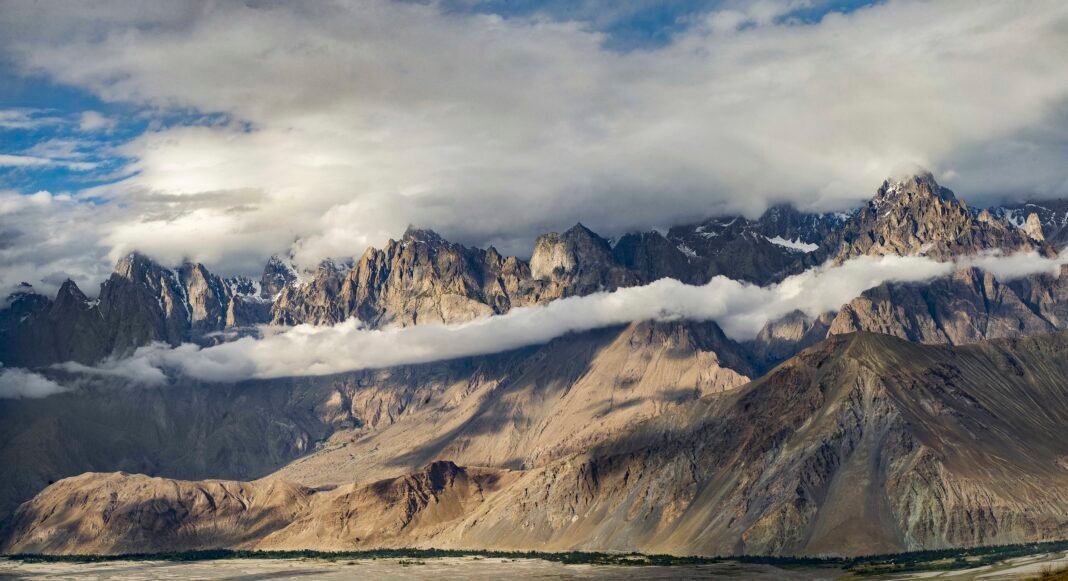
Some mountains stand on the horizon like scenery. The Haldi Cones stand like a summons. Rising from the Karakoram above Haldi village in Ghanche district, Gilgit-Baltistan, this cluster of granite spires and towers is one of the most striking sights in Baltistan — a skyline of rock that looks drawn by hand, sharp enough to cut the clouds. Most of these cones have never been climbed. They are not on the mainstream tourist circuit. And that is exactly why you should go.
This Haldi Cones travel guide will help you decide whether this corner of the Karakoram belongs on your itinerary — and when to time your visit for the clearest views. We cover how to reach Haldi village from Khaplu and Skardu, the best viewpoints and treks, where to stay, what to eat, Balti culture, and practical travel tips. For more of Pakistan’s north, see our Hunza Valley guide, our Attabad Lake guide, and the wider Explore Pakistan collection.
Quick Facts
- Location: Haldi village, Ghanche district, Gilgit-Baltistan — in the Karakoram range, between the Masherbrum and Saltoro ranges
- Altitude: Highest point around 7,742 metres (25,400 ft); Haldi village itself sits at around 3,167 metres (10,390 ft)
- Famous For: Sharp granite cones and towers, mostly unclimbed; dramatic valley views from Khaplu and Machulu
- Nearest City: Khaplu town, around 25 km away (Ghanche district centre); Skardu is the regional hub, roughly 103 km from Khaplu
- Accessibility: Drive from Khaplu to Haldi village on a mountain road, then walk or trek toward the base for closer views
- Known Landmarks: Haldi village, Yuchung Masherbrum viewpoint, Machulu village, Khaplu Fort, Chaqchan Mosque
- Best For: Mountain photographers, trekkers, nature lovers and travellers who want Baltistan without the crowds
Why Visit Haldi Cones
The first reason to visit the Haldi Cones is simple: they are among the most beautiful mountains in the world that almost nobody talks about. While Hunza’s Rakaposhi and Skardu’s Shangrila draw the crowds, the cones above Haldi village stand in near silence — fluted granite towers catching the sunrise, snowfields draping their upper slopes, the Ghanche valley unfolding below. If you have ever wanted to see the Karakoram as it was before tourism found it, this is as close as you can get on a normal holiday.
The second reason is the accessibility. This is not an expedition you need months to prepare for. You can stand in Khaplu in the morning, drive to Haldi village the same day, and be staring up at unclimbed granite spires by the afternoon. For the more ambitious, a moderate trek from Haldi village climbs toward the base of the cones — a proper mountain experience of six to ten hours — without requiring technical climbing skills or an expedition budget. Few places on earth offer that ratio of grandeur to effort.
The third reason is the valley around them. Ghanche district, with Khaplu at its heart, is one of the richest corners of Baltistan — centuries-old mosques, a restored royal fort, apricot orchards, and a culture shaped by Tibetan, Persian and Central Asian influences over a thousand years. The Haldi Cones make an ideal anchor for a longer Baltistan trip: Khaplu Fort and Chaqchan Mosque in the morning, the cones at golden hour, and a Balti dinner under a sky full of stars. If your idea of travel is discovery rather than checklists, the Haldi Cones should be high on your list.
Who is it perfect for? Photographers chasing light on granite; trekkers who want a real Karakoram objective without the crowds of K2 base camp; families who can enjoy the valley views without walking at all; and anyone who has done Hunza and Skardu and is hungry for the next level. When should you go? May to October is the realistic window, with June through September offering the clearest skies and the greenest valley. This guide walks through all of it below.
History of Haldi Cones
The Haldi Cones themselves have no human history to speak of — they are geology, carved by ice and weather over millions of years, and most of their summits have never felt a human foot. What does have history is the valley at their feet, and that history is rich.
Haldi village is a historic settlement of Baltistan, sitting at the confluence of the Saltoro and Hushe rivers. Records note that a fort once stood here until around 1750 AD, and the village appears in old regional histories of Baltistan such as the Shigar Nama. The Balti poet Johar Ali Johar — known as Bowa Johar, celebrated as a master of the Balti behartaweel form — is buried near the Khanqah-e-Muallah in Haldi, a reminder that this valley has produced scholars and poets, not just shepherds and soldiers. American author Greg Mortenson, writing in Three Cups of Tea, described Haldi as one of the most beautiful places he had seen in Pakistan.
The wider region’s history runs deep. Baltistan sat on the old trade routes between Kashmir, Ladakh, Yarkand and Central Asia, and Khaplu was a small kingdom ruled by the Yabgo dynasty. Islam — in the Noorbakhshi Sufi tradition particular to this region — arrived centuries ago, and the 14th-century Chaqchan Mosque in Khaplu, founded by the missionary Sayyid Ali Hamdani’s followers, is one of the oldest in the region. The granite cones watched all of this unfold in complete indifference, which is rather the point: the Haldi Cones are ancient in a way that makes human history feel brief, and standing beneath them gives you that rare, vertiginous sense of deep time.
The cones became known to the outside world only gradually. Wikipedia’s entry on the Haldi Cones identifies them as a group of mountains in the Karakoram in Ghanche district, with the highest point at 7,742 metres, and notes that most of the towers and cones remain unclimbed while peaks of the Khane Valley to the north have been climbed. Trekking outfits in Skardu now offer Haldi Cones trekking itineraries, and travel writers have begun calling them a hidden gem of the Karakoram — but the valley remains wonderfully under-visited, and the Haldi Cones are still, for all practical purposes, a secret worth keeping quietly.
Top Things to Do in Haldi Cones
Drive to Haldi village and see the cones up close
The essential experience is also the simplest: drive from Khaplu to Haldi village — around 25 km on a valley road — and walk into the open ground above the village where the cones fill the sky. The spires rise directly above you, their fluted granite faces catching the light differently every hour. Morning light sharpens their edges; evening light warms them to gold. Bring a wide-angle lens and a telephoto — you will use both. Local guides can point out the named cones and the routes trekkers take toward their bases.
Trek toward the base of the cones
For trekkers, a moderate route climbs from Haldi village toward the high ground beneath the cones — a round trip of roughly six to ten hours depending on fitness and how far you push. The trail crosses alpine pasture and moraine, with views opening up across the Karakoram as you gain height. Trekkers report Himalayan-range views from the higher campsites. This is a proper mountain day: no technical climbing, but you will want sturdy boots, layers, food and water, and ideally a local guide who knows the water points and the weather signs. Campsites below the cones make it possible to stay overnight and catch sunrise on the granite — the single most spectacular moment of the trip.
The Yuchung Masherbrum viewpoint
For one of the finest framed views of the Haldi Cones, head to the Yuchung viewpoint, famous for its outlook on the Masherbrum massif. From here the cones line up across the Ghanche valley in a composition that photographers travel specifically to capture. Sunrise and sunset both work; sunset adds warm light on the high snowfields while the valley below softens into blue shadow. This is an easy stop on a day trip and needs no walking beyond the roadside.
Photography from Machulu village
Machulu village, on the opposite side of the valley, offers a different and equally rewarding angle on the cones — the full sweep of the towers with the river and fields in the foreground. Villagers here are used to visitors and are generally welcoming; ask before photographing people, and a smile and a greeting in Balti go a long way. The terraced fields of Machulu in harvest season, with the cones behind them, are among the most photographed scenes in Ghanche.
Explore Haldi village itself
Do not rush back to Khaplu. Haldi is one of Baltistan’s historic villages — wander its lanes, visit the Khanqah-e-Muallah, find the tomb of the poet Bowa Johar, and sit with a cup of salted Balti tea while the cones tower above. The village grows apricots, apples and wheat in terraced fields fed by glacier streams, and in autumn the whole valley turns to gold. This is living Baltistan, not a museum — and it deserves an unhurried half day.
Famous Places In and Around Haldi Cones
- Khaplu Fort and Palace: The restored 19th-century royal fort of the Yabgo rulers, now partly run as a Serena heritage hotel — Baltistan’s finest historic building.
- Chaqchan Mosque: A 14th-century wooden mosque founded in the era of Sayyid Ali Hamdani’s missionaries — an architectural treasure.
- Saling: A scenic valley and village en route, popular with motorbike tourers for its dramatic approaches.
- Siachen-side valleys: Hushe and Saltoro valleys offer further trekking toward some of the Karakoram’s great peaks.
- Skardu: The regional hub, about 103 km from Khaplu, with Shangrila Lake, Shigar Fort and the gateway to Deosai.
How to Reach Haldi Cones
The Haldi Cones are reached via Khaplu, the main town of Ghanche district. The standard journey is: fly or drive to Skardu, drive to Khaplu (about 103 km, roughly 2.5 to 3 hours on a good mountain road), then drive on to Haldi village (around 25 km, under an hour). From Islamabad the whole journey takes a full day if you fly to Skardu, or two days by road.
Route Details
- From Islamabad (by air): Take the roughly 1-hour flight from Islamabad to Skardu (morning flights; weather-dependent, so keep a buffer day). From Skardu airport, hire a car or jeep to Khaplu (~103 km, 2.5–3 hours), stay overnight, then drive to Haldi village (~25 km, 45–60 minutes).
- From Islamabad (by road): Drive the Karakoram Highway via Mansehra, Naran and Babusar Top (open roughly June to October) or via Besham and Chilas (open year-round but longer) to Skardu — a 14 to 18-hour journey best split over two days. Then Skardu to Khaplu as above.
- From Lahore: Drive or take a bus/coach to Islamabad first, then follow the Islamabad route. Allow three days door-to-door by road, or one long travel day if you fly Lahore–Islamabad–Skardu.
- From Karachi: Fly to Islamabad, then fly or drive onward to Skardu as above. There are no direct flights to Skardu from Karachi; the whole trip needs two to three days each way.
Nearest airport: Skardu International Airport, around 130 km from Haldi village. Daily-ish flights from Islamabad (weather permitting). Road conditions: Skardu–Khaplu is a paved, well-maintained mountain road; Khaplu–Haldi is a narrower valley road, fine for cars in summer. In winter (December to February) snow can close sections and Babusar Top is shut, so check conditions before travelling. Transport options: Private car or hired 4×4 jeep is the norm — public vans run Skardu–Khaplu but Haldi needs a private vehicle or a tour arrangement. Most visitors hire a driver in Skardu or Khaplu for the whole trip.
Where to Stay in Haldi Cones
There are no hotels at the cones themselves — the accommodation base is Khaplu town, with Skardu as the wider hub. Khaplu has grown into a proper tourist town with options at every tier.
Luxury: The Serena Khaplu Palace — the restored Yabgo royal fort itself — is one of Pakistan’s most celebrated heritage hotels, with rooms in the old fort, manicured gardens and fort-view terraces. It is genuinely special and worth the splurge if your budget allows. Mid-range: Khaplu town has several comfortable hotels and guesthouses with hot water, heating and valley views; most cluster along the main road near the bazaar. Budget: Simple guesthouses and homestays in Khaplu and Haldi village offer clean rooms and home-cooked Balti food at friendly prices — ask your driver or any shopkeeper and you will be directed. Camping: Trekkers heading for the cones camp below them; bring your own tent and gear, as there are no established campsites with facilities. Wherever you stay, book ahead in July and August, when domestic tourism peaks and Khaplu fills up.
Where to Eat: Local Foods of Haldi Cones
The food of this valley is Balti food — hearty, simple and shaped by altitude and apricots. Dishes to try include mamtu (steamed dumplings), thukpa-style noodle soups, buckwheat pancakes, balay, and anything made with the valley’s famous apricots: dried apricots, apricot juice, apricot kernel oil and apricot jam. Salted butter tea (gur gur chai) is the drink of the mountains — an acquired taste, but try it at least once. Khaplu’s small bazaar has restaurants serving Pakistani staples (karahi, daal, biryani) alongside Balti dishes, plus tea houses and bakeries. Expect a full meal to be very budget-friendly by city standards. If you stay in a village guesthouse, eat what the family eats — it will be fresher and better than any restaurant version. Carry snacks and water for the Haldi day trip, as there are no proper restaurants in the village itself.
Weather in Haldi Cones
Haldi village sits above 3,000 metres, so the weather follows high-mountain rules: strong sun by day, cold nights, and weather that can change in an hour. The tourist season runs May to October. Winter (November to March) is severe, with heavy snow and temperatures far below freezing — beautiful from a postcard, but not a time to visit. Always carry a warm layer even in summer, and check the forecast before any trek.
| Season | Temperature Range | Conditions |
|---|---|---|
| Winter (Dec–Feb) | -15°C to 0°C | Heavy snow, roads may close, most tourism shut |
| Spring (Mar–May) | 0°C to 18°C | Blossom season in the valley, cool and fresh, melting snow |
| Summer (Jun–Aug) | 10°C to 28°C | Best trekking and viewing weather, clear skies, green valley |
| Autumn (Sep–Nov) | -2°C to 20°C | Golden apricot harvest colours, crisp air, fewer visitors |
Language and Culture of Haldi Cones
The people of this valley are Balti — of Tibetan origin, speaking the Balti language (a Tibetan dialect) alongside Urdu, which most people in the tourist trade speak. The majority are Shia Muslims, and the valley has a distinctive Noorbakhshi Sufi heritage visible in its old khanqahs and mosques. Baltis are famously hospitable: guests are honoured, tea is offered before business, and a traveller in need will rarely be turned away.
For visitors, a few courtesies matter. Dress modestly — this is a conservative mountain society, and women should keep shoulders and knees covered and carry a scarf for mosques and shrines. Ask permission before photographing people, especially women. Remove shoes before entering mosques and homes. During prayer times, keep noise down near mosques. Alcohol is not part of local life and should not be consumed openly. A few words of Balti — even just a greeting — will earn you enormous goodwill. Respect the fragile mountain environment: carry out all rubbish, stay on paths, and do not disturb livestock or irrigation channels, which are the lifeblood of the valley.
Shopping in Haldi Cones
Khaplu’s bazaar is the shopping stop for the Haldi Cones trip. Look for dried apricots and apricot products (the valley’s most famous export), walnuts and almonds, handwoven Balti shawls and caps (topis), wood carvings, and traditional Balti rugs. Apricot kernel oil, sold in small bottles, is a prized local product. Prices are reasonable and bargaining is gentle rather than aggressive. There are no shopping malls in this valley — the bazaar and a few handicraft shops near the fort are the real deal, and the most authentic souvenirs come directly from village homes and orchards.
Travel Tips for Haldi Cones
Packing Essentials
Sun protection is non-negotiable at this altitude — strong sunscreen, sunglasses and a hat, even on cool days. Layers: a warm fleece or jacket for mornings and evenings, lighter clothes for midday. Sturdy walking shoes or trekking boots if you plan to hike. A reusable water bottle, basic first-aid kit, any personal medication, and a power bank (electricity can be intermittent in the villages). A camera with a zoom lens for the cones.
Safety Tips
The valley is peaceful and crime against tourists is essentially unheard of, but mountain safety is real: never trek alone, hire a local guide for anything beyond a village walk, start early to avoid afternoon weather, and turn back if clouds build over the peaks. Altitude affects some visitors — ascend gradually, drink water, and rest if you feel unwell. Keep your vehicle’s fuel topped up in Khaplu, as stations thin out beyond it. Register with your hotel if heading out trekking so someone knows your plan.
Money & Connectivity
Carry cash — ATMs exist in Khaplu town but can run dry in peak season, and there are none in Haldi village. Mobile signals are patchy: SCOM (the local network) works best in Gilgit-Baltistan, while other networks are unreliable outside towns. Buy a local SIM in Skardu or Khaplu if you need connectivity. Internet is slow and intermittent — download offline maps before you leave Skardu.
Best Time to Visit Haldi Cones
Summer (June to August) — the prime window
The classic season: clear skies, warm days, the valley at its greenest, all roads open, and the best trekking conditions. This is also peak domestic tourism season, so book Khaplu accommodation ahead. For photographers, the long days give extended golden hours on the granite.
Spring (April to May) — blossom season
Apricot and cherry blossom sweep through Baltistan’s valleys in spring, and the Haldi valley is lovely — though the cones may still hold more snow and some higher paths can be soft. A beautiful, quieter time for valley views and village walks.
Autumn (September to October) — the golden season
Many regulars call this the best time: harvest colours turn the valley gold and amber, the air is crystal clear, crowds thin out, and the cones stand razor-sharp against blue skies. Nights turn cold, so pack accordingly. By late October, winter starts closing in.
Winter (November to March) — for the hardy only
The cones in full snow are magnificent, but access is difficult, temperatures brutal and tourist facilities largely closed. Only experienced winter travellers with proper gear and local support should attempt it.
Final Thoughts
The Haldi Cones are a reminder that Pakistan’s north still holds places that feel undiscovered. A cluster of granite towers that no crowd has claimed, a valley with a thousand years of history at their feet, and a journey — Skardu to Khaplu to Haldi — that is itself half the pleasure. It takes a little more effort than the standard northern circuit, and it gives back far more than it asks.
Go in summer for the classic experience or in autumn for the golden light. Walk the village, take the trek if you can, stand at the Yuchung viewpoint at sunset, and let the cones do what they have done for millennia: put everything in perspective. Some mountains you visit. The Haldi Cones are mountains you remember.
FAQs
Where are the Haldi Cones located?
The Haldi Cones are a group of granite peaks in the Karakoram range above Haldi village in Ghanche district, Gilgit-Baltistan, Pakistan — about 25 km from Khaplu town.
What is the best time to visit the Haldi Cones?
May to October is the visiting season. June to August offers the clearest weather and best trekking; September to October brings golden autumn colours and fewer crowds.
How do I reach the Haldi Cones?
Travel to Skardu (by air from Islamabad or by road via the Karakoram Highway), drive to Khaplu (~103 km, 2.5–3 hours), then drive to Haldi village (~25 km, under an hour). A private car or hired jeep is the standard transport.
Are the Haldi Cones safe to visit?
Yes — the Ghanche valley is peaceful and welcoming to tourists. The main risks are mountain-related (weather, terrain, altitude), so trek with a guide and take standard precautions.
Can families visit the Haldi Cones?
Absolutely. The cones are visible from Haldi village and the Yuchung viewpoint without any trekking, making it a fine family day trip from Khaplu.
Where can I stay near the Haldi Cones?
Khaplu town is the base, with options from the luxury Serena Khaplu Palace to mid-range hotels and budget guesthouses. Trekkers can camp below the cones.
What food is available near the Haldi Cones?
Balti cuisine in Khaplu and village guesthouses — dumplings (mamtu), noodle soups, buckwheat dishes, apricot products and salted butter tea — plus standard Pakistani dishes in Khaplu’s bazaar restaurants.
Have the Haldi Cones ever been climbed?
Most of the cones and towers remain unclimbed; they are known as a mountaineering challenge. Peaks in the nearby Khane Valley to the north have been climbed. A moderate non-technical trek reaches the base area.