Twenty minutes from Islamabad’s city centre, a centuries-old stepwell and the ruins of a historic mosque sit quietly in the Margalla Hills — visited by few, remembered by fewer. This Baoli & Mosque travel guide covers the Losar Baoli, a dressed-brick stepwell from the Sher Shah Suri period, and the old mosque attributed to Shahab-ud-Din Ghori that stands above the Shah Allah Ditta caves. Together they make one of the capital’s most rewarding half-day heritage outings: real history, forest scenery and no crowds.
Quick Facts
- Location: Margalla Hills, Islamabad Capital Territory, near Shah Allah Ditta village
- Altitude: foothill to mid-hill terrain; the baoli sits on the hill road above the caves
- Famous For: Losar Baoli, a dressed-brick stepwell of the Sher Shah Suri period; ruins of a mosque attributed to Shahab-ud-Din Ghori
- Nearest City: Islamabad, about 14 kilometres southeast
- Accessibility: metalled road from Shah Allah Ditta (D-13) via the Kenthla–Haripur Road; reachable by car or bike
- Known Landmarks: Shah Allah Ditta caves, tomb of Hazrat Shah Allah Ditta, banyan trees, natural spring
- Best For: history lovers, photographers, hikers, day-trippers from Islamabad and Rawalpindi
Why Visit Baoli & Mosque
Islamabad is famous for the Faisal Mosque and the Margalla trails, but its oldest stories are written in places like this. The Baoli & Mosque site packs three layers of history into one hillside: an ancient stepwell that still holds water, the broken walls of a mosque from the era of the Ghurid conquests, and the 2,400-year-old Buddhist caves just below. Few spots in the capital let you touch the Gandhara period, the Sultanate era and the Suri interlude in a single afternoon.
The setting is half the experience. The baoli sits among trees on the hill road, where birdsong replaces traffic noise and the well’s cool, clear water is still drawn by local residents. The mosque ruins, with their weathered walls, stand as a quiet reminder that this pass was once a highway for caravans and armies moving between Kabul, Taxila and the Punjab plains. For photographers, the combination of old brickwork, forest light and hill views is hard to beat.
Practically, it is an easy outing. There is no entry fee, no long hike is required to reach either structure by road, and the site pairs naturally with the Shah Allah Ditta caves and a drive onward toward Khanpur Dam. If you live in Islamabad or are visiting for a few days, this is the heritage stop that most itineraries miss — and the one locals recommend once you ask. For more easy escapes around the capital, see our guide to places to visit in Islamabad.
History of Baoli & Mosque
The history here begins long before the baoli or the mosque. The Margalla Hills lie between two ancient civilisations — the Soan valley culture and Gandhara — and the pass at Shah Allah Ditta was a natural corridor for caravans and armies moving east and west. The village itself is believed to be more than seven hundred years old, and its route was used by travellers from the Kabul region toward the Gandharan city of Taxila. Rulers and generals including Sher Shah Suri and the Mughal emperors are recorded as having passed through while travelling between Afghanistan and Hindustan.
The Losar Baoli (the Losar Stepwell) is constructed of dressed bricks and, in its present form, dates to the Sher Shah Suri period in the mid-16th century — the same era that produced the great baolis along the Grand Trunk Road. Sher Shah’s administration famously built wells, sarais and mosques at intervals along the highways for travellers, and this well served the caravan route through the hills. Local historians note that the site itself is older: the well in some form has existed since ancient times, with roots reaching back toward the Gandhara period, and was rebuilt and reshaped in the Suri era. With a diameter of about six feet, it still supplies water to local residents for their daily needs.
The mosque beside the ascent is attributed to Shahab-ud-Din Ghori, the Ghurid ruler whose campaigns at the end of the 12th century opened the way for Muslim rule in the subcontinent. Travellers climbing from the caves toward the top of the mountain pass the stepwell and the mosque together — the classic pairing of water and prayer that served medieval caravans. Today the mosque stands in ruins, its walls broken, and the road leading to it is worn, but its outline and masonry are still clearly visible.
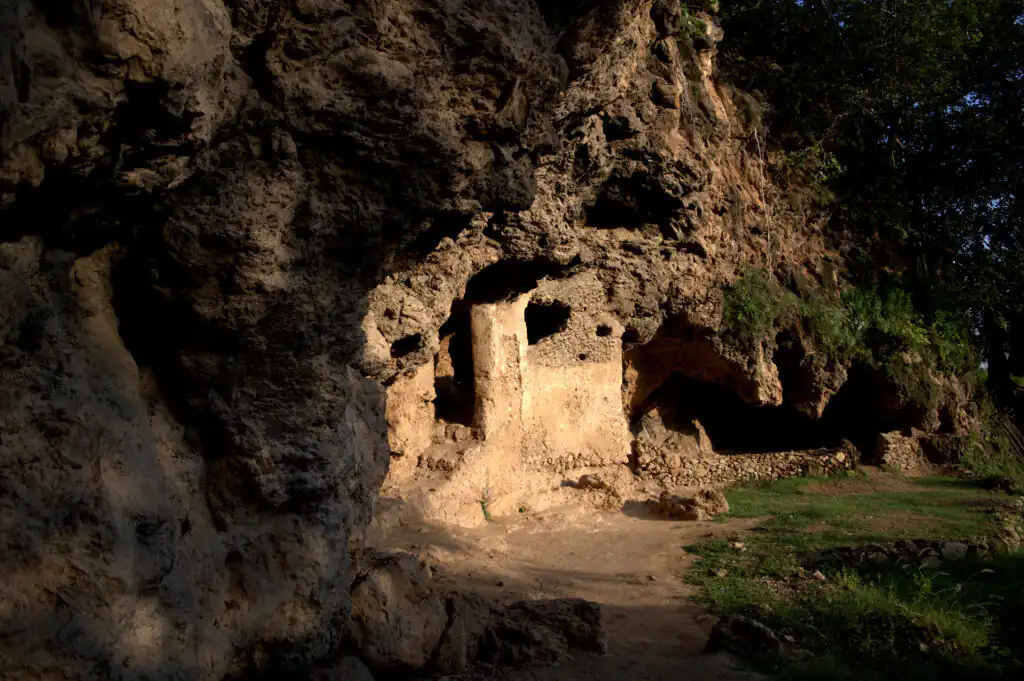
Below both structures lie the Shah Allah Ditta caves, which carry the deepest history of all: natural rock shelters used for thousands of years, later occupied by Buddhist monks, then Hindu sadhus, and finally Muslim mystics. Murals of Buddha from the Buddhist era, some 2,400 years old, appear on the cave walls. The caves are named after Hazrat Shah Allah Ditta, a Mughal-era dervish whose tomb and shrine stand nearby. Together, caves, baoli and mosque tell a continuous story of faith and travel spanning more than two millennia.
Top Things to Do in Baoli & Mosque
Descend the Steps of Losar Baoli
The baoli’s wide staircase leads down through arched openings to the cool water below — the classic stepwell experience. The dressed-brick masonry is worth a close look: fine, regular courses that have survived centuries of weather. The well is still functional, so you may see locals drawing water. Step carefully, as the old stone can be slippery, and do not throw anything into the water.
Explore the Old Mosque Ruins
A short distance from the baoli stand the broken walls of the mosque attributed to Shahab-ud-Din Ghori. There is no roof and no formal structure left, but the remaining walls and the plan of the building are easy to read. It is a contemplative spot — few visitors, old stone, and a view over the hills. Treat it as the heritage site it is: do not climb the walls or remove loose material.
Visit the Shah Allah Ditta Caves
At the base of the hill, the ancient caves are the essential companion stop. Two natural rock shelters hold 2,400-year-old Buddhist murals, and the site also includes centuries-old banyan trees and a natural spring with a pond. The caves have served Buddhists, Hindus and Muslims in turn, and the atmosphere — cool stone, old trees, running water — is genuinely atmospheric.
Photography and Nature Walks
The whole hillside is photogenic: the baoli’s geometry, the mosque’s ruined walls against the sky, the banyan canopy at the caves, and the waterfall that runs in wetter months. The surrounding Margalla forest is good for short nature walks and birdwatching. Early morning gives the best light and the fewest people.
Drive the Hill Road Toward Khanpur
The Kenthla–Haripur road continues past the baoli toward Kenthla village and on to Khanpur Dam, about 15 to 20 kilometres away. The drive itself is scenic — narrow, winding, with views back over Islamabad — and Khanpur’s water sports and lakeside resorts make a natural second half of the day.
Famous Places In and Around Baoli & Mosque
- Shah Allah Ditta Caves: 2,400-year-old Buddhist caves with murals, directly below the baoli.
- Tomb of Hazrat Shah Allah Ditta: shrine of the Mughal-era dervish the village is named after.
- Kenthla Village: a peaceful hill village on the road to Khanpur, with terraced fields and streams.
- Khanpur Dam: about 15–20 km onward; boating, jet skiing and cliff diving.
- Margalla Hills Trails: the capital’s famous hiking network, a short drive back toward the city.
How to Reach Baoli & Mosque
The site is about 14 kilometres northwest of central Islamabad, making it one of the easiest heritage outings in the country. The standard approach is to drive to Shah Allah Ditta town, which sits just west of Islamabad’s D-12 sector. From the caves at the base of the hill, take the metalled Kenthla–Haripur road up into the hills; the Losar Baoli is signposted near a road-construction landmark on this road, and the mosque ruins lie along the same ascent.
From Lahore, drive the M-2 to Islamabad (about 375 km, 4 to 5 hours) and then continue to Shah Allah Ditta — the whole journey is roughly 400 kilometres. From Karachi, fly to Islamabad and drive the last 30 to 45 minutes by car or ride-hailing. The nearest airport is Islamabad International Airport, about 40 minutes away by road.
The hill road is narrow but driveable in an ordinary car; bikers love it. Public transport will get you to Shah Allah Ditta village, but the climb to the baoli is best done in a private vehicle. There is no official parking lot — visitors park along the road near the site.
Route Details
- Islamabad (F-10/D-12) to Shah Allah Ditta: drive west past D-12 to the village (about 20–30 minutes from central Islamabad).
- Shah Allah Ditta to the caves: follow signs to the caves at the base of the Margalla Hills; visit the caves, spring and shrine first.
- Caves to Losar Baoli and mosque: take the Kenthla–Haripur road uphill; look for the baoli near the road landmark, with the mosque ruins on the same ascent.
- Onward option: continue the hill road via Kenthla to Khanpur Dam (15–20 km) for the afternoon.
Where to Stay in Baoli & Mosque
This is a day-trip destination — almost nobody needs to stay overnight at the site itself, and there are no hotels at the baoli. Islamabad offers the full range: luxury hotels in the Blue Area and around the Margalla Hills, mid-range hotels in F-6, F-7 and F-10, and budget guest houses across the sectors. For a countryside feel, a few farmhouse-style guest houses and resorts sit on the city’s western edge near the hills.
If you are combining the baoli with Khanpur Dam, the lakeside resorts and campsites at Khanpur offer overnight stays with water-sport packages. Book ahead on weekends, when both the dam and the Margalla picnic spots fill up.
Where to Eat: Local Foods of Baoli & Mosque
There are no restaurants at the baoli or mosque — plan accordingly. Small tea stalls and dhabas in Shah Allah Ditta village serve chai, parathas and snacks, and many visitors simply pack a picnic to eat among the trees. The caves area is a popular picnic spot for Islamabad families.
For a proper meal, drive back toward D-12 or into Islamabad’s sectors. The capital’s food scene needs no introduction: desi barbecue and karahi in Melody and Aabpara, the food streets and cafes of F-7 and F-10, and the upscale restaurants with Margalla views. A budget-friendly dhaba meal near the village costs very little; a mid-range restaurant meal in Islamabad sits in the usual city range. If you continue to Khanpur, the lakeside restaurants there serve fresh fried fish — a local favourite.
Weather in Baoli & Mosque
The site shares Islamabad’s climate, with the hills running a degree or two cooler than the city. Summers are hot, winters are mild and pleasant, and the monsoon brings heavy rain to the Margallas. Spring and autumn are the finest seasons for the visit.
| Season | Temperature Range | Conditions |
|---|---|---|
| Winter (Dec–Feb) | 5°C to 20°C | Cool, clear days; excellent for sightseeing and photography; chilly mornings on the hill |
| Spring (Mar–Apr) | 18°C to 30°C | Wildflowers in the hills; the best overall season; waterfall may be flowing |
| Summer (May–Jun) | 30°C to 40°C | Hot; visit early morning or late afternoon; carry water |
| Monsoon (Jul–Sep) | 28°C to 35°C | Heavy rain; hills turn lush green; roads can be slippery — drive carefully |
| Autumn (Oct–Nov) | 18°C to 30°C | Clear skies, comfortable temperatures; second-best season after spring |
Language and Culture of Baoli & Mosque
Urdu is the working language, with Punjabi and Potohari widely spoken in the surrounding villages. English is understood in Islamabad’s hotels and by many younger visitors. The culture of the site is layered: the caves are a spiritual place for locals, the shrine of Shah Allah Ditta is an active place of reverence, and the mosque ruins deserve the respect due to any old place of worship.
Dress modestly, particularly around the shrine and mosque — covered shoulders and knees are appropriate. Remove shoes if you enter any active prayer space near the shrine. Ask before photographing worshippers or local residents. Keep noise down at the caves, and carry out all litter; the forest here is part of the Margalla Hills National Park ecosystem and deserves care.
Shopping in Baoli & Mosque
There is no souvenir market at the site itself — a village tea stall is the extent of commerce. For shopping, Islamabad’s markets are minutes away: Jinnah Super and Kohsar Market for books and handicrafts, Aabpara and Melody for everyday bazaar shopping, and the weekly bazaars for fresh produce. The Lok Virsa heritage museum shop and the Saidpur Village craft stalls sell Pakistani handicrafts — pottery, embroidery, woodwork — that make better souvenirs than anything at a roadside stall. There is no mall at the site; the nearest large malls are in Islamabad’s sectors.
Travel Tips for Baoli & Mosque
Packing Essentials
Sturdy walking shoes with grip (the baoli steps and hillside paths can be slippery), a water bottle, sun protection, and a camera. In winter, a light jacket for the hill breeze. A small picnic kit if you plan to eat at the site.
Safety Tips
Visit in daylight hours only — the site has no lighting and the hill road is not advisable after dark. Stay back from the baoli’s inner steps when they are wet. Keep children close near the well. The area is generally peaceful, but as with any semi-rural spot, avoid isolated wandering alone at dusk.
Money & Connectivity
There is no entry fee and no ticket office — carry small cash for village tea stalls and parking tips. Mobile signals from all major networks work well since you are minutes from the capital. There are no restrooms at the baoli or mosque; the nearest facilities are back in the village or at Islamabad’s sector markets.
Best Time to Visit Baoli & Mosque
October to April — Heritage Season
Cooler months are ideal: clear air, comfortable walking temperatures, and the best light for photography. Winter mornings can be misty in the hills, which makes the old stonework look magnificent. This is also the most comfortable window for combining the site with the caves and a Khanpur drive.
March to June — Spring and Early Summer
Spring brings wildflowers and flowing water to the hills — arguably the prettiest time. By May and June it gets hot; shift your visit to early morning, and carry plenty of water.
July to September — Monsoon
The Margallas turn brilliantly green, but heavy rain makes the hill road slippery and the baoli steps treacherous. Visit only on dry days, and skip the trip during active downpours.
Final Thoughts
The Baoli & Mosque site is the kind of place that rewards curiosity. It has no ticket counter, no crowds and no gift shop — just a working stepwell, a ruined mosque and 2,400-year-old caves stacked on one hillside, twenty minutes from a modern capital. In a country full of grand monuments, there is something special about heritage this quiet.
Go in the morning, take the caves and the baoli together, and finish with lunch back in the city or a drive to Khanpur. If this Baoli & Mosque travel guide inspired your visit, you might also like our northern escapes like Malam Jabba or the Hunza Valley in our Explore Pakistan collection.
FAQs
Where are the Baoli and Mosque located?
The Losar Baoli and the old Ghori-era mosque are in the Margalla Hills near Shah Allah Ditta village, about 14 kilometres northwest of Islamabad, on the hill road above the ancient caves.
How old are the Baoli and the Mosque?
The baoli in its present dressed-brick form dates to the Sher Shah Suri period (mid-16th century), with older origins reaching back toward the Gandhara era. The mosque is attributed to Shahab-ud-Din Ghori (late 12th century).
How do I reach Losar Baoli from Islamabad?
Drive to Shah Allah Ditta (west of D-12, 20–30 minutes from central Islamabad), visit the caves, then take the Kenthla–Haripur road uphill to the baoli and mosque ruins.
Is there an entry fee?
No. The site is free and open; there is no ticket office or official opening hours. Visit during daylight.
What is the best time to visit?
October to April offers the most comfortable weather. Spring (March–April) is the prettiest, with wildflowers and flowing water in the hills.
Can families visit the Baoli and Mosque?
Yes, it is a short, easy outing suitable for families. Keep children supervised near the well steps, and note there are no restrooms at the site.
Where can I eat nearby?
Village tea stalls serve snacks, but plan a picnic or eat in Islamabad’s sectors (D-12, F-10, F-7) or at Khanpur Dam’s lakeside restaurants.
What else can I combine with this trip?
The Shah Allah Ditta caves and shrine (same hillside), Kenthla village, Khanpur Dam’s water sports (15–20 km onward), and the Margalla Hills trails.