This Gurdwara Sajjan Thag, Makhdoompur Pahoran travel guide takes you to one of the most moving Sikh shrines in southern Punjab — the inn of a notorious robber whose life was turned around by a single hymn of Guru Nanak. Whether you are a pilgrim tracing the Guru’s travels, a history lover hunting for forgotten heritage, or a traveller curious about the old Multan–Delhi road, this guide covers why the shrine deserves your visit, how to reach it from Lahore, Islamabad and Karachi, the best time to go, where to stay and eat, and what to expect when you arrive.
Quick Facts
- Location: Makhdoom Pur Pahoran town, Khanewal District, Punjab — on the old Multan–Delhi road, between Kabirwala and Khanewal, close to Tulamba
- Famous For: The spot where Guru Nanak met Sajjan Thag, a robber who ran a caravan inn and was reformed by the Guru’s shabad on hypocrisy
- Sikh Tradition: The Gurdwara is dedicated to the First Guru, Sri Guru Nanak Dev Ji; also known as Gurdwara Pehli Patshahi Makhdoom Pur Pahoran
- Nearest City: Khanewal, a short drive away; Kabirwala and Mian Channu are the nearest bus points
- Accessibility: Reachable by train via Khanewal railway station and by road via buses from Kabirwala or Mian Channu; the shrine stands inside the town
- Known Landmarks: The historic gurdwara building (now partly used as a public school), the old caravan-serai trail of the Multan–Delhi road, the khaddi and khaddar textile workshops of Makhdoom Pur Pahoran
- Best For: Sikh pilgrims, history travellers, students of religious heritage, photographers of old architecture, and explorers of southern Punjab
Why Visit Gurdwara Sajjan Thag, Makhdoompur Pahoran
There are gurdwaras built by kings, and there are gurdwaras raised by wealthy congregations. Then there is the Gurdwara Sajjan Thag at Makhdoompur Pahoran — a shrine whose story is one of the most human in all of Sikh history. This is the place where a robber’s inn became a house of worship. Sajjan ran what looked like an honest caravan serai near Tulamba, offering food and shelter to tired travellers on the Multan–Delhi road. Behind that welcome, though, lay a trap: he and his men robbed and killed the travellers they hosted. When Guru Nanak stayed at his inn during his travels from Pakpattan, Sajjan tried the same trick on him. The Guru simply sang. The shabad he composed there — “bronze is bright and shiny, but when it is rubbed, its blackness appears; washing it a hundred times will not remove its stain” — went straight to the robber’s conscience. Sajjan broke down, confessed everything, and gave up his life of crime. His inn of thieves became a gurdwara.
That is the heart of why this place is worth the journey. Most heritage sites impress you with stone and scale; this one moves you with a story. Standing in the walled compound where the robber’s rooms once stood, you can almost hear the hymn that changed a man’s heart. The shrine’s history reaches forward to the present day too — Sikh pilgrims from India, Australia, the United States and Europe continue to come here, as reported in recent years, drawn by the same devotion that built the place five centuries ago. Few places in southern Punjab carry this kind of living spiritual memory.
The town around the gurdwara makes the visit richer. Makhdoom Pur Pahoran is an ancient settlement on Sher Shah Suri’s famous Multan–Delhi road, the great artery that once carried armies, merchants and pilgrims between the Indus valley and the imperial cities of Hindustan. The town itself is known across Pakistan for its khaddi and khaddar — handwoven cloth, bedsheets and garments made on traditional looms. A visit here combines a deeply meaningful shrine with the everyday life of a working Punjabi market town, and that combination is exactly what makes it special: it is not a museum piece behind glass, but a living neighbourhood where history and ordinary life still share the same streets.
If you are building a heritage journey through Punjab — Nankana Sahib, Lahore, Pakpattan, Multan — this gurdwara fits naturally into the route. It is a half-day stop that will stay with you far longer than the time it takes. Pilgrims come for the Guru’s footsteps; travellers come for the story of the reformed robber; and everyone leaves with the same thought — that a single honest hymn can rebuild a human being. That is what this shrine is really about, and it is worth coming to feel it.
History of Gurdwara Sajjan Thag, Makhdoompur Pahoran
The history of this shrine begins in the early 1500s, during the first great journey (udasi) of Sri Guru Nanak Dev Ji. According to Sikh tradition, the Guru set out from Pakpattan and travelled toward Tulamba when he reached a spot where two men — Sajjan and Gajjan, uncle and nephew — had set up what looked like a travellers’ inn. In reality it was a trap: they welcomed merchants and wayfarers, and then robbed and murdered them. They tried the same on Guru Nanak, but the Guru saw through the hospitality. Here he composed one of his most famous shabads, the hymn beginning “Ujjal kaihan chilkana” — “Bronze is bright and shiny, but when it is rubbed, its blackness appears; washing it a hundred times will not wash away its impurity.” The words struck Sajjan with the force of a confession. He fell at the Guru’s feet, renounced his crimes, and his inn was converted into a gurdwara to commemorate the event. The shrine thus belongs to the Guru Nanak period — the very earliest layer of Sikh history in Punjab.
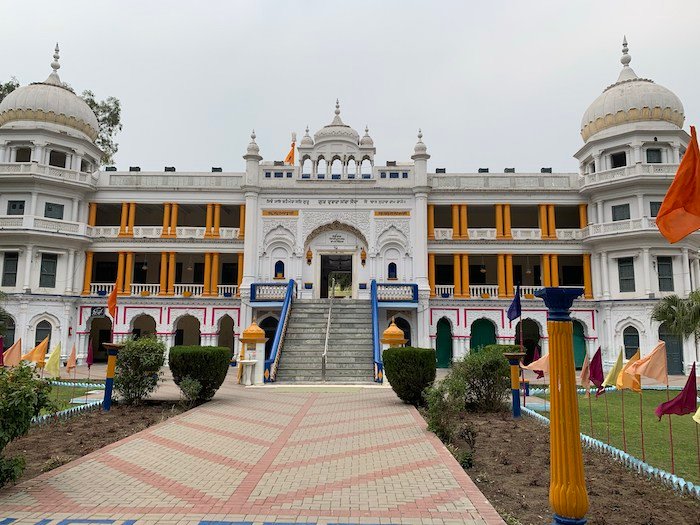
The shrine’s later history is tied to a remarkable figure, Bhai Jodh Singh, who is recorded as a disciple and army general of the sixth Guru, Sri Guru Hargobind Sahib Ji, and a resident of this village. His descendants went on to build the present gurdwara building in Samvat 1970 — which corresponds to 1913–14 CE. The old surveys describe a beautifully built complex: a boundary wall running around two ghumaon (a traditional measure of land) with the Gurusthan, the sanctum, at its centre. To the west stood a large tank that has since been filled in and levelled. Along the boundary wall were rooms for the sangat, the congregation, and the compound was planted with green trees, flowering creepers, roses and jasmine whose blossoms perfumed the whole enclosure. This was the classic form of a Punjabi gurdwara complex of the early 1900s — sanctuary, lodging for pilgrims, water for bathing, and gardens.
Partition in 1947 changed everything for the shrine, as it did for hundreds of Sikh religious sites across West Punjab. The Sikhs of Makhdoom Pur migrated to India, and the gurdwara passed into government care. Municipal records came to designate the building as a Government Higher Secondary School, though the Auqaf registers and the town’s old residents still call it the Gurdwara. The central pond was filled and levelled; the rooms once meant for the sangat became classrooms; the Gurusthan became the headmaster’s office. Yet the old dome survives — visitors in recent years have noted that the inner side of the dome and the upper parts of the walls escaped the whitewash brush and still show their original character, and despite the bustle of the school, the place keeps the peace of a place of worship.
The town itself has its own deep history. Makhdoom Pur Pahoran stands on the old Multan–Delhi road built by Sher Shah Suri, the 16th-century ruler whose highways knitted northern India together. Tulamba, a very short distance away, is one of the ancient towns of the region with roots stretching back to the earliest settlements of the Indus valley. Before 1947 the town’s population was a mix of Muslims, Hindus and Sikhs; after independence, refugee families from across the new border settled here. The town remains a working commercial centre with five main bazaars, a railway station, and its famous textile workshops — a place where the past is not preserved behind ropes but woven into the present.
Top Things to Do in Gurdwara Sajjan Thag, Makhdoompur Pahoran
Visit the historic gurdwara building
The shrine is the reason for the journey. The walled compound still holds the historic structure with its dome, and the building’s bones — the Gurusthan at the centre, the rooms along the boundary that once lodged pilgrims — tell the story of Sajjan’s reformed inn without a single plaque. Walk the boundary, look up at the dome, and read the shabad of Sajjan Thag to yourself; the place becomes far more vivid when you know the hymn it commemorates. Because the building now also serves as a school, visit outside school hours and ask permission respectfully before entering — the staff are accustomed to heritage visitors and pilgrims.
Trace Guru Nanak’s route through the region
Makhdoom Pur Pahoran sits on the old route of Guru Nanak’s travels between Pakpattan and Tulamba, and the countryside around still runs with the same canals and canal colonies the Guru’s companions would have crossed. Heritage travellers often combine this shrine with Pakpattan (the shrine of Baba Farid, where the Guru’s journey through this region began) and Tulamba nearby. If you are mapping the Guru’s Punjabi udasi, this stop is one of the most story-rich on the trail.
Walk the bazaars and khaddi workshops
The town’s five bazaars are the living part of the visit. Makhdoom Pur Pahoran’s speciality is khaddi and khaddar — handwoven cloth, bedsheets and garments — and the workshops and looms are a working attraction in themselves. Watch a weaver at his loom, buy a length of khaddar straight from the source, and you will carry home something genuinely made in the town whose shrine you came to see.
Explore Tulamba and the old Multan–Delhi road
A very short distance from the town lies Tulamba, one of the oldest towns in the region, standing on the ancient Multan–Delhi highway of Sher Shah Suri. The stretch of the old road here is layered with centuries of travel history — armies, caravans, pilgrims and robbers like Sajjan all passed along it. It is a rewarding detour for anyone interested in how this part of Punjab became a crossroads.
Photograph the old architecture
The gurdwara’s dome, the surviving upper walls, the old trees and the lanes of the surrounding town are beautiful in the low light of winter mornings. The carved wooden doors and the whitewashed courtyards of the mohalla around the shrine make fine subjects. Ask before photographing people or school premises — courtesy goes a long way here.
Famous Places In and Around Gurdwara Sajjan Thag, Makhdoompur Pahoran
- Tulamba — ancient neighbouring town on the old Multan–Delhi road, minutes away.
- Kabirwala — historic town on the Ravi, known for its old bazaars and the shrine of Khalid Walid.
- Khanewal — district headquarters and railway junction, the main transit point for the visit.
- Pakpattan — the shrine of Baba Fariduddin Ganjshakar, starting point of the Guru’s regional journey.
- Multan — the city of saints, about an hour and a half away, with its forts, shrines and blue pottery.
How to Reach Gurdwara Sajjan Thag, Makhdoompur Pahoran
The shrine lies inside Makhdoom Pur Pahoran town, on the old Multan–Delhi road between Kabirwala and Khanewal. The town sits close to the national highway network of southern Punjab, so reaching it is straightforward from any major city. The nearest railway station is Khanewal Junction, one of the busiest junctions in Punjab, and the nearest bus points are Kabirwala and Mian Channu.
Route Details
- From Lahore: Take the N-5 (Grand Trunk Road) south via Okara, Sahiwal and Chichawatni, then continue toward Khanewal — roughly 260 km, about 4 to 5 hours by car. From Khanewal, local roads lead the short distance to Makhdoom Pur Pahoran. Alternatively, take the motorway M-3/M-4 corridor toward Abdul Hakim and approach via Khanewal.
- From Islamabad: Take the M-2 south to Lahore and continue on the N-5, or use the motorway network toward Multan (M-4) and exit for Khanewal — roughly 600 km, a full day’s drive of 8 to 9 hours. Most travellers break the journey at Lahore or Multan.
- From Karachi: Travel north on the N-5 via Hyderabad, Sukkur and Rahim Yar Khan to Multan, then onward to Khanewal — roughly 900 to 950 km, best done as an overnight journey by train to Khanewal or Multan, then by road. Direct trains on the Karachi–Peshawar main line stop at Khanewal Junction.
- From Multan: Take the N-5 north toward Khanewal — around 90 km, about 1.5 hours by car.
- Local approach: From Khanewal, buses and vans run toward Kabirwala and Mian Channu; ask for Makhdoom Pur Pahoran, which lies between Kabirwala and Khanewal near Tulamba. From Khanewal railway station you can also get a train service on the local line.
Nearest airport: Multan International Airport, around 100 km away, with domestic flights from Karachi, Lahore and Islamabad. Road conditions: The N-5 and motorways are all-weather. The town’s streets are paved; the shrine is inside the town so no off-road travel is needed. Summer afternoons in this hot belt can be punishing, so travel early in the day. Transport options: Own car or hired car is the most flexible; Daewoo and other bus services run the main corridors; trains serve Khanewal Junction well from all directions.
Where to Stay in Gurdwara Sajjan Thag, Makhdoompur Pahoran
Makhdoom Pur Pahoran is a small working town, so treat it as a day visit and base yourself in a bigger city nearby — that is how almost all heritage travellers do it. The town has simple local guesthouses and small hotels of the kind found in every Punjabi market town; they are basic but adequate for a night if you arrive late. Do not expect named luxury properties in the town itself.
Mid-range: Khanewal city has a spread of mid-range hotels near the railway station and the main bazaar — clean rooms with air-conditioning and attached baths, the standard for district towns in Punjab. Multan, about an hour and a half away, offers a much wider mid-range and upper mid-range selection if you prefer a comfortable base with restaurants and shopping.
Budget: Simple lodges and dharamshala-style rooms are available in the smaller towns; Khanewal’s budget hotels cluster around the station. For pilgrim groups, the practical approach is a day trip from Multan or Khanewal, returning the same evening.
Camping: Not needed and not practical for this visit — the shrine is inside a town, and the flat canal-irrigated plains around it offer no camping grounds of interest. Base yourself in town accommodation instead.
Where to Eat: Local Foods of Gurdwara Sajjan Thag, Makhdoompur Pahoran
You are in the heart of southern Punjab, and the food shows it. The regional table is Punjabi through and through: fresh tandoori roti, makhan (white butter) and desi ghee, sarson ka saag in winter with makki ki roti, dal makhani, and slow-cooked desi chicken. The town’s dhabas and small restaurants serve the standard Punjabi menu — daal, sabzi, kebabs and karahi — at budget-friendly prices, the kind of honest roadside food that has fed travellers on this route for centuries.
Being close to Multan, the region’s sweet traditions reach here too: Sohan halwa, Multan’s famous dense sweet, is sold in the bazaars, and jalebi with doodh (milk) is the classic morning pairing. In summer, lassi and sugarcane juice from street vendors are the essential coolers — and you will want them, because Khanewal district sits in the hot belt. Meal costs are modest: a full dhaba meal is genuinely budget-friendly, and even a comfortable restaurant dinner in Khanewal or Multan stays easy on the wallet by Pakistani city standards.
Weather in Gurdwara Sajjan Thag, Makhdoompur Pahoran
Makhdoom Pur Pahoran lies in the hot southern plains of Punjab, in the same climate belt as Multan, where summer afternoons are famously fierce. Plan the visit for the cool months and travel early in the day whenever you are here.
| Season | Temperature Range | Conditions |
|---|---|---|
| Winter (Dec–Feb) | 5–20°C | Cool, pleasant days; cold mornings with occasional fog. The best season to visit. |
| Spring (Mar–Apr) | 20–36°C | Warming up quickly; mornings still comfortable, afternoons hot by late April. |
| Summer (May–Jul) | 30–46°C | Very hot; Multan-region afternoons average around 41°C in June. Avoid midday outings. |
| Autumn (Sep–Nov) | 22–38°C | Heat eases from late October; November is pleasant and a good visiting month. |
Language and Culture of Gurdwara Sajjan Thag, Makhdoompur Pahoran
The town speaks the Jhangvi dialect of Punjabi alongside Urdu, and you will hear both in the bazaars. The population is predominantly Muslim, with mosques in every mohalla, and the town’s old families carry memories of the pre-partition days when Sikhs and Hindus lived alongside them. That shared history shows in the way locals still speak of the gurdwara with respect — the shrine is part of the town’s own story, whatever the faith of the speaker.
Visitors to the shrine should dress modestly and cover their heads inside the gurdwara building, as is customary at Sikh shrines; remove your shoes before entering. Because the building currently serves as a school, visit quietly, keep to the historic parts of the compound, and ask the staff’s permission before walking through. Punjabi hospitality here is warm and direct — accept the offer of chai, greet elders with “Assalam-o-Alaikum,” and you will be welcomed like a guest rather than a tourist.
Shopping in Gurdwara Sajjan Thag, Makhdoompur Pahoran
Shopping here is about one thing done well: cloth. Makhdoom Pur Pahoran’s speciality is khaddi and khaddar — handwoven cotton fabric — along with bedsheets and ready-made garments, and the town’s five main bazaars are full of it. Buy khaddar suiting or bedsheets straight from the town’s own workshops; the quality is genuine and the prices are far below what the same fabric costs in Lahore’s markets. There are no shopping malls here — and that is the point. The bazaars are traditional: fabric merchants, sweet shops, crockery and household goods, the everyday commerce of a Punjabi market town. For wider shopping, Khanewal and Multan are the regional centres.
Travel Tips for Gurdwara Sajjan Thag, Makhdoompur Pahoran
Packing Essentials
Carry a head covering (a simple scarf or rumal) for the shrine, comfortable walking shoes, sunscreen and a water bottle. In winter bring a light jacket for cold mornings; in summer bring a hat and plan shrine visits for early morning. A copy of the Sajjan Thag shabad on your phone adds meaning to the visit.
Safety Tips
The town is a settled, peaceful market town and heritage visitors are treated warmly. Travel in daylight on the rural approaches, keep valuables out of sight as you would anywhere, and respect the school premises — avoid visiting during class hours if possible. Women travellers will find the bazaars comfortable during the day; modest dress is the norm.
Money & Connectivity
Carry cash — small-town shops and dhabas run on cash, and while Khanewal has ATMs, the town’s own banking options are limited. Mobile signals from all major networks work in the town; data coverage is adequate for maps and messaging.
Best Time to Visit Gurdwara Sajjan Thag, Makhdoompur Pahoran
Winter (November to February) — the ideal season
This is the season to come. Cool, dry days around 15–20°C, clear light for photography, and the town’s bazaars at their liveliest. The shrine’s compound and gardens are at their greenest in late winter, and the walk around the old town is a pleasure rather than an ordeal.
Spring (March to April) — still good, go early
March mornings are pleasant, and the wheat fields around the town turn golden — the classic Punjab spring. By late April the heat builds, so start your day at the shrine early and retreat to shade by afternoon.
Summer (May to August) — visit only if you must
Summer here is genuinely severe, with afternoons pushing past 40°C. If you must travel in summer, do the shrine at dawn, carry water, and plan to be indoors by 11 a.m. The monsoon brings some relief but also humidity.
Autumn (September to October) — improving fast
October onward the heat breaks and the town becomes comfortable again. Late autumn is a fine shoulder season with fewer travellers and soft light on the old buildings.
Final Thoughts
The Gurdwara Sajjan Thag at Makhdoompur Pahoran is not the grandest shrine in Punjab, and it does not try to be. Its power is in its story: a robber’s inn, a single hymn, a changed heart — and five centuries later, pilgrims from three continents still coming to stand where it happened. In a region full of grand forts and marble tombs, this quiet walled compound offers something rarer: a place that asks you to think about who you are and who you might become. That is a lot to get from a half-day stop in a small Punjabi town.
Come in winter, walk the boundary of the old compound, read the shabad of the bronze that shines but hides its blackness, buy a length of the town’s khaddar from the bazaar, and eat a simple dhaba meal before you leave. You will have touched one of the most human stories in Sikh history, in the very place where it unfolded. For heritage travellers mapping Guru Nanak’s Punjab, this is not an optional stop — it is one of the essential ones. Explore more of Punjab’s sacred heritage through our Explore Pakistan guides.
FAQs
Where is Gurdwara Sajjan Thag located?
It stands in Makhdoom Pur Pahoran town, Khanewal District, southern Punjab, on the old Multan–Delhi road between Kabirwala and Khanewal, near Tulamba.
What is the story of Sajjan Thag?
Sajjan ran a travellers’ inn that was secretly a robbers’ trap. When Guru Nanak stayed there, he composed the shabad “bronze is bright and shiny, but when rubbed its blackness appears,” which reformed Sajjan; his inn became a gurdwara.
What is the best time to visit?
November to February, when the weather is cool and dry. Summer afternoons in this region average around 41°C and should be avoided.
How do I reach Makhdoom Pur Pahoran?
Travel to Khanewal by train or road (about 260 km / 4–5 hours from Lahore), then take a local bus or van from Kabirwala or Mian Channu toward the town, which lies between Kabirwala and Khanewal.
Is the gurdwara still an active shrine?
The historic building is partly used as a public school today, but it remains a revered site: Sikh pilgrims from Pakistan and abroad continue to visit to pay homage.
Is it suitable for families?
Yes. The shrine is inside a town with paved roads, and the visit is a gentle half-day heritage stop. Combine it with a bazaar walk for a full family outing.
Where can I stay nearby?
Base yourself in Khanewal for simple mid-range hotels, or in Multan (about 1.5 hours away) for a wider choice of comfortable hotels.
What local food should I try?
Southern Punjabi staples — tandoori roti with makhan, sarson ka saag in winter, and Multan-style Sohan halwa from the bazaars, all at budget-friendly dhaba prices.
What makes this gurdwara unique among Sikh shrines?
It commemorates not a battle or a birth but a moral transformation — the reform of a robber by a single hymn of Guru Nanak — making it one of the most story-driven shrines in Punjab. See also the Gurdwara Nanaksar Pakpattan travel guide for another shrine on Guru Nanak’s regional route.