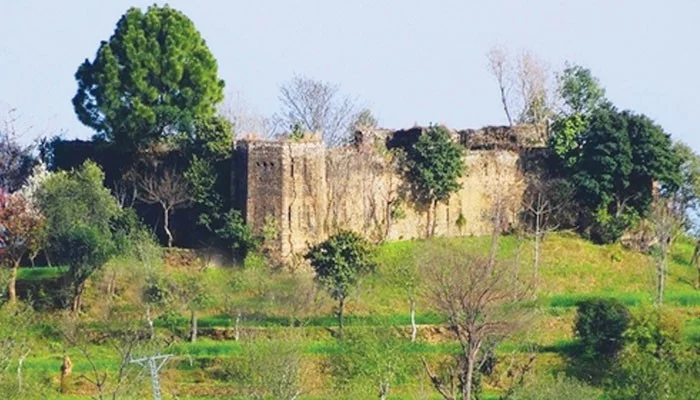
On a low rocky hill above the village of Baral, a short drive south of Palandri, stands one of Azad Kashmir’s most atmospheric ruins: a square 19th-century fort with octagonal corner towers, built to hold a kingdom’s frontier. This Baral Fort, Palandri travel guide covers the fort’s real history, what to see in its courtyard and cells, the best time to visit, how to reach it from Islamabad, Lahore and Karachi, and the nearby places that turn the trip into a full day in Sudhnoti District.
Quick Facts
- Location: Baral village, Sudhnoti District, Azad Jammu and Kashmir
- Altitude: hilltop position above the surrounding valley (Palandri sits around 1,300–1,400 metres)
- Famous For: a square Dogra-era fort (1837–39) with octagonal corner towers and a central sandstone water tank
- Nearest City: Palandri, about 19–20 km to the north (roughly 50 minutes by road)
- Accessibility: off the Kotli–Palandri road; scenic winding tarmac road from Palandri
- Known Landmarks: the fort’s cusped-arch entrance, central water tank, rows of cells; nearby Rani Baoli
- Best For: history lovers, photographers, heritage travellers, day-trippers from Rawalakot or Islamabad
Why Visit Baral Fort, Palandri
Baral Fort is not a polished monument — and that is exactly its appeal. There is no ticket office, no crowd, and usually no other visitor at all. What there is: a compact square fortress on a low eminence, its walls still rising some 18 metres, its four octagonal towers intact, and hills running away on every side. You walk through a cusped arch, cross a partly ruined domed chamber, and emerge into a courtyard centred on a dressed-sandstone water tank, with rows of small cells along the walls. It is history you can touch, in complete quiet.
The fort also rewards the architecturally curious. Its square plan with octagonal corner turrets follows the same template as the forts of Muzaffarabad, Ramkot, Baghsar and Mangla — a design tradition favoured in Kashmir across centuries. Standing in the courtyard, you are looking at a building language that connects Baral to the great fortress sites of the region, in miniature.
Finally, the journey is part of the visit. The road from Palandri winds through green hills and small settlements, and the district around it holds a string of smaller heritage sites — Rani Baoli, old temples, colonial-era buildings — that make Baral the centrepiece of a full heritage day. For travellers collecting the lesser-known forts of Pakistan, this one belongs on the list. See more heritage destinations in our Explore Pakistan section.
History of Baral Fort, Palandri
The documented history of Baral Fort begins in the late 1830s. The fort was built between 1837 and 1839 by Maharaja Gulab Singh — the Dogra ruler who would shortly afterwards become the first Maharaja of Jammu and Kashmir under the Treaty of Amritsar (1846) — to strengthen Dogra control over the Sudhnoti area around Palandri (then often spelled Plundry). It was a frontier garrison: a compact stronghold from which a small force could hold the surrounding country for the Dogra government.
Local historical debate adds a second thread. Some historians have claimed an older origin, suggesting the fort — or an earlier structure on the same commanding hill — was built by the Ghakars in the 17th century. The Ghakars were the powerful Potohar tribe who dominated this region before the rise of Sikh and Dogra power, and their association with hill forts across the area is well established. The truth may combine both stories: an older site refortified and rebuilt in its present form by Gulab Singh’s engineers. What is certain is the 1837–39 construction in its current square-and-towers form, and its protection today under the AJK Antiquities Act of 1986.
The fort’s later history is humble and very Kashmiri. After the partition of 1947, the building was repurposed as a middle school, serving village children from 1947 until 1957 — a decade in which lessons echoed where soldiers had once stood watch. The upper storey, with its wooden pillars and wooden gate, has since collapsed, leaving the stone shell visitors see today. There is no inscription on the building, so its stones tell the story themselves: firing slits in high walls, a domed entrance chamber, the central tank that made a siege survivable.
The wider district carries its own history. Palandri’s Chinjal Hill was the first capital of Azad Kashmir after 1947, and the town later became the headquarters of Sudhnoti District. The area saw heavy engagement during the 1947–48 conflict, and its landscape of forts, baolis and temples reflects centuries as a contested frontier between the Punjab plains and the Kashmir valley.
Top Things to Do in Baral Fort, Palandri
Walk the Courtyard and the Cells
Enter through the cusped arch on the south side, pass through the partly ruined domed chamber, and step into the main courtyard. Rows of small cells line the walls — the garrison’s living quarters and stores. Walking their length gives the clearest sense of the fort’s compact, efficient military design: everything a frontier post needed, fitted into a square of about 40 to 50 square metres.
Study the Octagonal Towers
Each corner of the square carries an octagonal watchtower — the fort’s most distinctive feature. Climb the hill around the exterior to see how the towers command every approach, and look for the firing slits pierced through the walls, still sharp after nearly two centuries. Photographers should circle the fort for the classic four-towers composition.
See the Central Water Tank
The dressed-sandstone water tank in the middle of the courtyard is a highlight in itself: finely cut stone, still holding the logic of a garrison that had to survive a siege. It is a reminder that in hill warfare, water engineering mattered as much as walls.
Admire the Entrance Arch
The cusped arch of the south entrance, leading through the domed chamber, is the fort’s finest surviving architectural detail — an Indo-Islamic touch on a military building. Look closely at the stonework around the arch before you pass through.
Take in the Valley Views
From the hillock, the hills run away on every side, with views toward the Khuiratta valley. The panorama is at its best in the clear months of autumn and spring. Bring a wide-angle lens; the combination of old stone in the foreground and layered ridges behind is superb.
Famous Places In and Around Baral Fort, Palandri
- Rani Baoli (near Palandri): a fine old stepwell a few kilometres outside Palandri town — combine it with the fort as the guidebooks suggest.
- Rani ki Bavlee & DC House (Rani ka Bangla), Palandri: historic buildings in Palandri town itself.
- Ouri Baral Tourist Point: a scenic viewpoint area near Baral, known for dense forest and views.
- Gora Dewan: a picturesque spot near Palandri, good for photography and a relaxed stop.
- Islampura Mandir: an old Hindu temple in Islampura village — a reminder of the district’s mixed religious heritage before 1947.
- Trar Khel: a peaceful mountain town in Sudhnoti with waterfalls (including Grattapaar) and the Mohi-ud-Din Islamic University.
How to Reach Baral Fort, Palandri
Baral Fort stands in Baral village, about 19 to 20 kilometres south of Palandri, off the Kotli–Palandri road. A scenic, winding tarmac road connects Palandri with Baral in roughly 50 minutes; from the village houses, the fort sits about 20 minutes further south on its low hill. Allow about an hour at the site itself.
From Islamabad or Rawalpindi, Palandri is roughly 100 to 120 kilometres via the Kotli road (through Sihala), a drive of about 3 to 4 hours. The road is paved and suitable for ordinary cars. From Lahore, the journey runs about 480 to 500 kilometres via the M-2 to Islamabad and then the Kotli road — roughly 8 to 9 hours with breaks, so an overnight stop in Islamabad or Rawalakot is sensible. From Karachi, fly to Islamabad and drive; the overland distance exceeds 1,500 kilometres.
The nearest airport is Islamabad International Airport. From there, hire a private car or book a tour van to Palandri; public coaches and vans run from Rawalpindi to Palandri, and from Palandri town a local taxi or Suzuki can be hired for the Baral trip. The final approach to the fort is on foot up the hillock — an easy ten-minute walk.
Route Details
- Islamabad/Rawalpindi to Palandri: take the Kotli road via Sihala; follow signs for Palandri (about 100–120 km, 3–4 hours).
- Palandri to Baral village: head south on the winding tarmac road toward Baral (about 19–20 km, roughly 50 minutes).
- Baral village to the fort: continue about 20 minutes south of the village houses; the fort stands on a low eminence — walk up the hillock (about 10 minutes).
- Day-trip option: combine the fort with Rani Baoli near Palandri town and return via the same road.
Where to Stay in Baral Fort, Palandri
There is no accommodation at the fort — it is a day-visit ruin. Palandri town has the nearest options: modest hotels and guest houses in the bazaar area, plus the government PWD rest house on the hilltop above town, which is also the recognised viewpoint for Palandri’s famous ridge views. Book the rest house in advance through the usual government channels if you want it.
For more choice, Rawalakot — about an hour and a half to two hours north — has hotels at every level and makes a good base for a two-day Sudhnoti–Poonch circuit covering Baral Fort, Toli Pir and Banjosa Lake. Many visitors do Baral as a long day trip from Islamabad, leaving early and returning by evening. Camping is possible in the surrounding hills for the well-equipped, but there are no organised campsites at the fort itself.
Where to Eat: Local Foods of Baral Fort, Palandri
Eat in Palandri town, not at the fort — there are no eateries at the ruin, so carry water and snacks for the visit. Palandri’s bazaar has dhabas and small restaurants serving the standard Pahari-Punjabi repertoire: daal, sabzi, chicken karahi, grilled meats, fresh tandoori roti and, of course, chai.
The regional drink to try is Kashmiri chai (noon chai), the pink salted tea of Azad Kashmir, alongside kehwa. Travellers passing through the district also encounter desi ghee-based village cooking — simple, hearty and filling. A dhaba meal in Palandri is budget-friendly; there is nothing resembling fine dining in the town, and that is part of its honesty. For a sweet stop, the bakeries in Palandri bazaar sell fresh rusks, biscuits and cakes.
Weather in Baral Fort, Palandri
Palandri sits at moderate hill altitude, so its climate is milder than the high valleys but distinctly seasonal. Summers are warm, winters are cool with cold nights, the monsoon brings heavy rain, and autumn is the clearest, most pleasant season. The fort’s exposed hilltop can be windy — carry a layer even on warm days.
| Season | Temperature Range | Conditions |
|---|---|---|
| Winter (Dec–Feb) | 2°C to 14°C | Cool days, cold nights; occasional frost; clear views on calm days |
| Spring (Mar–Apr) | 12°C to 24°C | Hills turn green; wildflowers; excellent for the fort and viewpoints |
| Summer (May–Jun) | 24°C to 33°C | Warm; visit the fort in the morning or late afternoon; carry water |
| Monsoon (Jul–Sep) | 22°C to 30°C | Heavy rain; lush scenery; hill roads can be slippery — drive carefully |
| Autumn (Oct–Nov) | 12°C to 26°C | Clear skies and crisp air; the best season for photography |
Language and Culture of Baral Fort, Palandri
The language of Sudhnoti District is Pahari/Pothwari, spoken in homes and bazaars, with Urdu universally understood. This is Sudhan country — the Sudhan tribe, known for its martial tradition and central role in the region’s 20th-century history, forms the backbone of local society. English is understood in hotels and rest houses.
The culture is conservative, hospitable and deeply rooted. Guests are welcomed warmly, and village elders are treated with visible respect. Visitors should dress modestly, ask before photographing people, and treat the fort as the protected heritage site it is — the AJK Antiquities Act protects it, so do not scratch walls, climb the towers, or remove stones. Friday is the weekly holiday rhythm here as across Azad Kashmir; plan around it if you need services.
Shopping in Baral Fort, Palandri
There are no shops at the fort; shopping happens in Palandri’s bazaar. Expect everyday bazaar goods — clothing, household items, fresh produce — plus regional specialities such as walnuts, honey and woollen shawls at fair prices. The bazaar is lively and very local in character, which is its charm. There are no shopping malls in Palandri or anywhere near Baral; the nearest modern retail is back in Rawalpindi/Islamabad. Bargaining is normal and good-natured.
Travel Tips for Baral Fort, Palandri
Packing Essentials
Sturdy walking shoes for the hillock climb, sun protection, a water bottle and snacks (nothing is sold at the fort), a camera with a wide-angle lens, and a light jacket — the hilltop is windier than the valley. In winter, add warm layers for the exposed site.
Safety Tips
The fort is a ruin: watch your footing on uneven stone, keep children away from wall edges and the old cells’ darker corners, and do not climb the towers or walls — the masonry is old and protected by law. Visit in daylight; the site has no lighting. The area is considered safe for visitors, and locals are helpful if you need directions.
Money & Connectivity
Carry cash — Palandri has banks and some ATMs, but card acceptance is limited and there is nothing to buy at the fort itself. Mobile signals from the major networks work in Palandri town and along the main road; coverage at the fort itself can be patchy. Download offline maps before leaving Palandri.
Best Time to Visit Baral Fort, Palandri
October to April — Heritage Season
The recommended window. Cooler temperatures make climbing the hillock and exploring the courtyard comfortable, the air is clear for the valley views, and the light is superb for photography. Autumn (October–November) is the single best period.
March to June — Spring and Early Summer
Spring brings green hills and wildflowers — beautiful, though warming up by May. Shift fort visits to morning or late afternoon in the hotter weeks, and combine with the greener viewpoints like Gora Dewan.
July to September — Monsoon
The landscape is at its lushest, but heavy rain makes the hillock slippery and the winding road demands care. Visit between showers if you come now, and wear shoes with grip.
Final Thoughts
Baral Fort will never be a headline attraction, and it is better for it. In an hour on its hilltop you get a 19th-century frontier fortress, a masterclass in compact military architecture, and a panorama of the Sudhnoti hills — usually entirely to yourself. It is the kind of place that makes a trip feel like discovery rather than tourism.
Pair it with Rani Baoli and the Palandri viewpoints for a full day, or fold it into a longer Azad Kashmir circuit with Rawalakot and Banjosa. If this Baral Fort, Palandri travel guide helped you plan, continue exploring with our Malam Jabba guide and the Explore Pakistan collection.
FAQs
Where is Baral Fort located?
Baral Fort stands in Baral village, Sudhnoti District, Azad Jammu and Kashmir — about 19–20 kilometres south of Palandri, off the Kotli–Palandri road.
Who built Baral Fort and when?
It was built between 1837 and 1839 by Maharaja Gulab Singh to strengthen Dogra control over the area. Some historians suggest an earlier Ghakar origin in the 17th century. It is protected under the AJK Antiquities Act of 1986.
How do I reach Baral Fort from Islamabad?
Drive about 100–120 km via the Kotli road to Palandri (3–4 hours), then 50 minutes south to Baral village; the fort is a 10-minute walk up the hillock from the road.
What is the best time to visit Baral Fort?
October to April is the recommended window — cool, clear and comfortable. October–November offers the best light for photography.
Is there an entry fee for Baral Fort?
No. There is no ticket office and no formal entry fee; allow about an hour for the visit.
Is Baral Fort safe to visit?
Yes, the area is considered safe and welcoming. Take care on the old stonework, do not climb the walls, and visit in daylight.
What can I combine with a Baral Fort trip?
Rani Baoli near Palandri, the PWD rest-house viewpoint above town, Gora Dewan, Islampura Mandir, Ouri Baral Tourist Point, and Trar Khel’s waterfalls.
Where should I stay when visiting Baral Fort?
Stay in Palandri town (hotels, guest houses and the PWD rest house), base yourself in Rawalakot for a wider choice, or do it as a long day trip from Islamabad.