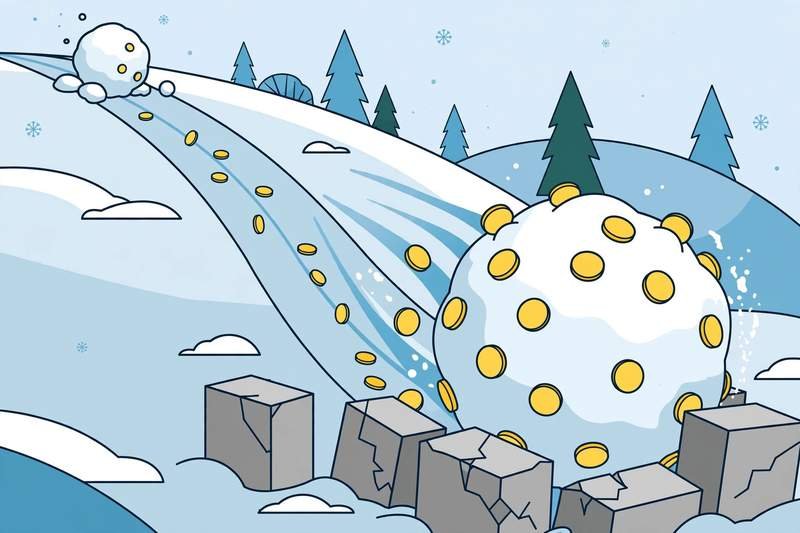
Imagine making your final debt payment just three years from now. No more minimum payments eating your paycheck. No more balances growing faster than you can shrink them. A debt snowball calculator can show you exactly how to get there.
The debt snowball method is one of the most popular payoff strategies in personal finance. It works by targeting your smallest debt first while you pay minimums on the rest. Each paid-off balance frees up more money for the next debt. Your payments snowball, and your momentum builds.
In this guide, you will learn how the method works step by step. You will see how to use a debt snowball calculator, follow a complete worked example with four real debts, and compare the snowball against the avalanche method. By the end, you will have a clear plan to become debt-free faster.
What Is the Debt Snowball Method?
The debt snowball method orders your debts from the smallest balance to the largest. You pay the minimum on every debt. Then you throw all extra money at the smallest one. When it is gone, you roll its entire payment into the next smallest debt.
For example, suppose you owe $600, $2,800, $6,500, and $11,000. You attack the $600 debt first, even if it has the lowest interest rate. Once it disappears, you move to the $2,800 debt with a bigger combined payment. The process repeats until every balance hits zero.
The method works because of psychology. Quick wins keep you motivated. Research on goal achievement shows that early progress builds confidence. Therefore, many people stick with the snowball longer than with strategies that promise wins years away.
How Does a Debt Snowball Calculator Work?
A debt snowball calculator turns your list of debts into a month-by-month payoff plan. You enter your numbers, and it shows your payoff order, your debt-free date, and your total interest cost. It removes all the guesswork.
What Information Do You Enter?
Most calculators ask for the same four details per debt. First, the current balance. Second, the annual interest rate (APR). Third, the minimum monthly payment. Fourth, the name of the debt, so you can track it.
You also enter one extra number: how much additional money you can pay each month. This is your snowball payment. Even $100 extra per month can cut years off your payoff timeline. Be realistic here. Choose an amount you can sustain every single month.
What Does the Calculator Show You?
The calculator sorts your debts from smallest to largest balance. Then it simulates your payoff month by month. It shows when each debt disappears and how your payment grows as debts drop off.
In addition, it calculates your debt-free date and total interest paid. Some calculators also show a chart of your shrinking balances. Seeing that downward slope keeps motivation high during the long middle months.
Getting Your Numbers Right Before You Calculate
A calculator is only as good as the numbers you feed it. Spend twenty minutes gathering accurate figures first. Your plan will be far more reliable.
Start with current balances, not original loan amounts. Log in to each account or check your latest statement. Balances change every month, so use this month’s figures.
Next, confirm each interest rate. Credit card APRs sit in the fine print of your statement or online account. For example, a card might charge 24.99% on purchases but a different rate on cash advances. Use the purchase APR for the balance you actually carry.
Then list the true minimum payment for each debt. Minimums shift as balances fall, but today’s number is a fine starting point. In addition, note which debts have fixed payments, like auto loans, and which have variable minimums, like credit cards.
Finally, decide your extra payment honestly. Review last month’s spending and find money you can redirect each month. A smaller amount you sustain beats a larger amount you abandon after two months. You can always raise it later when you get a raise or cut an expense.
One more tip: decide how to handle windfalls now. Tax refunds, bonuses, and cash gifts can supercharge your snowball. Plan in advance to send at least half of any windfall to your current target debt. Deciding now removes temptation later.
With clean inputs, your debt snowball calculator gives you a payoff date you can trust. Update the numbers every few months. As a result, your plan stays accurate all the way to debt freedom.
Debt Snowball Calculator: A Complete Worked Example
Let us walk through a full example. Meet a borrower with four debts and $200 extra to pay each month. We will apply the snowball method and track every phase.
The Four Debts
Here is the starting point, ordered smallest to largest as the snowball requires:
- Medical bill: $600 balance, 0% APR, $25 minimum payment
- Credit card: $2,800 balance, 24.99% APR, $60 minimum payment
- Personal loan: $6,500 balance, 11.5% APR, $150 minimum payment
- Auto loan: $11,000 balance, 7.2% APR, $220 minimum payment
Total debt is $20,900. Total minimum payments are $455 per month. With the extra $200, the monthly debt budget is $655. This example uses simplified math for illustration.
Phase 1: Crush the Medical Bill (Months 1–3)
The medical bill gets the full snowball payment: $25 minimum plus $200 extra, or $225 per month. At 0% interest, the $600 balance disappears in about 3 months. First win achieved.
Meanwhile, the other three debts receive only their minimums. Their balances barely move, and that is fine. The plan is working exactly as designed.
Phase 2: Attack the Credit Card (Months 4–15)
Now the snowball grows. The $225 that went to the medical bill rolls into the credit card payment. The new credit card payment is $285 per month ($60 minimum + $225 snowball).
The card balance is about $2,795 after three months of minimums. At $285 per month, it takes roughly 12 more months to clear. By month 15, the highest-interest debt is gone. Two wins down.
Phase 3: Eliminate the Personal Loan (Months 16–28)
The snowball keeps rolling. The full $285 now joins the $150 personal loan minimum, making a $435 monthly payment. The loan balance sits near $5,200 after months of minimum payments.
At $435 per month, the personal loan falls in about 13 months. By month 28, three of four debts are history. Only the auto loan remains.
Phase 4: Finish the Auto Loan (Months 29–38)
The final snowball is powerful: $655 per month against the auto loan. The remaining balance is roughly $6,300. At this pace, it takes about 10 more months.
The result: $20,900 of debt gone in about 38 months, or just over three years. Without the extra $200 per month, minimum payments alone would have stretched past six years and cost thousands more in interest.
Debt Snowball vs Avalanche: Which Is Better?
The avalanche method is the snowball’s main rival. Instead of the smallest balance, it targets the highest interest rate first. In our example, the avalanche would attack the 24.99% credit card before the 0% medical bill.
Mathematically, the avalanche wins. It minimizes total interest paid. In our example, the avalanche would save a few hundred dollars in interest compared with the snowball. Over larger debts, the savings grow.
However, behavior beats math for most people. The avalanche delays the first win. In our example, the credit card takes 15 months to clear, while the snowball delivers a win in 3 months. Many borrowers quit during that long wait.
Here is a simple rule. If you are disciplined and motivated by numbers, choose the avalanche. If you need momentum and quick wins to stay on track, choose the snowball. The best method is the one you will actually finish.
In addition, you can blend the two. Start with the snowball for fast wins, then switch to the avalanche once your habits are strong. Flexibility keeps the plan alive.
7 Tips to Stay on Track With the Snowball
A plan only works if you follow it. These tips help you stay consistent for the full payoff journey.
- Automate every payment. Set up automatic transfers for minimums and your snowball amount. Automation removes willpower from the equation.
- Build a small emergency fund first. Save $1,000 before attacking debt aggressively. This buffer stops surprise expenses from becoming new debt.
- Stop adding new debt. Put the credit cards away. A snowball cannot grow if balances keep rising.
- Track your progress visually. Use a chart or a simple spreadsheet. Watching balances fall is deeply motivating.
- Celebrate each payoff. Enjoy a small, cheap reward when a debt dies. Positive reinforcement strengthens the habit.
- Roll the full payment forward. When a debt is paid off, add its entire payment to the next target. Do not absorb it into spending.
- Revisit your budget monthly. Raises, bonuses, and tax refunds are bonus snowballs. Direct windfalls straight at your current target debt.
Frequently Asked Questions
What is the debt snowball method in simple terms?
List your debts from smallest to largest balance. Pay minimums on all of them. Put every extra dollar toward the smallest debt. When it is paid off, roll that whole payment into the next smallest debt. Repeat until you are debt-free.
Is the debt snowball better than the avalanche method?
It depends on what keeps you going. The avalanche saves more money in interest because it targets high rates first. The snowball delivers faster wins because it targets small balances first. Studies on consumer behavior suggest quick wins improve follow-through, which is why many advisors recommend the snowball.
How much extra should I pay each month?
Pay as much as your budget allows after covering essentials and a small emergency fund. Even $100 extra monthly makes a real difference. In our example, $200 extra cut the timeline nearly in half. Use a debt snowball calculator to test different amounts and see your debt-free date change.
What if two debts have the same balance?
Break the tie by interest rate. Target the higher-rate debt first. You get the psychological win of clearing a small balance either way, so you might as well save on interest too.
Will the debt snowball hurt my credit score?
Paying down debt generally helps your score by lowering your credit utilization. You might see a small temporary dip when you close your oldest credit card, since it shortens your credit history. For most people, the long-term effect of becoming debt-free is strongly positive.
Should I include my mortgage in the snowball?
Most experts say no. Mortgages are large, low-rate, secured debts. Including one can stall your momentum for years. Focus the snowball on consumer debts like credit cards, personal loans, and car loans. Tackle the mortgage separately once those are gone.
Conclusion: Start Your Snowball Today
The debt snowball method turns an overwhelming pile of balances into a clear, ordered plan. Smallest first, minimums everywhere else, and every extra dollar aimed at one target. A debt snowball calculator shows you the finish line before you take the first step.
- Order debts smallest to largest and attack the smallest with all extra cash.
- Roll each freed-up payment into the next debt so your payment keeps growing.
- In our example, $20,900 of debt disappeared in about 38 months with $200 extra per month.
- The avalanche saves more interest, but the snowball’s quick wins keep most people going.
Your next step takes ten minutes. List every debt with its balance, rate, and minimum payment. Enter the numbers into a debt snowball calculator and pick your extra monthly amount. Then automate the payments and watch the first balance fall. Future you will be grateful.
This article is for general information only and is not financial advice.