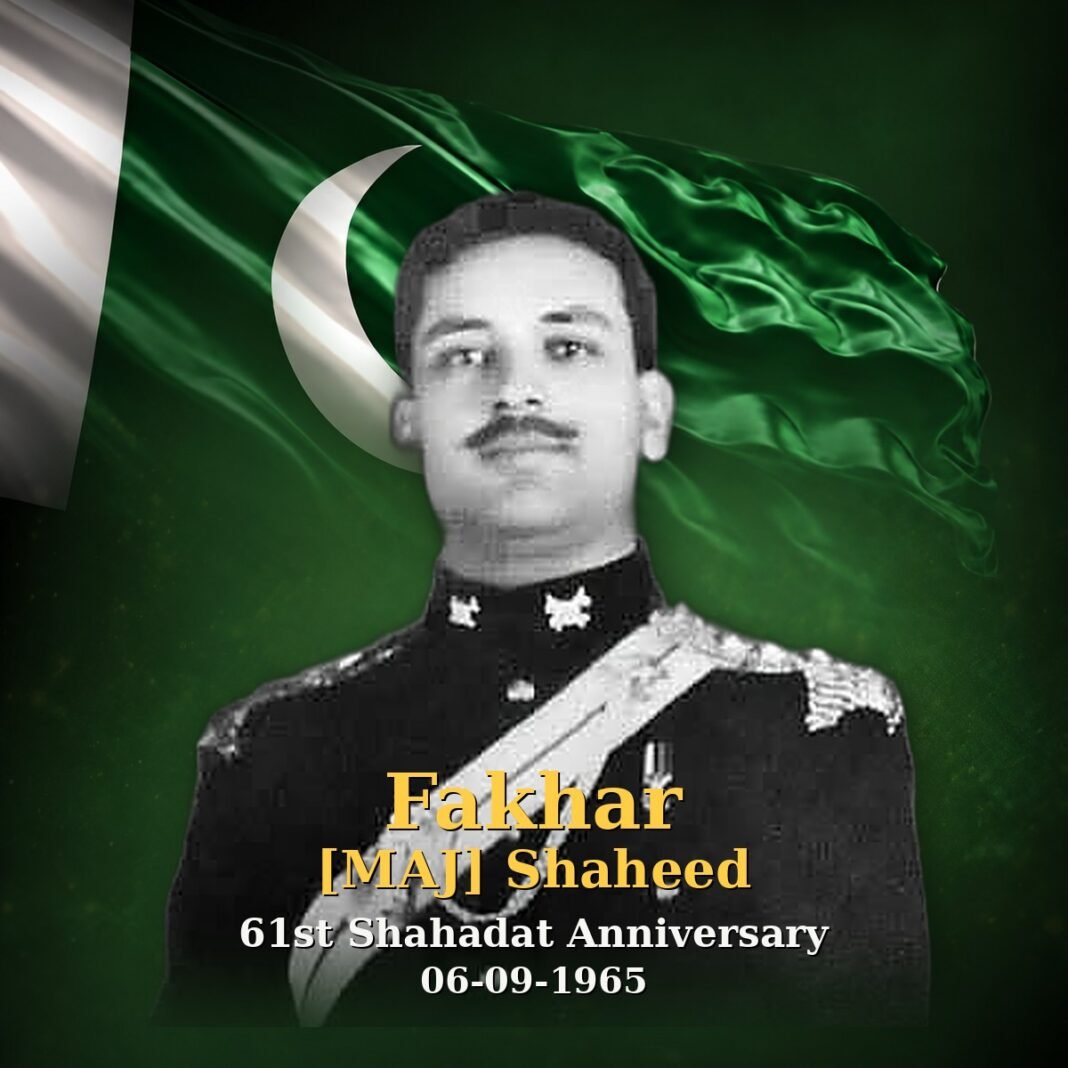
On the morning of 6 September 1965, war came to Pakistan — and on that very first day, in the mountains of Kashmir, Major Fakhar e Alam Khan gave his answer. He did not wait to see which way history would turn. He went where the fighting was hardest, and he never came back.
He was an officer of the 9th Long Course, who had served with 4 Frontier Force and 13 Lancers — one of the young nation’s earliest soldiers, raised alongside Pakistan itself. This September, the nation marks the 61st anniversary of his shahadat, and his name still stands where it has always stood: at the very front of the story of 1965.
His tribute is remembered alongside another hero of that same September — Major Illam Din Shaheed of the 6th Long Course, ex 8 Medium Regiment and Sutlej Rangers Lahore, who fell at the Wagah border near Lahore and became the first shaheed of the 1965 war. First reported missing in action, his body was later recovered. Together, the two names recall the opening days of a conflict that would define Pakistan’s identity.
The War of 1965
When the war engulfed the nation in September 1965, the officers and men of the Pakistan Army answered the call without hesitation. Major Fakhar e Alam Khan fought in Kashmir, where some of the fiercest battles of the war were waged at high altitude and with terrible ferocity. On 6 September — the very day the war engulfed the nation — he laid down his life in combat.
The officers of the early Long Courses belonged to a generation that had grown up with Pakistan. They had watched the country come into being, and when it was threatened, they defended it with their lives. His shahadat on the first day of full-scale war places him among the earliest heroes of that conflict — men who fell before the outcome was known, before the legends were written, when all that stood between the country and calamity was the courage of men in uniform.
The 1965 war forged the legend of the Pakistan Army, and men like Major Fakhar e Alam Khan were its authors. Trained in the young nation’s first military academy, they proved that Pakistan’s soldiers would stand against any odds. In Kashmir, where he fought, the outcome of the war would shape the nation’s identity for generations.
The Original Tribute
The anniversary tribute posted in their honour reads as follows:
Today is 61st shahadat anniversary of Maj Fakhar e Alam Khan Shaheed
9L/C ex 4FF/ 13L
On 06Sep65, He embraced shahadat in Kashmir during the war.
Today is 61st shahadat anniversary of Maj Illam Din Shaheed
6L/C ex 8Med Regt/ Sutlej Rangers Lhr
On 06Sep1965, Was first shaheed of 1965 war at Wahga Border Lahore, He was previously reported as missing in action but later his body was found.
Sixty-One Years of Remembrance
Every year on 6 September, Defence Day of Pakistan, the nation honours the heroes of 1965. Sixty-one anniversaries have passed since Major Fakhar e Alam Khan fell in Kashmir, and his name is still spoken with honour. That is the immortality that shahadat grants: the nation does not forget.
There is something especially moving about the first martyrs of a war. They fell before anyone knew who would win, before any song was sung about them, when fear must have been real and courage had to be greater. Major Fakhar e Alam Khan and Major Illam Din did not live to see the Pakistan they saved.
The Pakistan they saved remembers them.
Defence Day itself is built on their sacrifice. Every parade, every tribute, every flag raised on 6 September is a renewal of the promise made in 1965 — that the nation its soldiers defended at such cost will remain worthy of that defence. The heroes of September are not history. They are the foundation on which the present stands.
Major Fakhar e Alam Khan Shaheed gave his life when Pakistan needed him most. May Allah grant him the highest place among the shuhada of 1965, and may his family take pride in a legacy that grows greater with every passing year. We salute the heroes of September — yesterday, today, and always.