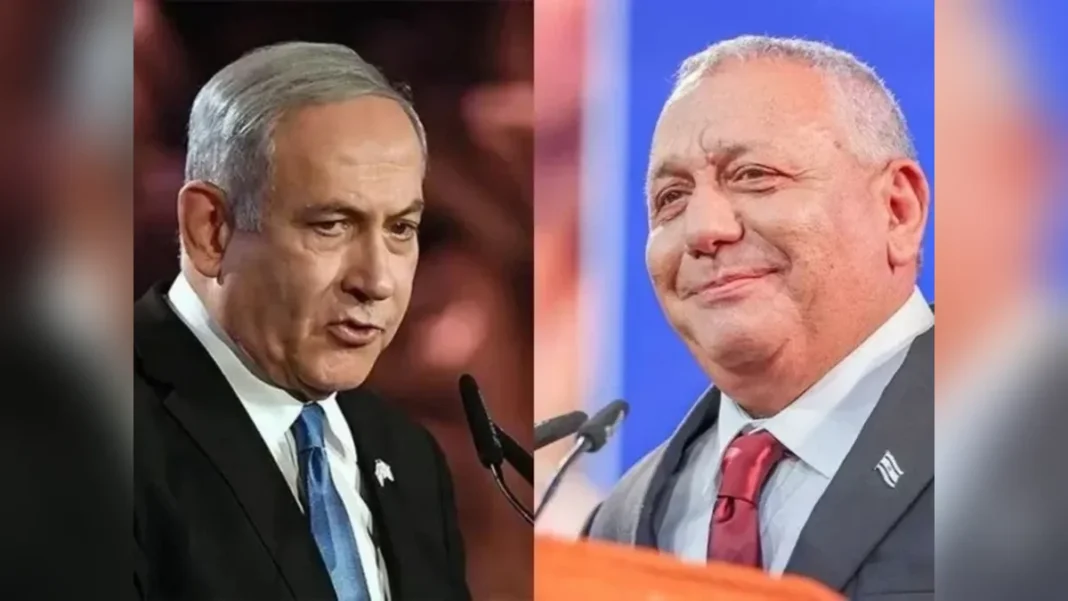
Netanyahu Eisenkot Unity Talks Begin in Israel
Benjamin Netanyahu and Gadi Eisenkot have opened direct talks on forming an Israel unity government, after Netanyahu offered to let his rival serve first as prime minister under a rotation deal. The Netanyahu Eisenkot unity talks began on Sunday at the Kirya military headquarters in Tel Aviv.
The Express Tribune reported that the meeting followed an invitation from Eisenkot on Saturday, hours after Netanyahu said he was willing to serve as alternate prime minister at the start of the term. Eisenkot said the talks should rest on a detailed policy proposal he sent Netanyahu a week earlier through a private channel set up at Netanyahu’s request. He said he had yet to receive a response on the issues it raised.
Netanyahu Eisenkot unity talks follow a weekend offer
Netanyahu, the caretaker prime minister, made the offer in a post on X on Saturday. He said the scale of the threat facing Israel, and the risk of a government unable to meet it, required him to set aside the principle that the largest party should lead.
“Given the magnitude of the existential threat and the possibility of a government that lacks the ability to confront it, my responsibility as a leader requires me to set everything aside, including the principle that the largest party should lead, and agree that Gadi Eisenkot will serve first as prime minister, while I serve as alternate prime minister at the beginning of the term,” Netanyahu said.
Eisenkot replied by inviting Netanyahu and his team to the Dan Accadia Hotel in Herzliya for immediate talks on a joint government’s policy framework. “If Likud is ready for genuine unity, I am ready to assess the seriousness of its intentions over the next 24 hours,” he said in a post on X.
The offer marked a sharp change. Likud had demanded that Netanyahu serve as sole prime minister for the full four-year term, and had ruled out a state commission of inquiry into the October 7, 2023 attack.
Neither bloc holds a majority after the October vote
The talks follow an inconclusive general election on October 27 that left neither side with a majority in the 120-seat Knesset. Eisenkot’s bloc won 48 seats, while Netanyahu’s alliance won 53. A government needs 61 seats.
President Isaac Herzog asked Eisenkot, the leader of the centrist Yashar party, to form a government. His mandate expires on December 6, and he can ask for a one-time extension of 14 days. If he fails, Herzog can give another lawmaker 28 days to try.
Eisenkot has signed coalition deals with Avigdor Lieberman’s Yisrael Beiteinu party and Yair Golan’s The Democrats. Even with Naftali Bennett’s B’Yachad party, his bloc holds only 48 seats, so he needs support from Arab-led or ultra-Orthodox parties, or a deal with Likud.
Three disputes stand in the way of a deal
Eisenkot has named three policy disputes that complicate the unity talks: a state commission of inquiry into the October 7 attack, a conscription law for ultra-Orthodox men, and changes to the judicial system. He said his bloc was willing to compromise on the inquiry and the judicial changes, but accused Likud of putting no concrete proposal on the table.
On Friday, Eisenkot accused Likud of stalling to run down the clock until his mandate expires and force a repeat election, noting the two sides had held only five meetings in two weeks. Likud replied that Eisenkot had already struck a deal for a “dangerous left-wing government” and was handing out cabinet posts while sending his team to unity talks.
Even so, Likud said its hand remained extended. “Our hand is extended to form a unity government, and we will do everything we can to achieve it,” the party said in a statement.
What happens next
The two leaders have not announced a deal, and no date has been set for a follow-up meeting. Eisenkot said on Friday that he intended to form a government within the eight days left in his mandate, and that he would keep three paths open at once: talks with the ultra-Orthodox parties, talks with Likud, and work on a broader coalition.
Under the rotation deal, Eisenkot would serve first as prime minister, with Netanyahu taking over later in the term, leaving Netanyahu out of the top job for the first time in years.
Feature Pakistan reported earlier on Netanyahu’s unity offer to Eisenkot, and Hamas says the Board of Peace failed to open Gaza entry. An Israeli strike killed two MSF staff in Gaza, while eight countries called for Palestinian elections in early 2027. Iran and the US have exchanged messages through Pakistan and Qatar.
Frequently asked questions
Who are Netanyahu and Eisenkot?
Benjamin Netanyahu is Israel’s caretaker prime minister and leader of the Likud party. Gadi Eisenkot is a former military chief and leader of the centrist Yashar party, and President Isaac Herzog asked him to form the next government after the October 27 election.
What is the rotation deal under discussion?
Netanyahu offered to let Eisenkot serve first as prime minister, with Netanyahu serving as alternate prime minister at the start of the term. The length of each turn has not been stated.
Why has no government been formed yet?
Neither bloc won a majority in the October 27 election. Eisenkot’s bloc holds 48 seats and Netanyahu’s alliance holds 53, while 61 seats are needed in the 120-seat Knesset.
When does Eisenkot’s mandate expire?
Eisenkot’s initial mandate to form a government expires on December 6. He can ask President Isaac Herzog for a one-time extension of 14 days.
What are the main disputes in the talks?
Eisenkot has named three disputes: a state commission of inquiry into the October 7, 2023 attack, a conscription law for ultra-Orthodox men, and changes to the judicial system.