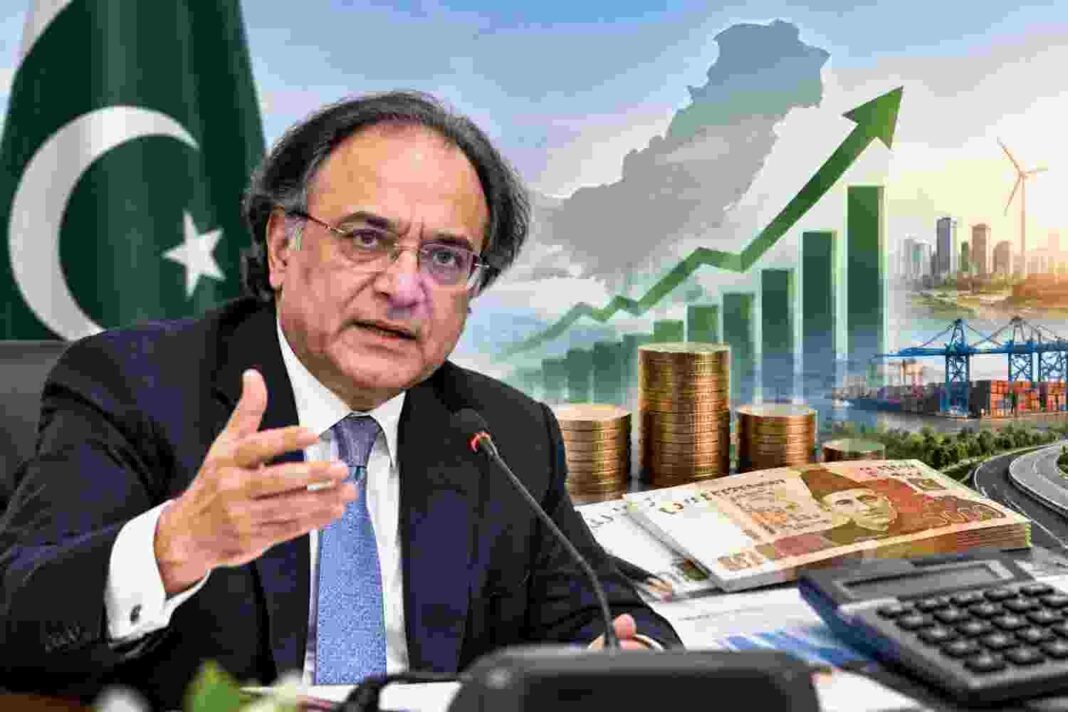
Federal Finance Minister Muhammad Aurangzeb has revealed the government’s Pakistan economy plan to improve financial stability, increase investment opportunities, and reduce dependence on external borrowing.
The finance minister said the government wants to create more opportunities for ordinary citizens by allowing them to invest in treasury bills with a small amount.
He explained that people can now invest in treasury bills with just Rs5,000. The initiative aims to encourage small investors and increase public participation in the financial sector.
Speaking on ARY News program On My Radar, Muhammad Aurangzeb discussed the government’s economic measures and explained how reforms can help strengthen Pakistan’s economy.
He said Pakistan needs major economic reforms to manage increasing debt and the growing cost of debt payments. According to him, reducing reliance on loans remains a major priority for the government.
The finance minister stressed that sustainable economic growth requires long-term planning and effective policies. He said the government is working on reforms that can improve financial management.
Muhammad Aurangzeb also discussed the National Finance Commission (NFC) Award and said discussions began in November and December last year.
He explained that the NFC Award process needs a consensus-based approach among all stakeholders. He added that distributing financial resources under the NFC system requires careful consideration.
The finance minister highlighted that Pakistan currently faces major challenges, including climate change and rapid population growth.
He said the current population growth rate is putting pressure on resources and the financial system. Therefore, the government needs to review existing resource and incentive policies.
As part of the Pakistan economy plan, the government is also focusing on reducing the country’s debt burden.
Muhammad Aurangzeb said authorities are considering different measures, including liability management trades and debt buyback strategies.
He explained that these steps can reduce borrowing costs and help lower pressure on debt repayments.
The finance minister said the government also wants to expand capital markets and reduce excessive dependence on traditional banking channels.
He added that the government is promoting investment through financial products such as Sukuk bonds. Officials are also encouraging non-bank financial institutions and the insurance sector to play a bigger role in investment activities.
Muhammad Aurangzeb said the government has started focusing on retail investors to make investment easier for common citizens.
He revealed that the Ministry of Finance signed an agreement and memorandum of understanding with JazzCash to improve access to investment opportunities.
The finance minister said the State Bank of Pakistan introduced a facility that allows small investors to buy treasury bills for as little as Rs5,000.
He believes this step will encourage more people to enter the investment market and develop a stronger savings culture in the country.
Talking about trade and the current account deficit, Muhammad Aurangzeb said the government wants to keep the deficit between $2 billion and $2.5 billion during the current fiscal year.
He said maintaining a balanced current account position remains an important part of the government’s financial strategy.
The finance minister also shared positive expectations regarding Pakistan’s IT sector. He said IT exports have improved steadily in recent years.
According to him, Pakistan recorded IT exports worth around $4.6 billion during the previous fiscal year. Freelancers contributed approximately $1.6 billion to this growth.
He expressed hope that IT exports could reach around $5.5 billion during the current fiscal year.
Muhammad Aurangzeb also discussed overseas remittances, saying Pakistan received $41.6 billion in remittances during the previous fiscal year.
He added that the amount could increase to nearly $44 billion if the current growth trend continues.
The finance minister said Pakistan can manage its current account despite challenges from trade losses.
He explained that increasing exports, supporting digital industries, encouraging investment, and improving financial policies are key parts of the Pakistan economy plan.
The government believes these measures can help create economic stability and support long-term growth. Muhammad Aurangzeb said continuous reforms will remain necessary to build a stronger and more sustainable economy.