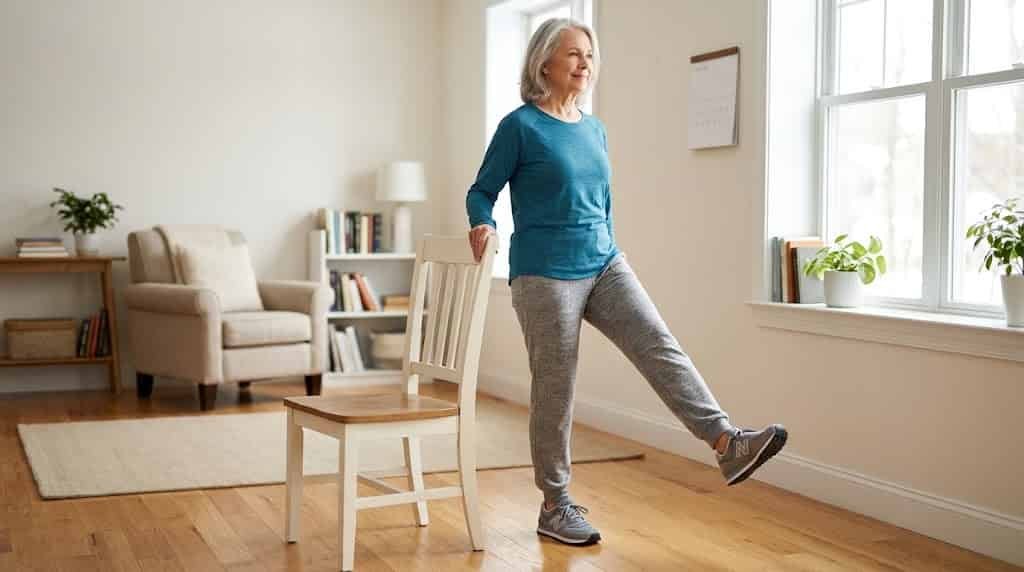
Getting up from a chair feels harder than it used to? Do stairs make your legs feel weak? Or have you started reaching for furniture when walking around the house?
These small changes can become more noticeable after 65. However, losing strength with age does not mean you should stop moving.
In fact, regular strength and balance exercises become increasingly important as we grow older.
And you do not necessarily need a gym, expensive equipment, or a complicated workout to get started.
A simple 10-minute standing routine at home can work your legs, challenge your balance, and help you practice movements you use every day.
The key is consistency.
This routine combines supported standing exercises, chair movements, gentle leg strengthening, and balance practice. Most exercises can be performed next to a sturdy chair or kitchen counter for additional support.
If you are over 65 and have been inactive, have significant balance problems, recently had surgery, have frequent falls, or have a medical condition that affects exercise, speak with a healthcare professional or physiotherapist before starting.
And remember: never exercise through chest pain, severe shortness of breath, faintness, or sudden severe pain.
Ready?
Place a sturdy chair near you, wear supportive footwear, clear the floor around you, and give yourself just 10 minutes.
Why Strength Can Decline After 65
Muscle strength can gradually decline as we age.
Age-related loss of muscle mass and function is often called sarcopenia. Physical inactivity can accelerate the process.
The legs deserve particular attention.
Strong legs help you stand up from a chair, climb stairs, walk, maintain balance, and recover when you stumble.
When leg strength decreases, ordinary activities can gradually become more difficult.
You may begin using your arms more when getting out of a chair. You may avoid stairs or walk more slowly.
That can create an unfortunate cycle.
Movement becomes difficult, so you move less. Moving less can then contribute to further losses in strength and physical capacity.
Regular physical activity can help interrupt this cycle.
Why Standing Exercises for Seniors Over 65 Matter
Standing exercises have an important advantage.
They train your body in the position you use for many daily activities.
Think about your normal day.
You stand up from bed, walk to another room, reach into cupboards, use stairs, get into a car, shop, cook, and move around your home.
These activities require coordination between your muscles, joints, and balance systems.
A well-designed standing routine can therefore train more than individual muscles.
It can help you practice functional movements.
However, safety comes first.
If your balance is uncertain, keep a sturdy chair, railing, or countertop within easy reach throughout the routine.
Your 10-Minute Standing Routine
The routine contains ten simple movements or activity periods.
Aim for approximately one minute for each section.
You do not have to perform every movement continuously for a full minute.
Take short rests whenever necessary.
Beginners can also start with five minutes and gradually work toward the complete routine.
Minute 1: Gentle Marching in Place
Stand behind a sturdy chair or beside a kitchen counter.
Place one or both hands on the support if necessary.
Stand tall and gently lift one foot from the floor.
Lower it and lift the opposite foot.
Continue alternating your legs as if you were slowly marching.
Keep the movement comfortable rather than trying to raise your knees as high as possible.
Continue for about 30 to 60 seconds.
This first minute gently introduces movement and prepares your legs for the exercises ahead.
If you feel unstable, keep both hands on the chair.
Minute 2: Sit-to-Stand
Place a sturdy chair against a wall so it cannot slide.
Sit toward the front of the chair with your feet comfortably positioned on the floor.
Lean slightly forward and stand up using your legs.
Then slowly lower yourself back into the chair.
Try to control the downward movement rather than dropping into the seat.
Repeat at a comfortable pace.
If necessary, use your hands on the chair or your thighs for assistance.
As you become stronger, you may gradually reduce how much help your arms provide.
Do not worry about completing a specific number of repetitions.
Quality and control matter more than speed.
The sit-to-stand exercise directly practices one of the most important movements for independent living.
Minute 3: Supported Calf Raises
Stand behind your chair and hold the backrest.
Keep your feet approximately hip-width apart.
Slowly lift your heels from the floor so that your weight moves toward the balls of your feet.
Pause briefly.
Then lower your heels slowly.
Continue at a controlled pace.
Calf muscles contribute to walking, ankle control, and standing stability.
Avoid bouncing up and down.
If raising both heels feels difficult, use a smaller range of motion.
Minute 4: Side Leg Raises
Continue holding the chair.
Shift your weight gently onto one leg.
Slowly move the opposite leg out to the side.
Keep your toes facing forward rather than rotating your entire body.
Bring the leg back toward the starting position.
Repeat several times before changing sides.
You can also alternate legs if that feels more comfortable.
Avoid leaning dramatically to the opposite side.
Side leg raises work muscles around the hips that contribute to stability during standing and walking.
Minute 5: Supported Mini Squats
Stand behind the chair with your feet comfortably apart.
Hold the chair for support.
Gently bend your knees while pushing your hips slightly backward.
You only need a small movement.
Then press through your feet and return to standing.
Keep your knees comfortable and maintain control.
This is not a deep gym squat.
The goal is simply to strengthen the muscles involved in bending, standing, and everyday lower-body movement.
If squatting causes knee pain, skip this exercise and continue with another comfortable movement.
Minute 6: Standing Knee Lifts
Stand tall while holding the chair.
Slowly raise one knee toward your chest as far as comfortably possible.
Lower it with control.
Then raise the opposite knee.
Continue alternating sides.
Do not worry about lifting your knees very high.
Even a small controlled movement can be useful.
Try to avoid leaning backward while lifting the knee.
This exercise challenges the hip muscles while also requiring you to briefly support more of your weight on one leg.
Minute 7: Standing Hamstring Curls
Hold your support.
Stand with your knees relatively close together.
Slowly bend one knee and bring your heel toward the back of your thigh.
Do not force the heel upward.
Return your foot to the floor and repeat with the other leg.
Continue alternating sides.
Keep your upper body upright.
The muscles at the back of the thighs help with walking and many everyday movements.
Minute 8: Heel-to-Toe Standing
This minute focuses more directly on balance.
Stand beside a sturdy counter or chair.
Place one foot slightly in front of the other.
If you feel comfortable, gradually move toward a heel-to-toe position, as though you were standing on a narrow line.
Keep your hand close to your support.
Hold the position briefly.
Then change which foot is in front.
You do not need to remove your hand from the support.
If heel-to-toe standing feels too difficult, simply place your feet closer together than usual.
Safety matters more than making the exercise difficult.
Minute 9: Side Steps
Stand facing your kitchen counter or behind a long, stable surface if available.
Take a small step to one side.
Bring your other foot toward it.
Continue for a few steps before moving in the opposite direction.
Keep your toes pointing generally forward.
Move slowly.
Sideways movement challenges your body differently from normal forward walking.
It can also strengthen muscles around your hips and legs that contribute to stability.
If space is limited, simply take one step left and one step right repeatedly.
Minute 10: Slow March and Cool Down
Finish where you started.
Stand tall with your chair nearby.
Begin gently marching in place.
Gradually make the movements smaller and slower.
Then stop and stand comfortably while holding your support if necessary.
Take several relaxed breaths.
Your 10-minute routine is complete.
The Complete Routine at a Glance
| Time | Exercise | Main Focus |
|---|---|---|
| Minute 1 | Gentle marching | Warm-up and mobility |
| Minute 2 | Sit-to-stand | Thighs and functional strength |
| Minute 3 | Calf raises | Calves and ankle strength |
| Minute 4 | Side leg raises | Hips and stability |
| Minute 5 | Mini squats | Legs and functional strength |
| Minute 6 | Knee lifts | Hips and balance |
| Minute 7 | Hamstring curls | Back of thighs |
| Minute 8 | Heel-to-toe standing | Balance |
| Minute 9 | Side steps | Lateral stability |
| Minute 10 | Slow march | Cool down |
Why Sit-to-Stand Deserves Special Attention After 65
If you could choose only one movement from this routine, sit-to-stand would be particularly useful.
It closely resembles something you perform throughout everyday life.
Every time you get out of a dining chair, rise from the sofa, or stand after sitting, your legs must generate enough force to lift your body.
Difficulty performing this movement can therefore become an obvious sign that lower-body function needs attention.
Practicing the movement provides your muscles with repeated exposure to the task.
Start with a higher, sturdy chair if a low seat makes standing difficult.
Use your hands when necessary.
Progress gradually rather than forcing yourself to perform the exercise without assistance.
Why Balance Training Becomes Important With Age
Strength is only one part of maintaining mobility.
Balance also matters.
Your brain combines information from your eyes, inner ear, muscles, joints, and nervous system to keep you upright.
Changes in vision, sensation, muscle strength, medications, and several health conditions can influence balance.
This is why exercises such as supported heel-to-toe standing and controlled side stepping can complement strength exercises.
However, balance training should never involve deliberately placing yourself at risk of falling.
Keep support within reach.
If you have already experienced repeated falls, ask a healthcare professional or physiotherapist about an individualized fall-prevention program.
Can 10 Minutes Really Make You Stronger?
Ten minutes is not a magic number.
You will not rebuild years of lost muscle in one short session.
However, ten minutes can provide an achievable starting point.
Repeated regularly, these exercises can contribute to the physical activity and strengthening work your body needs.
Current physical activity guidance for older adults encourages a combination of aerobic activity, muscle-strengthening activity, and activities that emphasize balance.
Adults should generally aim for muscle-strengthening activities on at least two days each week.
Older adults should also include activities that combine balance, strength, and functional movement.
Therefore, think of this routine as part of a broader active lifestyle rather than your entire weekly exercise requirement.
How Often Should Seniors Do This Routine?
If you are new to exercise, begin gradually.
You could perform the routine several times each week while paying attention to how your body responds.
Strength exercises require recovery as well.
You do not need to exhaust your muscles every day to benefit.
Walking and other appropriate physical activities can complement this routine on other days.
As your fitness improves, you may increase repetitions, perform movements more slowly, or progress to more challenging exercises.
Progress should remain gradual.
How to Make the Routine Easier
There is nothing wrong with modifying an exercise.
Use both hands on a chair instead of one.
Perform smaller leg movements.
Complete fewer repetitions.
Rest for 20 or 30 seconds between exercises.
Start with five minutes instead of ten.
You can even practice only two or three exercises at first.
The goal is to create a routine you can perform safely and consistently.
How to Make It Harder as You Become Stronger
After several weeks, the original exercises may begin to feel easier.
That can be a good sign.
You can progress gradually by performing movements more slowly and with greater control.
You might also increase repetitions within the same period.
For certain exercises, you may eventually use less hand support if you can do so safely.
Resistance bands or light weights can provide another progression, but older adults who are unfamiliar with resistance training may benefit from professional guidance before adding resistance.
Do not progress by making balance exercises unsafe.
The Chair Is a Safety Tool, Not a Sign of Weakness
Some people avoid using support because they believe it makes an exercise less effective.
That is a mistake.
A sturdy chair allows you to practice movements while reducing unnecessary fall risk.
As your balance improves, you might gradually use lighter fingertip support during appropriate exercises.
But there is no prize for removing your hand from the chair.
Safe exercise is better than difficult exercise.
Stop Exercising If You Notice These Warning Signs
Normal exercise can make your muscles feel warm or mildly tired.
However, some symptoms deserve immediate attention.
Stop exercising if you develop chest pain or pressure, severe or unusual shortness of breath, fainting, severe dizziness, sudden weakness, or severe pain.
Seek appropriate medical attention when symptoms warrant it.
People with heart disease, uncontrolled medical conditions, recent surgery, serious joint problems, or substantial mobility limitations should get individualized advice before beginning a new exercise program.
Do Not Forget Protein and Nutrition
Exercise provides the stimulus for maintaining and building muscle, but nutrition also matters.
Older adults need adequate protein and overall nutrition to support muscle health.
Useful protein sources can include eggs, fish, chicken, milk, yogurt, lentils, beans, and other foods appropriate for the individual’s diet.
Protein requirements vary according to body size, health conditions, kidney function, activity, and other factors.
Therefore, someone with a medical condition should not dramatically increase protein intake without appropriate professional advice.
Vitamin D, calcium, and overall dietary quality also matter for healthy aging.
Walking Alone May Not Be Enough
Walking is excellent physical activity.
It can support cardiovascular health, endurance, mood, and mobility.
However, walking and strength training do not provide exactly the same stimulus.
Exercises such as sit-to-stand, calf raises, and controlled squatting challenge muscles differently.
Therefore, an older adult who already walks regularly can still benefit from appropriate strengthening and balance exercises.
You do not necessarily need to choose between walking and strength training.
They can complement each other.
What If You Have Knee Pain?
Knee discomfort is common among older adults, but its causes vary widely.
Do not force yourself through painful squats or repeated chair stands simply because they appear in a routine.
Reduce the depth of the movement or skip the painful exercise.
A higher chair can also make sit-to-stand easier.
If knee pain persists, worsens, causes swelling, or substantially limits your mobility, seek professional assessment.
Exercise should challenge your muscles, not punish painful joints.
What If You Are Afraid of Falling?
Fear of falling deserves attention.
Do not perform unsupported balance exercises if you do not feel safe.
Start beside a solid kitchen counter or a sturdy chair that cannot slide.
You can also ask another person to remain nearby during your first few sessions.
If you have experienced a recent fall or regularly lose your balance, a physiotherapist can assess your individual strength, gait, and balance.
A personalized program may be safer than following a general online routine.
Small Improvements Can Matter
The goal after 65 does not need to be lifting enormous weights or performing complicated exercises.
Think about everyday victories.
Standing from a chair with less effort.
Walking through a shop with more confidence.
Climbing stairs more comfortably.
Maintaining enough strength to continue doing household activities.
Feeling steadier while moving around your home.
These functional improvements can have enormous value.
Ten minutes may feel insignificant, but a manageable routine that you actually perform is more useful than an ambitious workout that you repeatedly postpone.
Frequently Asked Questions
What are the best standing exercises for seniors over 65?
Useful options include supported sit-to-stands, calf raises, side leg raises, gentle marching, hamstring curls, side steps, and appropriate balance exercises. The best routine depends on the person’s health and mobility.
Can a 70-year-old regain leg strength?
Older adults can improve strength through appropriately designed resistance and functional exercise. The amount of improvement varies according to health, nutrition, starting fitness, and consistency.
Is 10 minutes of exercise enough for seniors?
Ten minutes can be a valuable starting point, particularly for an inactive person. However, older adults should work toward broader physical activity recommendations when their health and abilities allow.
How often should people over 65 do strength exercises?
General physical activity recommendations encourage adults to perform muscle-strengthening activities on at least two days each week. Individual needs can vary.
What exercise helps seniors get out of a chair?
Sit-to-stand directly practices this movement and strengthens several lower-body muscles involved in standing.
Can I do standing exercises if my balance is poor?
You may need support or professional supervision. Use a sturdy chair or counter, and avoid unsupported exercises that create a fall risk. Repeated falls or severe balance problems warrant professional assessment.
Is walking enough after age 65?
Walking provides many health benefits, but older adults can also benefit from exercises specifically targeting muscle strength and balance.
Should seniors exercise every day?
Regular movement is beneficial, but not every day needs to involve challenging strength training. A balanced week can include walking, strengthening, balance work, and appropriate recovery.
When should an older adult stop exercising?
Stop if you experience symptoms such as chest pain, faintness, severe dizziness, severe shortness of breath, sudden weakness, or significant pain. Seek medical attention when appropriate.
Is it too late to start exercising at 65 or 70?
Age alone does not make physical activity pointless. Older adults can benefit from appropriately selected exercise, although people with health or mobility concerns may need professional guidance.
Start With 10 Minutes, Then Build From There
After 65, maintaining strength is about much more than appearance.
Strong legs help you stand, walk, climb stairs, maintain balance, and continue doing everyday activities independently.
You do not need to begin with an exhausting workout.
Start with ten manageable minutes.
Keep a sturdy chair nearby, move slowly, and concentrate on controlled movements rather than speed.
As the exercises become easier, progress gradually.
Most importantly, keep moving.
Those ten minutes today could become the beginning of a stronger, steadier, and more active routine for the years ahead.
Medical note: This article provides general health and exercise information and does not replace individualized medical or physiotherapy advice.