For almost forty years, Parliament House Islamabad has been the physical centre of Pakistani democracy. Every budget, every vote of confidence and every joint sitting of the democratic era has taken place inside its two chambers on Constitution Avenue.
This guide covers the building end to end: who designed it, when it opened, what happens in each wing, the world records it holds — and how ordinary citizens can see it from the inside.
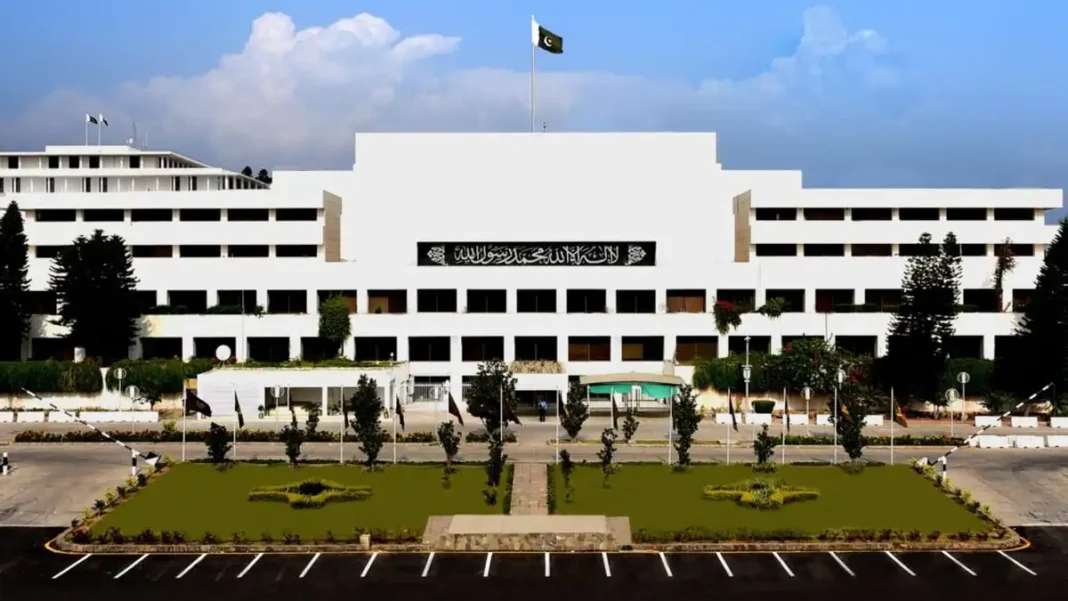
Quick answer: Parliament House Islamabad (Aiwan-e-Parleman) is Pakistan’s parliament building on Constitution Avenue in the Red Zone. Designed by Edward Durell Stone and inaugurated on 28 May 1986, it houses the 336-member National Assembly (west wing) and the 96-member Senate (east wing).
In this guide
Design and construction
The commission for a permanent parliament building came with Islamabad’s master plan in the 1960s. American architect Edward Durell Stone produced a modernist design — five storeys, 598,000 square feet — softened with geometric screens, arches and courtyards drawn from Islamic and Mughal tradition.
Construction stretched across the 1970s and early 1980s. The finished building was inaugurated on 28 May 1986 by President General Zia-ul-Haq, ending decades in which the legislature met in temporary venues such as Ayub Hall, Rawalpindi, and Islamabad’s old assembly hall.
Inside the two chambers
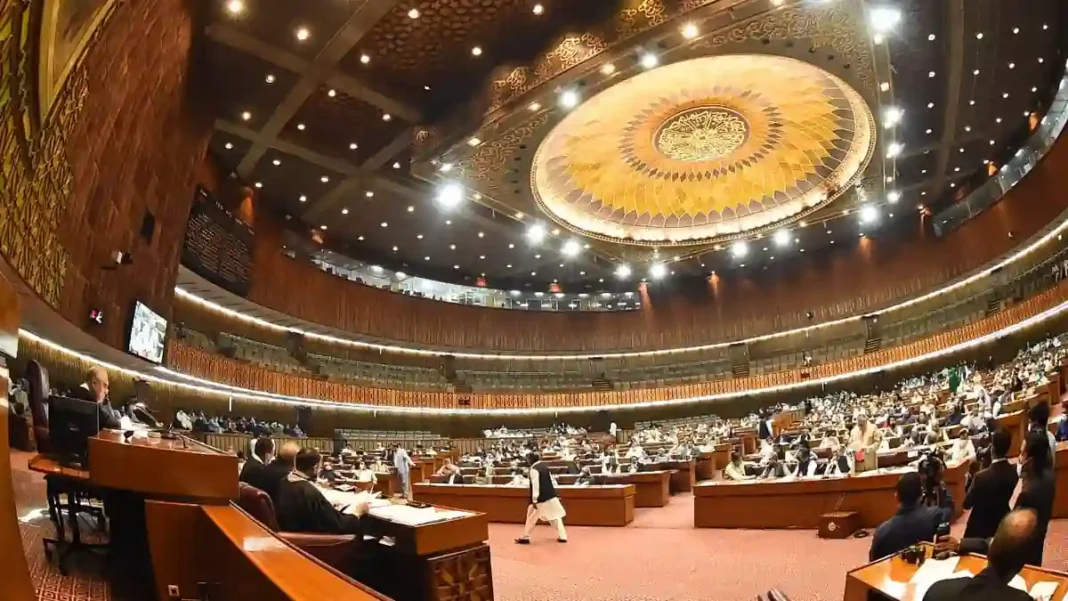
The building’s plan is symmetrical and functional. The National Assembly sits in the west wing: 336 members (266 general seats, 60 reserved for women, 10 for minorities), presided over by the Speaker. The Senate sits in the east wing: 96 senators elected indirectly for staggered six-year terms, presided over by the Chairman Senate.
Each chamber has its own public gallery, press gallery, members’ lobbies and committee rooms. Joint sittings — presidential addresses and certain legislation — take place in the larger National Assembly chamber. The offices of the Speaker, the Chairman Senate and both secretariats sit between the wings.
Records: solar power and the museum
In April 2015 Parliament House became the first parliament in the world to run entirely on solar power. A 1-megawatt plant, installed with Chinese financial assistance and inaugurated by Prime Minister Nawaz Sharif and President Xi Jinping, covers both houses’ load; surplus electricity flows to the IESCO grid under Pakistan’s first NEPRA net-metering licence for a public building.
In January 2018 the Senate Museum opened inside the building, exhibiting documents and artefacts from Pakistan’s parliamentary history since 1947 — a rarity among working legislatures in South Asia.
How to visit Parliament House
Walk-in tourism is not possible: the building stands in the high-security Red Zone. Visits — including student groups and foreign delegations — require prior permission and a security pass, normally arranged through a member of the National Assembly or Senate, or via the secretariats at na.gov.pk and senate.gov.pk.
When either house is in session, pass-holders can watch proceedings from the public galleries — the closest ordinary citizens get to legislation as it happens.
Frequently asked questions
Who built Parliament House Islamabad?
It was designed by American architect Edward Durell Stone and built over the 1970s and early 1980s, opening on 28 May 1986.
Which two houses meet at Parliament House?
The National Assembly (336 members, west wing) and the Senate (96 members, east wing) — Pakistan’s lower and upper houses.
Can tourists enter Parliament House Islamabad?
Only with prior permission and a security pass arranged through an MNA, senator or the parliamentary secretariats. The Red Zone location rules out casual visits.