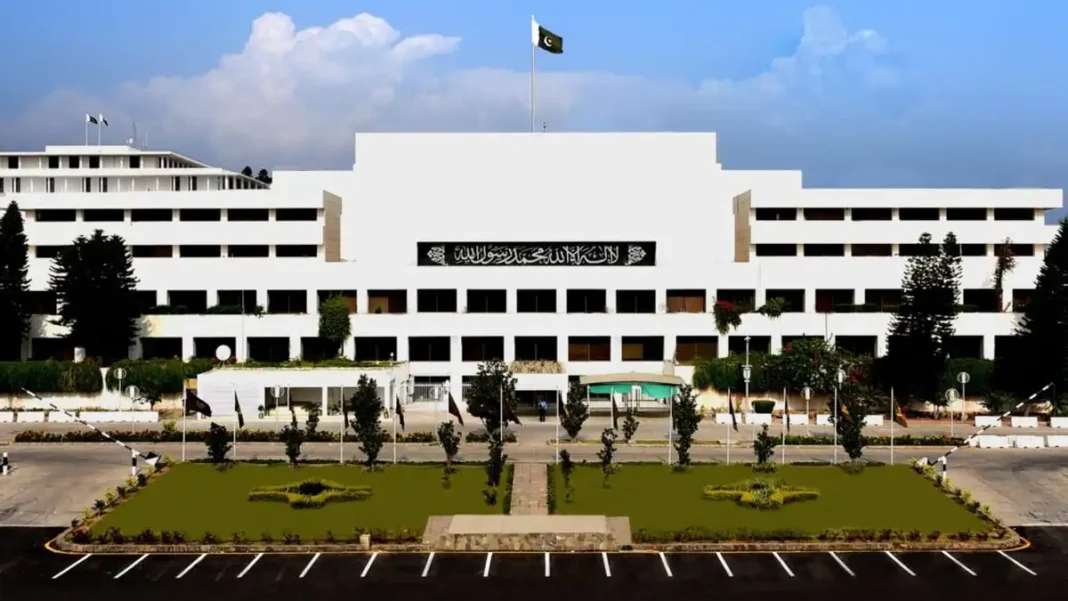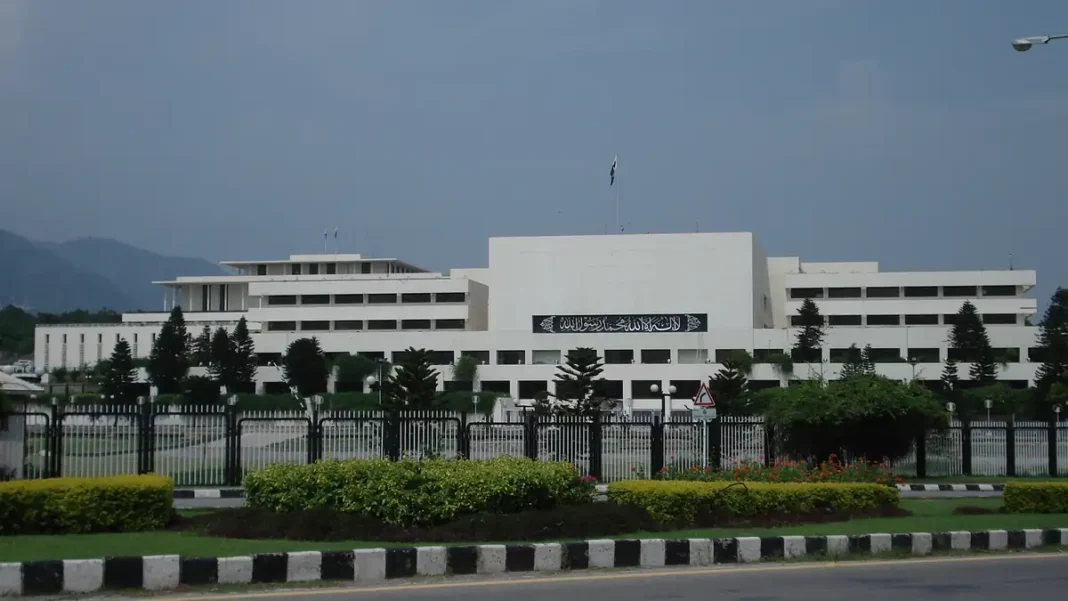
Parliament House is the common name for the building in Islamabad where Pakistan’s two-chamber Parliament meets. If you want the essential facts — where it is, who designed it, how many members sit there and what records it holds — this is the short version.
Quick answer: Parliament House Pakistan (Aiwan-e-Parleman) sits on Constitution Avenue, Islamabad. Opened 28 May 1986, designed by Edward Durell Stone, it houses the 336-member National Assembly and the 96-member Senate, and was the world’s first fully solar-powered parliament (2015).
Parliament House: 20 key facts
| Official name | Aiwan-e-Parleman (ایوانِ پارلیمان) |
| Location | Red Zone, Constitution Avenue, Islamabad |
| Architect | Edward Durell Stone (USA) |
| Inaugurated | 28 May 1986 by President Zia-ul-Haq |
| Size | 598,000 sq ft, five storeys |
| National Assembly | 336 members — west wing |
| Senate | 96 members — east wing |
| Solar record | World’s first fully solar parliament (April 2015, 1 MW) |
| Senate Museum | Opened January 2018 |
| Public access | By prior permission and security pass only |
The two chambers
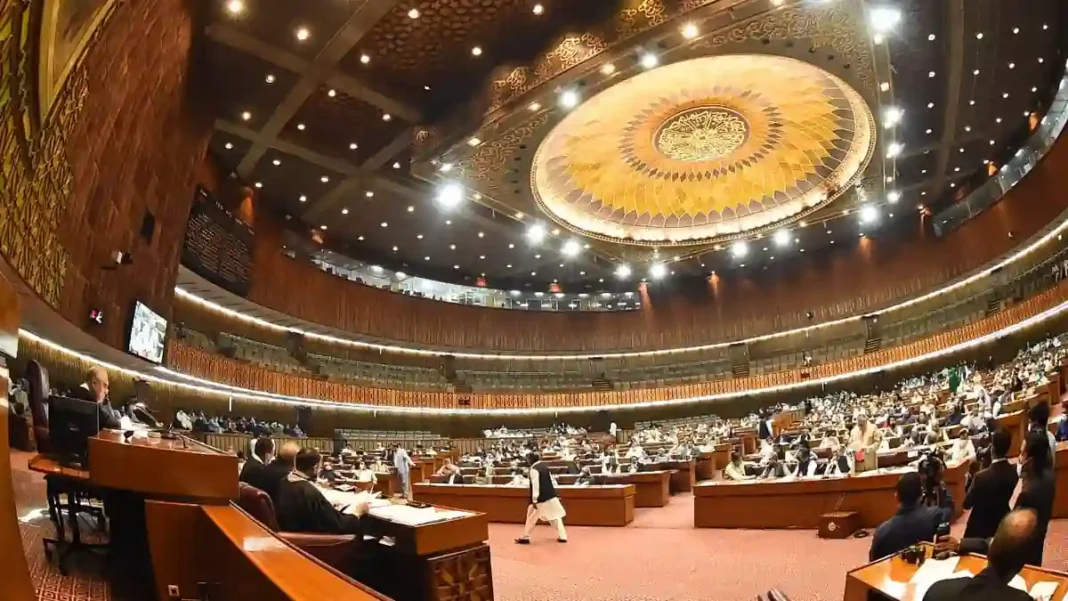
The National Assembly (west wing) is the directly elected lower house: 266 general seats plus 60 reserved for women and 10 for minorities, totalling 336. It passes the federal budget and elects the prime minister.
The Senate (east wing) is the upper house: 96 senators — 23 from each province and 4 from Islamabad — chosen indirectly by the provincial assemblies for six-year staggered terms. It cannot be dissolved, which gives it continuity the Assembly lacks.
Joint sittings for presidential addresses are held in the larger National Assembly chamber.
Records held by the building
First fully solar-powered parliament in the world — the 1 MW plant inaugurated in April 2015 by PM Nawaz Sharif and President Xi Jinping, built with Chinese assistance, with surplus power exported to IESCO under a NEPRA net-metering licence.
Home of the Senate Museum (opened 2018), one of the few parliamentary museums inside a working legislature in South Asia.
How laws are made here
A bill can be introduced in either house (money bills only in the National Assembly). It passes through committee scrutiny and three readings, then goes to the other house for the same process. Once both houses pass it, the bill goes to the President for assent — and becomes an Act of Parliament.
All of this happens inside the two chambers of this one building: committee rooms on the upper floors do the detailed clause-by-clause work, while the chambers themselves host the debates and divisions (votes). The Public Accounts Committee, drawn mainly from the National Assembly, examines how the government spends public money — its hearings are among the most closely watched proceedings in the building.
The federal budget — the single most important annual event in the parliamentary calendar — is presented in the National Assembly chamber each June, followed by days of debate before the vote.
Visiting in brief
The building stands in the Red Zone, so casual visits are not possible. Members of the public can attend with prior permission and a security pass, usually arranged through an MNA or senator, or through the secretariats at na.gov.pk and senate.gov.pk. When the houses are in session, pass-holders may observe from the public galleries.
The Senate Museum (opened January 2018) is the building’s public-facing cultural space, tracing Pakistan’s parliamentary history from 1947 through documents, photographs and artefacts.
Frequently asked questions
Where is Parliament House Pakistan?
On Constitution Avenue in Islamabad’s Red Zone, near the Presidency, PM Office and Supreme Court.
When did Parliament House open?
28 May 1986, inaugurated by President General Zia-ul-Haq.
How many members sit in the two houses?
336 in the National Assembly and 96 in the Senate — 432 parliamentarians in total.