

PSX KSE-100 weekly review: a volatile week on the board
KARACHI: The PSX KSE-100 weekly fall wiped out the index’s early gains as persistent geopolitical tensions offset optimism over Pakistan’s staff-level agreement with the International Monetary Fund for loan disbursements worth $1.2 billion.
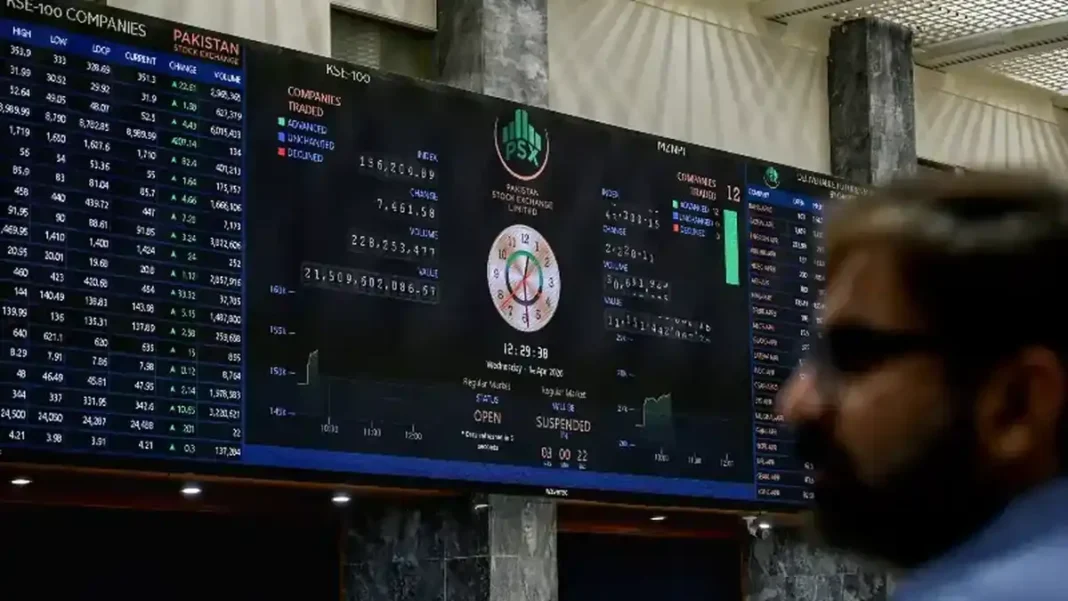
The benchmark KSE-100 index shed 1,066 points, or 0.6 per cent, during the outgoing week to settle at 167,089 on Friday, according to Arif Habib Limited.
Monday opened badly on regional and domestic political concerns. The index dived 2,288 points to close at 165,867, breaching the key 166,000 support level. Tuesday brought a strong comeback, with the index gaining 2,593 points to reclaim 168,460. Wednesday saw consolidation with a modest 120-point rise to 168,580. On Thursday, the IMF’s successful review ran into geopolitical headwinds and the index fell 1,139 points to 167,442. Friday traded both ways on cautious sentiment and position-squaring ahead of the weekend, closing 353 points lower at 167,089.
IMF deal versus geopolitical reality
Pakistan and the IMF reached a staff-level agreement on the fourth Extended Fund Facility review and the third Resilience and Sustainability Facility review. The deal paves the way for $1 billion and $210 million in disbursements respectively, subject to executive board approval. Total disbursements under both programmes would reach $5.7 billion.
The positive news, however, was only partly able to lift the market. Wadee Zaman of JS Global said persistent US-Iran tensions and escalating clashes between Saudi Arabia and Yemen’s Houthis prompted the Makkah Defence Alliance to agree on rapid force deployment. Brent crude remained above $100 a barrel.
Domestic fuel prices saw mixed adjustments, with motor spirit rising by Rs6.20 a litre to Rs398.96 and high-speed diesel falling by Rs3.92 a litre to Rs395.72. The IMF urged the government to phase out fuel subsidies, broaden the tax base and ensure timely energy tariff adjustments, cautioning that risks remained high amid geopolitical tensions and volatile energy prices.
Bonds, debt and the rupee
The government raised Rs381 billion in the recent Pakistan Investment Bond auction against a target of Rs350 billion. Yields increased by 26 to 41 basis points across three, five and 10-year tenors, declined 19 basis points for two-year bonds, and bids for 15-year papers were rejected. The rise in yields fuelled expectations of a possible policy rate hike at the next monetary policy announcement.
The central government’s debt decreased by 0.5 per cent month-on-month to Rs82.95 trillion as of August, up 7.1 per cent from Rs77.46 trillion a year earlier. The finance ministry separately reported that state-owned enterprise debt had surged to Rs10.1 trillion by the end of December 2025.
Pakistan’s foreign exchange reserves held by the State Bank remained stable at $21.5 billion. The rupee appreciated marginally by 0.03 per cent to close at Rs277 against the dollar.
Corporate snapshot
Total cement dispatches rose six per cent year-on-year to 4.62 million tons in September, driven by a seven per cent increase in domestic sales while exports remained flat. First-quarter fiscal 2027 dispatches grew four per cent to 13.14 million tons.
SECMC, a public-private partnership between the Sindh government and Engro, is expanding its Thar Block-II coalmine to supply additional coal to Lucky Electric Power Company. The expansion should let the power producer transition fully to local Thar coal, cutting reliance on imported fuel.
Sazgar Engineering’s four-wheeler sales remained flat at 2,474 units in August and September, while three-wheeler sales rose 32 per cent to 5,173 units, driving overall sales growth of 22 per cent to 10,872 units.
Oil production declined 6.4 per cent week-on-week to 63,700 barrels per day, while gas production fell 1.4 per cent to 2,999 million cubic feet per day.
FAQ
How did the KSE-100 end the outgoing week?
The PSX KSE-100 weekly fall totalled 1,066 points, or 0.6 per cent, with the index closing at 167,089 on Friday after a volatile five sessions.
What did the IMF agree with Pakistan?
A staff-level agreement on the fourth Extended Fund Facility review and the third Resilience and Sustainability Facility review, paving the way for $1 billion and $210 million in disbursements pending board approval.
Why did stocks fall despite the IMF deal?
Geopolitical uncertainty, including US-Iran tensions and Saudi-Houthi clashes, plus Brent crude above $100 a barrel and rising bond yields, weighed on investors and offset the IMF optimism.
What is the outlook for the market?
Analysts say the IMF programme keeps the macro picture supported, but sentiment will hinge on regional de-escalation, oil prices and the State Bank’s next policy rate decision.