LAHORE: Punjab animal exports have jumped 43 per cent. Over the past year, 400,000 animals were prepared for export. As a result, rural livestock farmers are expected to earn Rs11 billion, according to a government handout.
The statement said 129,581 animals raised under the Livestock Card scheme have already been exported. The scheme was launched by Chief Minister Maryam Nawaz Sharif. Moreover, it gives farmers Rs27,000 per animal for feed and fodder expenses.
Disease-free zones open foreign markets
To support exports to China, Europe and the United States, the government has taken a key step. It has notified eight Foot-and-Mouth Disease compartments. In addition, it plans to establish seven more this year.
FMD-free certification opens the door to premium meat markets. Without it, however, importing countries block live animals and meat over disease fears. With it, Punjab’s producers can compete for high-value contracts abroad. Consequently, they are no longer limited to selling only in local mandis.
Processing plants and billion-rupee investment
The government plans to set up five meat-processing plants. In addition, it will build five modern slaughterhouses. Meat-packing facilities and commercial and corporate feedlots are also planned.
It will offer Rs19 billion in financing subsidies. These target integrated livestock value-chain investments. Meanwhile, private investment of Rs65 billion is expected in the meat value chain. Furthermore, Punjab’s first FMD vaccine production unit is planned as a public-private partnership. It is backed by Rs28 billion in private investment.
Through the Livestock Connect system, authorities have linked 1,725 fattening farms with 20 export slaughterhouses. They have also connected 88 meat exporters and 34 meat traders. As a result, a formal chain now runs from farm gate to foreign buyer.
Punjab animal exports: what it means for rural families
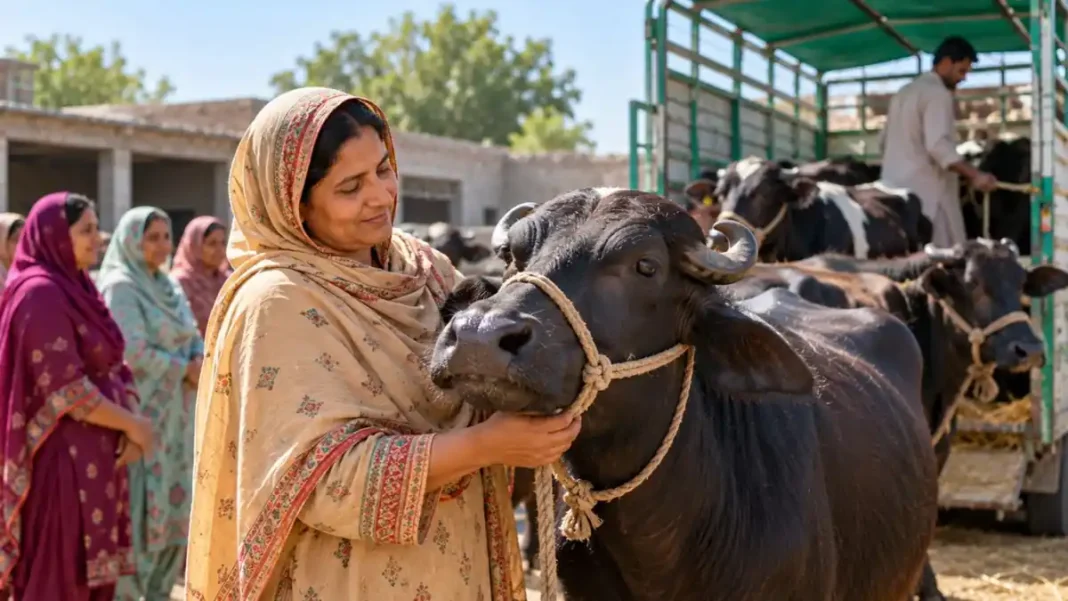
The headline figure that matters most to readers is Rs11 billion. In fact, that sum will flow to rural livestock farmers. For households that keep a few buffaloes or goats, the Livestock Card changes the equation. Its Rs27,000 per animal for feed turns a subsistence animal into a managed asset.
The programme is also reaching women in record numbers. Rural women farmers registered under the scheme have risen from 90 to 1,107. As a result, income now flows directly into the hands of rural women. Indeed, this marks a twelvefold jump.
The chief minister said the government wants to improve farmers’ access to national exporters. In addition, it aims to open up international online markets. The goal is to turn livestock from subsistence farming into an export business. It fits the province’s wider push toward technology-led farming. For example, theGreen Pakistan smart farming initiativepoints the same way. So does theplan to bring AI tools to Punjab’s fields. For crop growers, theRs5,000 wheat support price debateshows the same policy focus on farm incomes.
FMD compartments work as segregated zones. They enforce strict animal movement controls and disease surveillance. Seven more are planned this year. Consequently, the certified capacity would nearly double. In addition, five processing plants, five slaughterhouses and the vaccine unit are in the pipeline. Together, they complete the chain. Finally, it runs from a vaccinated animal on a registered farm to a packed container bound for a foreign port.
How much have Punjab’s animal exports grown?
Punjab animal exports have increased 43 per cent. In addition, 400,000 animals were prepared for export over the past year.
What is the Livestock Card scheme?
The scheme was launched by Chief Minister Maryam Nawaz Sharif. It gives farmers Rs27,000 per animal for feed and fodder expenses. Moreover, the number of registered rural women farmers has grown from 90 to 1,107.
Which markets is Punjab targeting?
China, Europe and the United States. The province has notified eight Foot-and-Mouth Disease-free compartments. Foreign buyers require this certification. In addition, seven more compartments are planned.