
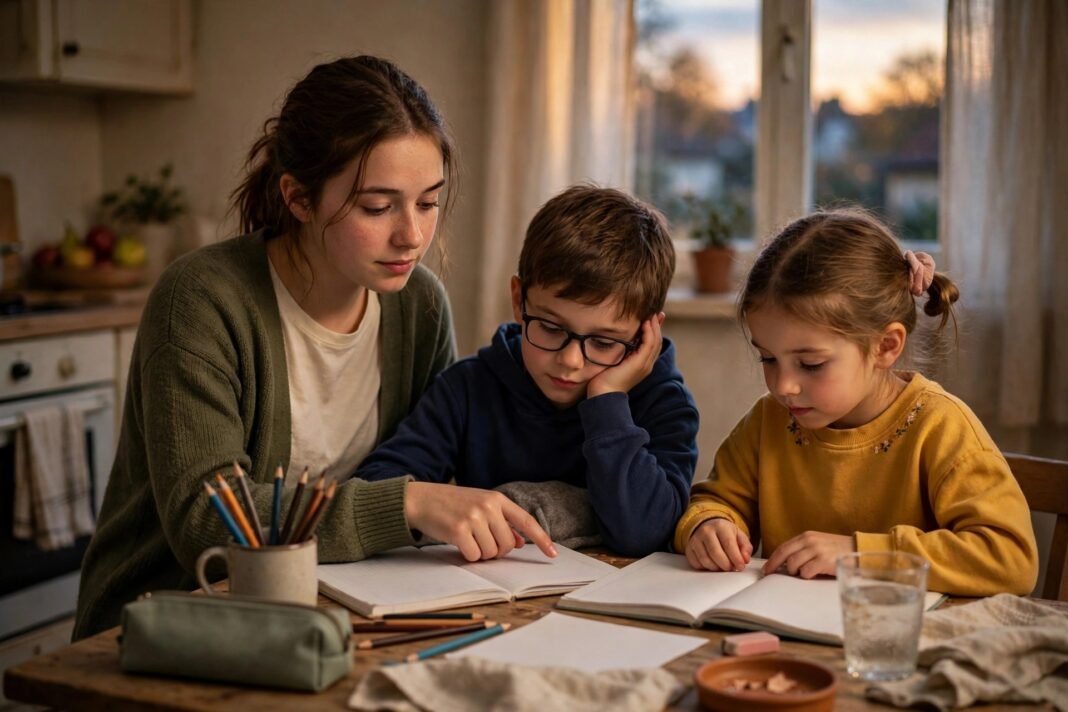
She is nine years old, and dinner is already on the table. She cooked it herself, because someone had to. This is how a daughter becomes second mother long before she is ready. Her younger brother does his homework beside her, and her little sister sleeps on her lap. Meanwhile, her own school bag sits untouched in the corner. Nobody asked her if she was tired. Nobody noticed that she is still a child herself.
If this feels familiar, you are not alone. In many families, the eldest girl slowly becomes the second mother of the house. She raises her siblings, runs the home, and carries worries that belong to adults. As a result, her own childhood quietly slips away. This piece explains why it happens, what it costs, and how she can begin to take her life back.
When a Daughter Becomes Second Mother Too Soon
Psychologists have a name for this pattern. It is called parentification. In simple words, it means a child takes on roles that belong to adults. For example, she cooks meals, cleans the house, and looks after younger siblings. In addition, she may comfort a parent, settle arguments, or keep the peace at home.
There are two kinds of parentification. The first is practical. She does the cooking, the cleaning, and the childcare. The second is emotional. She becomes the person everyone leans on. She listens to adult worries, calms tempers, and holds the family together. Both kinds are heavy. However, the emotional kind is harder to see, so it often goes unnoticed for years.
Helping at home is not the problem. Children learn and grow when they share small jobs. The problem starts when the work is too much for her age, never ends, and nobody thanks her for it. In fact, research links this pattern to anxiety and low mood in adult life. The girl who carried everything often grows into a woman who cannot stop carrying everything.
Why It Happens in So Many Families
This pattern rarely comes from cruelty. In most cases, parents are overwhelmed themselves. They may work long hours, struggle with money, or face illness. Sometimes a parent is missing, unwell, or simply exhausted. So the eldest girl steps in, because someone must. She is capable, and everyone can see it. As a result, the family leans on her more and more.
Expectations about girls play a part too. Research on household work shows that daughters get more cooking and caring jobs than sons from childhood. The eldest girl gets this assignment first and longest. She is praised for being mature and responsible. But that praise can hide a heavy truth. She is doing an adult’s job with a child’s heart.
In many homes, nobody plans this. It grows slowly, one small job at a time. First she watches her brother for an hour. Then she cooks dinner every night. Before long, the whole house depends on her. This is how a daughter becomes second mother without anyone deciding it. And because she manages so well, nobody stops to ask what she has lost.
The Childhood She Quietly Loses
A child who raises children misses her own childhood. She has little time to play, to rest, or to simply be young. Her schoolwork may suffer, because homework comes after the cooking and the cleaning. Her friendships may fade, because she cannot go out like other children. So she grows up fast, but she grows up with gaps.
The deepest loss is harder to name. She learns that her needs come last. If she is sad, she hides it. If she is tired, she keeps going. Over time, she may forget how to know what she wants at all. She becomes skilled at reading other people’s moods. However, her own feelings stay locked away. That early lesson can follow a girl for years, as our article on how childhood emotional neglect follows girls into adulthood explains.
What Happens When a Daughter Becomes Second Mother
The role does not end when she grows up. It follows her into adult life. At work, she takes on extra tasks without being asked. In friendships, she becomes the helper, the planner, the one who remembers everything. In her own home, she struggles to rest. She feels guilty when she does nothing, because doing nothing was never allowed.
Research links this pattern to anxiety, low mood, and burnout in adult life. She may find it hard to trust that others will care for her. She may keep giving until she is empty. And when she finally says she cannot cope, people are surprised. After all, she has always coped. That is the trap of being capable. Everyone sees the strength, and nobody sees the cost.
Her own dreams are often the first thing she gives up. School, hobbies, and plans for the future all take second place to the family’s needs. Our article on why talented girls give up their dreams shows how often this happens. And even as an adult, she may keep putting everyone else first, just as daughters who carry emotional responsibilities for ageing parents often do.
How She Can Begin to Heal
Healing starts with naming what happened. She was not simply a helpful child. She carried a load that belonged to adults. A daughter becomes second mother through a thousand small moments, and no single moment felt like a choice. Saying this out loud is not blame. It is honesty. And honesty is the first step toward change.
Next, she can practise small acts of care for herself. Rest is not laziness. Saying no is not selfishness. She can start with one boundary, such as one evening a week that belongs only to her. In addition, she can ask for help, even when it feels strange. Asking is a skill, and it grows with practice.
Talking to a counsellor can help too. A trained listener can help her grieve the childhood she missed and build a life that includes her own needs. Support groups for women with similar stories can also help. Above all, she needs to hear one truth. She was a child. She deserved a childhood. It is not too late to claim the life she set aside.
Where to Find Support
If this story feels like yours, support is available. A licensed therapist or counsellor can help you work through the weight of an early caregiving role. Online directories list therapists in many places, and many offer sessions by video call. In addition, free online listening services offer a safe place to talk, day or night. Books on parentification and the eldest daughter experience can also help you feel less alone. You carried your family. Now it is time to let someone carry you, even a little.
Did you grow up as the second mother of your family? What helped you most? Share your story in the comments, or share this article with a woman who needs to read it.