AJK Chief Justice Calls for Autonomous Weapons Treaty
Azad Jammu and Kashmir Chief Justice Raja Saeed Akram Khan has called for a binding international autonomous weapons treaty, warning that artificial intelligence is changing the nature of warfare and letting machines make decisions that could decide who lives and who dies.
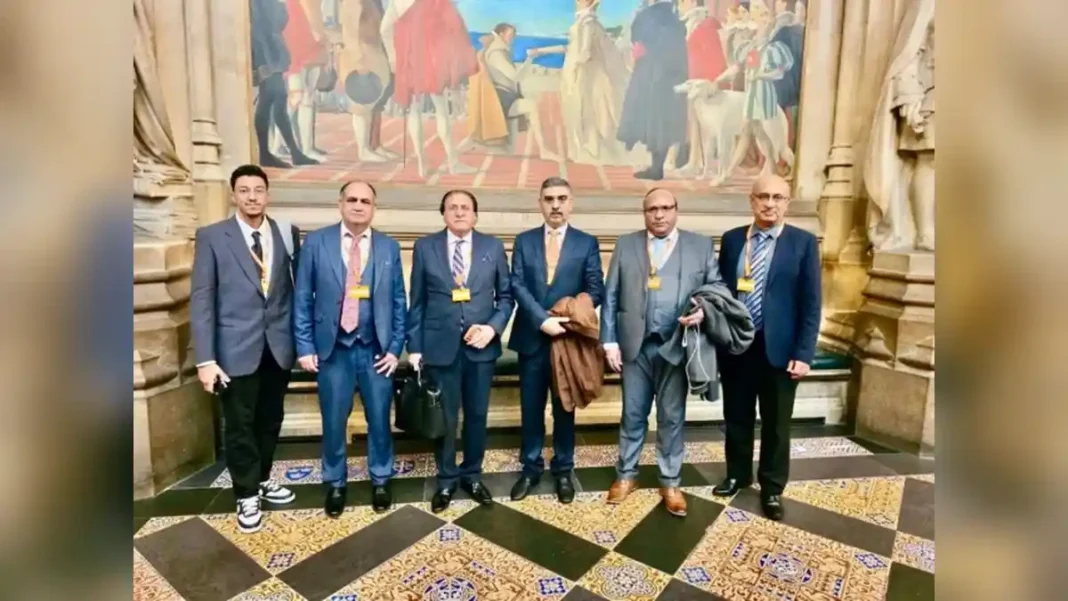
He made the call while addressing an international human rights seminar at the House of Lords in London on Saturday, the Tribune reported. The seminar, titled “AI Wars and Human Rights”, was organised by The Wisdom Trust and hosted by Lord Brennan KC.
Autonomous weapons treaty: what the chief justice proposed
Justice Khan said meaningful human oversight must remain central to every decision involving the use of lethal force. He also called for technology companies developing AI-powered military systems to be brought within the framework of legal accountability.
He urged the global community to establish an effective, legally binding agreement to prohibit or regulate autonomous weapons, keep meaningful human control over lethal-force decisions, and hold both states and technology companies accountable for the consequences of their systems.
“Artificial intelligence should serve humanity, not rule over it or become a force that decides who lives and who dies,” he said. He added that technological progress must remain guided by human values, international law and respect for human dignity.
The seminar brought together members of the House of Lords, British parliamentarians, prominent barristers, legal experts, university professors, human rights scholars and representatives of international organisations from different countries.
Human control and the question of blame
Justice Khan acknowledged the considerable potential of artificial intelligence for good, yet warned that its irresponsible use in military operations could threaten human rights and international peace.
He pointed to the use of advanced technologies in military operations in Gaza, Ukraine and Iran. AI-assisted target identification, drone surveillance and autonomous weapons were creating unprecedented risks for civilian populations, particularly women and children, he said.
He cautioned that the unchecked deployment of such technologies could undermine fundamental principles of international humanitarian law. Those principles include distinction between combatants and civilians, proportionality in the use of force and accountability for violations.
He then raised the question at the heart of the debate: who should be held responsible if an autonomous weapons system mistakenly kills an innocent civilian? The international community must answer that question through clear legal frameworks, he said, rather than allowing technological developments to outpace international law.
Meaningful human control means a person, not a machine, takes the decision to use lethal force, and can understand, oversee and stop the action. Without it, blame for a wrong strike has no clear home.
Kashmir and the rights warning
Justice Khan also drew attention to the Jammu and Kashmir dispute and the human rights situation in Indian Illegally Occupied Jammu and Kashmir (IIOJK), referring to United Nations Security Council Resolution 47.
Resolution 47, adopted in 1948, set out a process for the people of Jammu and Kashmir to decide their future through a plebiscite. Justice Khan said the people of IIOJK had been struggling for their right to self-determination since 1947, adding that international human rights organisations had repeatedly expressed concern over alleged human rights violations there.
He stressed that emerging technologies, including facial recognition, drone surveillance and AI-powered monitoring systems, must be subject to safeguards protecting fundamental freedoms and human rights.
Pakistan’s self-determination resolution at the United Nations keeps the same question on the world body’s agenda, and the chief justice used the London platform to press it again before an international audience.
The wider push for rules on military AI
The call comes as states debate the same questions at the United Nations. States opened a path to a pact on killer robots after talks at the United Nations, the first step towards a binding agreement on autonomous weapons.
That process has not been smooth. The United States and Russia opposed talks on autonomous weapons, which has slowed the effort to set common rules.
The big powers have still begun to talk about limits. Trump and Xi discussed guardrails for military AI, and the US and China held AI safety talks at APEC. Justice Khan’s speech adds a judicial voice from Pakistan to that debate, and it links the weapons question to the rights of civilians in conflict zones.
At the end of the seminar, Justice Khan and Graham Soper, founder of The Wisdom Trust and chairman of its Board of Trustees, exchanged commemorative shields.
Frequently asked questions
What did the AJK chief justice call for?
He called for a binding international treaty to regulate autonomous weapons, with meaningful human control over every decision involving lethal force.
Where did he make the call?
He spoke at the “AI Wars and Human Rights” seminar at the House of Lords in London, organised by The Wisdom Trust and hosted by Lord Brennan KC.
Why does he say human control matters?
He warned that AI is letting machines make decisions that could decide who lives and who dies, and said a person must stay in control of any lethal-force decision.
Who should be blamed if an autonomous weapon kills a civilian by mistake?
Justice Khan asked exactly that question and said the answer must come through clear legal frameworks that hold both states and technology companies accountable.
What did he say about Kashmir?
He drew attention to the Jammu and Kashmir dispute and the human rights situation in IIOJK, referring to United Nations Security Council Resolution 47, and said the people there had struggled for self-determination since 1947.