Zeeshan Ali Returns to Earth Tonight After Space Mission
Pakistan’s first astronaut, Wing Commander Muhammad Zeeshan Ali returns to Earth tonight, bringing Pakistan’s first human spaceflight to a close.
Ali is due to leave the station at 9pm on Sunday aboard the Shenzhou-23 spacecraft, Chinese media reported. He is expected to land at about 2am on Monday at the Dongfeng landing site in northern China.
He will travel with two Chinese astronauts, return commander Zhang Zhiyuan and Hong Kong payload specialist Li Jiaying. The three completed a handover ceremony aboard Tiangong on 28 November, when the incoming Shenzhou-24 crew took charge of the station.
A short mission with a long tail
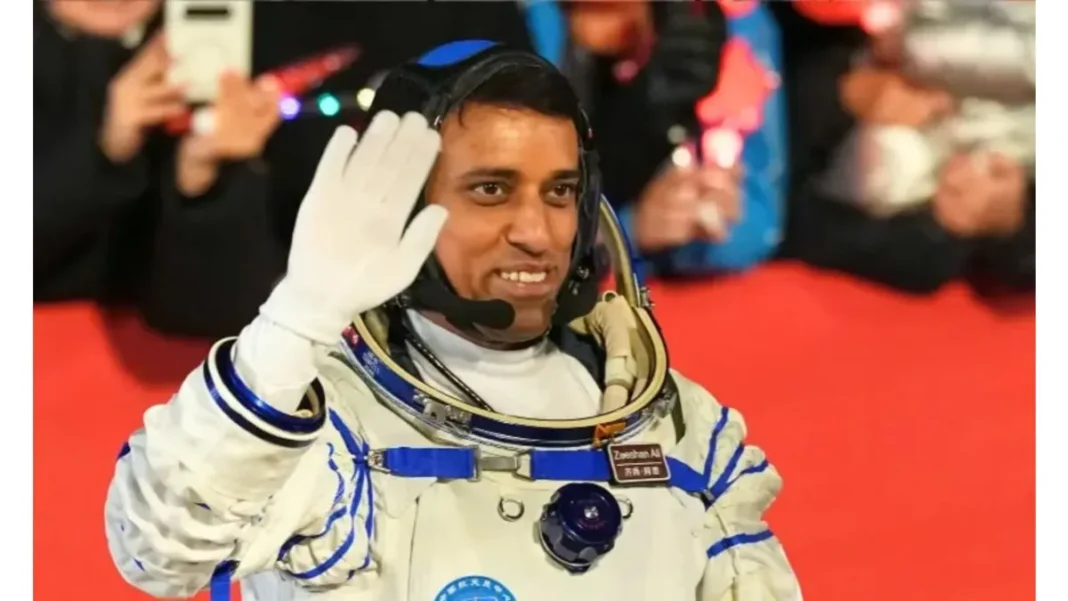
Ali reached space on 25 November aboard China’s Shenzhou-24 spacecraft, which lifted off from the Jiuquan Satellite Launch Centre at 5:18am Pakistan time. The craft docked with the Tiangong station about three hours and 38 minutes later.
His flight made him the first Pakistani to enter Earth orbit and the first foreign astronaut to reach the Tiangong station. A Pakistan Air Force pilot, he flew as a payload specialist on a short joint mission with China, rather than on a standard six-month Chinese crew rotation.
The mission carried four experiments selected jointly by Pakistan and China. Three of them will stay mounted outside the station for about a year: a graphene radiation-shield composite, a self-healing carbon-fibre composite, and 32 quinoa seed samples. The fourth is an indoor cyanobacteria experiment, run inside the station to study oxygen regeneration and food production.
The return timing has been reported by Chinese media, but Beijing had not formally confirmed an exact landing time when this report was written. State news agency Xinhua had said only that Shenzhou-23 would land “in the coming days”. Independent tracking of airspace closure notices pointed to a landing window between 2:06am and 2:36am Pakistan time on Monday, which matches the time given in the Chinese media reports.
What the mission means for Pakistan
The flight is the most visible result of a space partnership between Pakistan and China that has grown steadily over the past two years. The two countries have signed letters on space cooperation, and Pakistan has set up its own mission control centre, Kehkashan, to follow the flight from home.
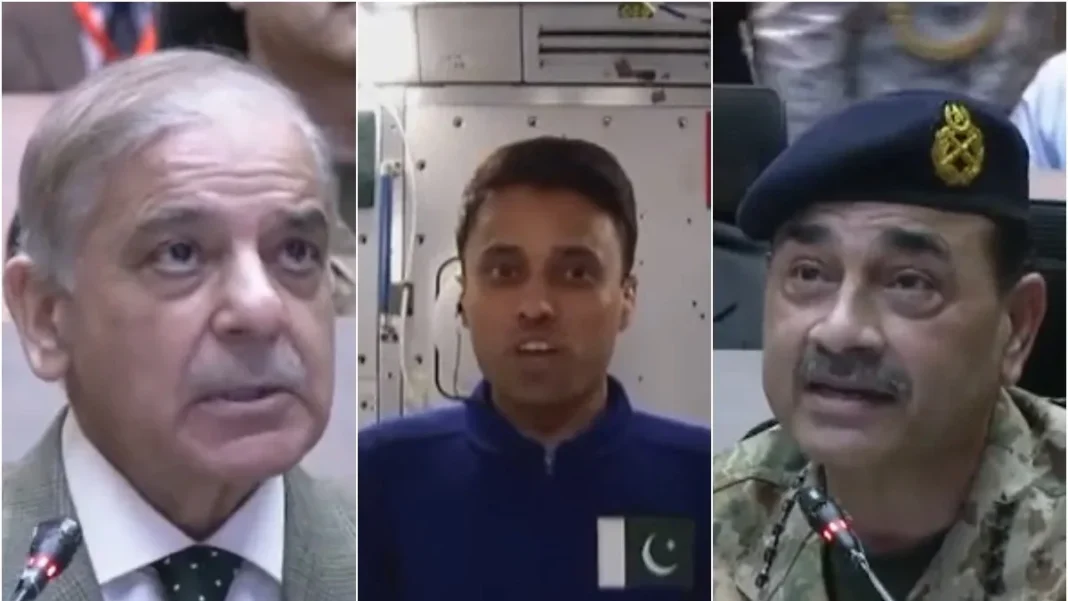
Prime Minister Shehbaz Sharif and the chief of defence forces spoke to Ali during his stay aboard the station. The call was a public mark of how much the mission mattered in Islamabad, where the flight has been followed closely since the launch.
Life aboard the station also carried a Pakistani touch. Ali’s menu included halal food prepared for the mission, a detail that drew wide attention at home and showed how the flight was planned around a Pakistani crew member from the start.
For the Pakistan Space and Upper Atmosphere Research Commission (SUPARCO), the mission is a first step rather than a finish line. A short flight cannot match the experience of a full six-month stay, but it gives Pakistani scientists and engineers direct access to work in orbit and a working link with China’s space programme.
Zeeshan Ali returns to Earth: the journey home
The Shenzhou-23 capsule will separate from Tiangong tonight and begin its descent to the Dongfeng site in Inner Mongolia. The landing zone will still be dark and very cold at that hour, and return windows are set by orbital mechanics rather than by choice.
Once the capsule lands, recovery teams will reach the crew and carry out the standard medical checks. Ali is then expected to return to Pakistan, where a formal welcome is likely. No date for his return home has been announced yet.
The end of the flight closes a week that began with a launch watched across Pakistan and ends with a landing in the early hours of Monday. For a country that had never sent a citizen into orbit before, the return matters as much as the launch: it proves the mission was completed and the crew came home safely.
Frequently asked questions
When does Zeeshan Ali return to Earth?
He begins his return from the Tiangong space station at 9pm on Sunday, 29 November, aboard the Shenzhou-23 spacecraft. Landing is expected at about 2am on Monday, 30 November, at the Dongfeng site in northern China.
Who is returning with him?
Two Chinese astronauts: return commander Zhang Zhiyuan and Hong Kong payload specialist Li Jiaying. The three held a handover ceremony with the incoming crew on 28 November.
What did he do on the Tiangong station?
Ali flew as a payload specialist on a short joint mission. He worked on four experiments selected by Pakistan and China, including materials and seed samples tested in orbit.
How long was he in space?
Five days, from the Shenzhou-24 launch on 25 November to the planned landing on 30 November. It was a short-duration mission, unlike standard Chinese crew rotations of about six months.
What happens to his experiments?
Three of the four experiments stay mounted outside the station for about a year. Their results will be studied once the material is brought back to Earth on a later mission.