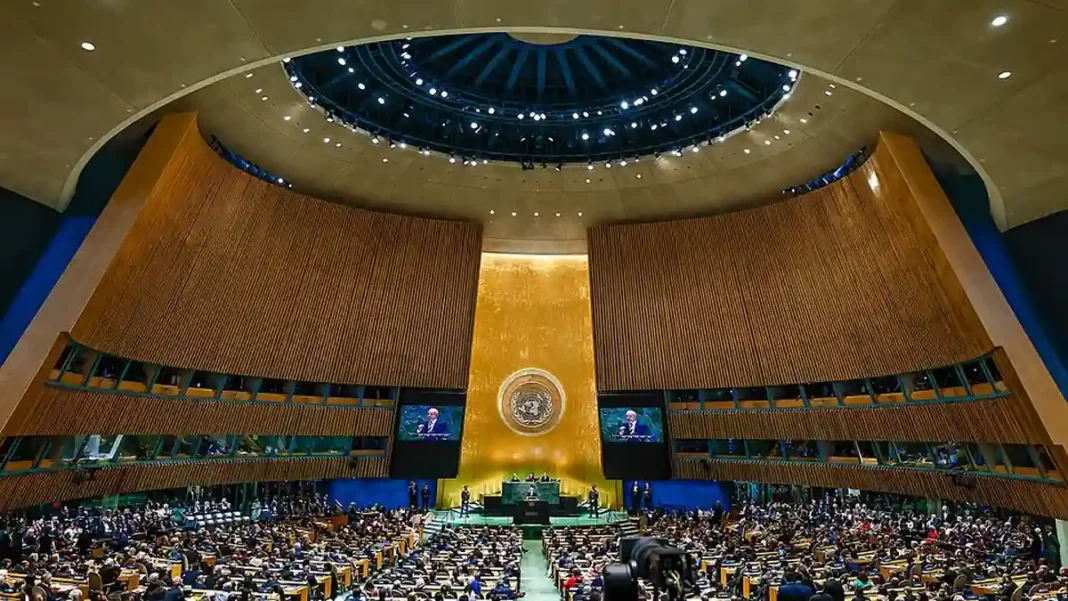
UNITED NATIONS: Pakistan has called for a stronger and revitalised United Nations General Assembly, one that can step in when the Security Council is paralysed by the veto. Its diplomat told the 193-member body this week that the Assembly must turn its words into action.
First Secretary Ansar Shah spoke at a plenary meeting of the General Assembly on Thursday. The joint debate covered the implementation of UN resolutions and the revitalisation of the Assembly’s work. He said the Assembly was the only principal UN organ with universal membership, embodying sovereign equality and inclusivity.
Revitalisation was not a procedural exercise alone, he said. It was a political endeavour to restore balance, equity and democratic participation in the organisation’s work. Pakistan aligned itself with the statement delivered by Algeria on behalf of the Non-Aligned Movement.
Assembly must act when Council cannot
Shah said the General Assembly’s role in maintaining international peace and security was broad and complementary to that of the Security Council. “When the Council is unable or unwilling to act, the Assembly is fully empowered to assume its responsibilities under the Charter,” he said.
He said the Assembly’s work extended to addressing the root causes of conflict. It should promote the peaceful settlement of disputes through mediation and arbitration, in line with the Charter’s principles.
For the Assembly to remain credible, its resolutions had to be implemented in letter and spirit, he said. They carried moral, legal and political weight as the collective will of the international community. All organs and member states had to respect and implement these decisions.
Dedicated mechanism to track resolutions
Pakistan repeated its proposal for a dedicated mechanism to monitor the implementation of General Assembly resolutions. The mechanism would be supported by regular, detailed reporting from the UN Secretariat. It would strengthen the Assembly’s effectiveness, accountability and relevance, Shah said.
He added that resolutions remained valid until their mandates were fully implemented. The principle underlined the enduring authority of the Assembly’s decisions.
Pakistan also backed efforts to make the Assembly’s work more efficient. He listed a leaner agenda, fewer resolutions, better reports and action-oriented outcomes. But the Assembly’s limits did not come from procedure, he argued. They came from the reluctance of some member states to let it fully exercise its Charter-based authority.
Closer watch on Security Council
Shah called for a stronger institutional relationship between the General Assembly and the Security Council. The Council should report to the Assembly more frequently and in greater substance, especially when acting under Chapter VII of the Charter.
He welcomed the continued use of resolution 76/262, under which the Assembly meets within 10 days of a veto in the Council. The UN’s own record of the veto initiative shows the Assembly debated a vetoed non-proliferation resolution on October 1. Such steps promoted transparency, accountability and the democratisation of the UN system, he said.
Pakistan has used UN forums to press its security concerns before, telling the world body earlier this week that India backs Taliban-linked terror groups behind attacks on Pakistani soil.
He praised the co-chairs of the working group on revitalisation, the envoys of Romania and Saint Kitts and Nevis. The group was set up under Resolution 79/327 to address the political constraints on the Assembly and reaffirm its central role.
Shah said norm-setting and the development of international law had to stay within the Assembly’s universal, participatory framework. The three pillars of the UN, peace and security, development and human rights, deserved balanced attention. He called for coherence between the UN80 reform initiative and the Assembly’s revitalisation.
On the selection of the next secretary-general, he reaffirmed transparency, inclusivity, gender parity and equitable regional representation. He hoped the process would conclude quickly for a smooth transition. The Assembly had to stay at the centre of new debates, from artificial intelligence to outer space and the global commons, he said.
Deputy Prime Minister Ishaq Dar met UN chief Antonio Guterres in Islamabad this week. Interior Minister Mohsin Naqvi briefed the UN chief on Pakistan’s counterterrorism effort. Pakistan’s earlier call at the UN for self-determination in Kashmir and Palestine drew wide attention recently. A detailed report carries the full statement text.
Frequently asked questions
What did Pakistan propose at the UN?
A dedicated mechanism to track how General Assembly resolutions are implemented, backed by regular Secretariat reporting. It also wants the Security Council to report to the Assembly more often and in greater substance.
What is resolution 76/262?
It is the veto initiative. The General Assembly meets within 10 days whenever a permanent member uses the veto in the Security Council, to debate the situation.
Who delivered Pakistan’s statement?
First Secretary Ansar Shah, speaking at the UNGA plenary’s joint debate on resolution implementation and Assembly revitalisation on October 8.