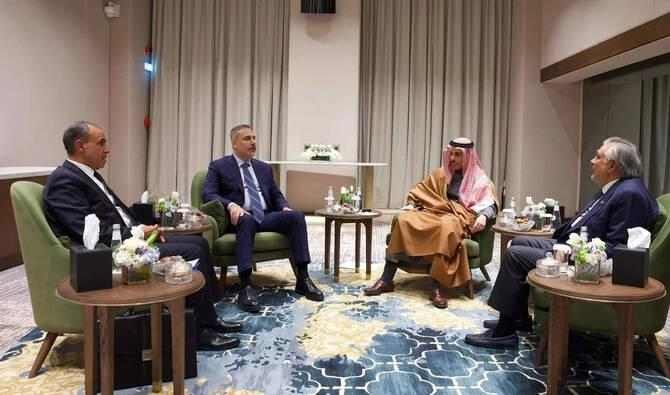
ISLAMABAD: Deputy Prime Minister and Foreign Minister Ishaq Dar has shared key details about the Makkah Defense Pact involving Pakistan, Saudi Arabia and Türkiye. He said the agreement aims to strengthen regional security and cooperation.
Dar described the agreement as a reflection of the close and brotherly ties among the three countries. Moreover, he said years of discussions and coordination led Pakistan, Saudi Arabia and Türkiye to reach the understanding.
According to the foreign minister, the three countries want to strengthen strategic cooperation against common peace and security challenges. Therefore, the agreement focuses on collective security rather than confrontation with another state.
Dar stressed that the Makkah Defense Pact carries a completely defensive character. He also made clear that the three participating countries have not designed the arrangement against any particular country.
Furthermore, the agreement reflects a shared desire to promote regional peace, stability and prosperity. Pakistan believes stronger coordination among friendly countries can contribute to a more secure regional environment.
Dar also addressed questions about Pakistan’s existing international commitments. He said the new arrangement does not cancel or change any existing bilateral or multilateral agreement involving the participating countries.
Similarly, the pact does not end or modify their existing arrangements with other countries or international organizations. As a result, the three governments can maintain their current partnerships while strengthening cooperation under the new framework.
One of the most important elements concerns collective defense among the three participating states. According to Dar, the countries will consider an external armed attack against one member as an attack against all three.
However, he linked this collective defense principle with international law. He said the countries would exercise their right to collective defense in accordance with Article 51 of the United Nations Charter.
The Makkah Defense Pact therefore seeks to create a framework for closer security coordination while respecting international obligations. Dar presented regional stability and peaceful cooperation as central objectives behind the initiative.
Meanwhile, the foreign minister rejected the idea that the agreement seeks confrontation with another regional power. He repeatedly emphasized its defensive purpose and its focus on strengthening peace.
Dar also indicated that the arrangement may not remain limited to its three initial participants. According to him, other countries in the region could join if they accept and follow the pact’s basic principles.
However, prospective participants would need to support peaceful approaches to regional disagreements. They would also need to resolve differences through mutual respect, dialogue and peaceful means.
This approach could expand the Makkah Defense Pact into a broader framework for regional cooperation. At the same time, its future development would depend on how participating and interested countries implement its stated principles.
Dar also connected the agreement with Pakistan’s broader foreign policy priorities. He said its principles remain consistent with Islamabad’s approach toward peace, cooperation and stronger relations with friendly countries.
Moreover, Pakistan intends to continue working closely with brotherly states across the region. Dar said Islamabad wants to promote lasting peace and stability through dialogue and stronger cooperation.
Pakistan also supports peaceful solutions to disputes rather than prolonged confrontation, according to the foreign minister. Therefore, Islamabad intends to continue pursuing diplomatic engagement with countries across the region.
The Makkah Defense Pact comes at a time when security challenges continue to influence regional diplomacy. Consequently, cooperation among Pakistan, Saudi Arabia and Türkiye could attract considerable attention from other governments.
Dar’s statement also seeks to clarify the purpose of the agreement amid questions about its strategic implications. He maintained that the initiative focuses on defense and does not seek hostility toward any country.
Furthermore, the collective defense provision gives the agreement significant strategic importance. It signals that the participating countries intend to support one another if any member faces an external armed attack.
However, Dar emphasized that this commitment will operate within the framework of the United Nations Charter. This position places international law at the center of the pact’s stated defense mechanism.
The foreign minister also highlighted economic and social stability alongside security. He argued that peace and regional stability can help countries create a safer and more prosperous future for their people.
Therefore, Pakistan views stronger regional cooperation as part of its long-term diplomatic priorities. Islamabad also wants to maintain close relations with friendly countries while supporting peaceful solutions to regional disputes.
The Makkah Defense Pact could gain further importance if additional regional countries express interest in joining. However, Dar said any potential member would need to respect the principles of peaceful dispute resolution and mutual respect.
For now, Pakistan, Saudi Arabia and Türkiye remain at the center of the initiative. Their governments aim to use strategic cooperation to respond collectively to shared peace and security challenges.
Dar concluded by reaffirming Pakistan’s commitment to lasting peace, stability and prosperity. He said Pakistan would continue working with regional partners to build a safer, more stable and prosperous future.