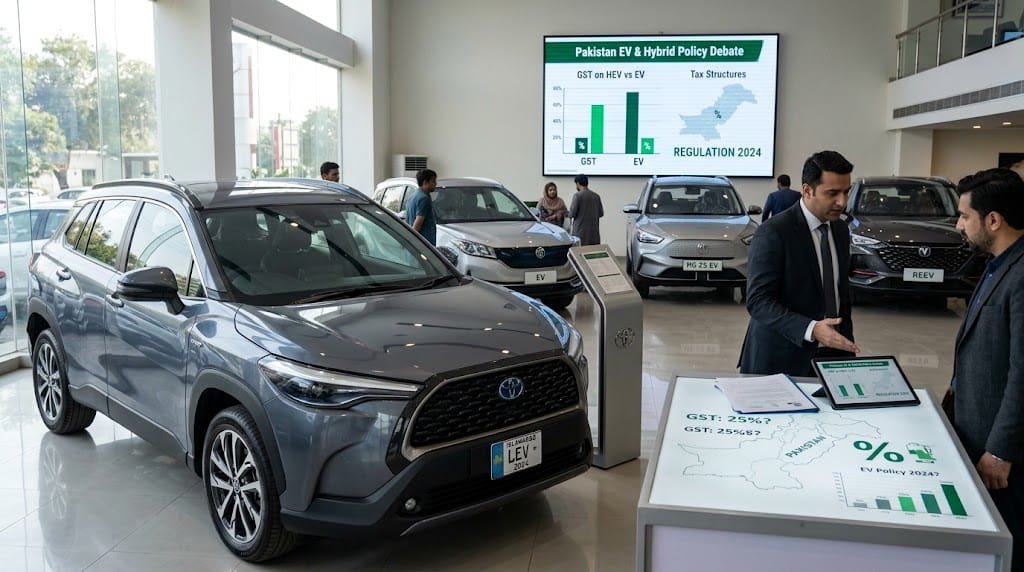
KARACHI: Toyota Pakistan’s parent company, Indus Motor Company, has raised concerns over the tax treatment of some Range-Extended Electric Vehicles in Pakistan, claiming that certain competitors may be using the REEV classification to benefit from lower tax rates.
The company raised the issue during its 37th Annual General Meeting after announcing its financial results for FY2026. Indus Motor management said regulators, including the Federal Board of Revenue, were reviewing the matter.
According to the company, some vehicles may be entering the market under a classification that gives them a more favourable tax position than conventional hybrid vehicles.
However, Indus Motor’s position represents an industry concern rather than a final finding of tax misuse by regulators.
The dispute mainly focuses on how Pakistan should classify Range-Extended Electric Vehicles, commonly known as REEVs.
Unlike conventional hybrid vehicles, REEVs use an electric motor to physically drive the wheels. They also carry a petrol engine, but that engine normally works as a generator to produce electricity for the battery rather than directly powering the wheels.
This technical difference has become important because vehicle classification can affect customs treatment, sales tax and overall pricing.
Indus Motor believes REEVs should not receive the same treatment as fully battery-powered electric vehicles simply because their wheels run only through electric motors.
The company argues that these vehicles still depend on an internal combustion engine and petrol to extend their driving range.
Therefore, Toyota Pakistan and several other industry stakeholders have questioned whether REEVs should enjoy tax advantages designed for electric vehicles.
Pakistan Automotive Manufacturers Association has also raised similar concerns in the past.
However, the FBR’s Customs Classification Committee has already examined the technical question involving two specific REEV models.
The committee reviewed the Deepal S05 REEV imported by Master Changan Motors and the Forthing Friday REEV imported by Capital Smart Motors.
During the proceedings, Indus Motor Company, PAMA, Sazgar Engineering and other industry stakeholders argued that REEVs were technologically closer to series hybrids than pure battery electric vehicles.
They argued that an REEV still carries an internal combustion engine and consumes fuel.
According to their position, this means such vehicles should not automatically receive fiscal benefits designed for vehicles that operate without an onboard fuel-powered engine.
The importers presented a different argument.
They said the petrol engine inside an REEV does not have any mechanical connection to the wheels.
Instead, the engine operates only as a generator. The electric motor remains solely responsible for physically moving the vehicle under all driving conditions.
The FBR committee accepted this technical interpretation for the two vehicles it reviewed.
In its majority decision, the committee classified the Deepal S05 REEV and Forthing Friday REEV under PCT 8703.8090, which covers vehicles using only an electric motor for propulsion.
The committee explained that an internal combustion engine used only to generate electricity does not qualify as a “motor for propulsion” when it cannot mechanically drive the wheels.
However, the FBR also made an important clarification.
It said its decision applied specifically to the two vehicles and the technical specifications provided during the classification proceedings. The ruling did not automatically apply to every REEV model entering Pakistan.
That distinction leaves room for further regulatory examination if other vehicles use different technical configurations.
Indus Motor now expects regulators to review the broader tax treatment and believes the process could create what it describes as a more level playing field for Pakistan’s automakers.
The dispute has gained greater importance because Pakistan’s automobile tax structure has changed significantly during 2026.
Hybrid electric vehicles had previously benefited from concessional sales tax rates under the Auto Industry Development and Export Policy 2021-26.
However, that policy expired on June 30.
After the expiry, hybrid and plug-in hybrid vehicles faced a much higher GST burden, creating immediate concerns among local assemblers.
In July, Toyota increased prices of its Corolla Cross hybrid models by more than Rs1.3 million after the higher tax rates took effect. Honda also increased the price of its hybrid HR-V model.
The tax increase also caused uncertainty across the market.
Some manufacturers temporarily stopped invoicing or delivering hybrid vehicles while waiting for clarity from the government.
The government later reduced GST on qualifying hybrid vehicles of up to 2,000cc from 25 percent to 18 percent, with the change taking effect from September 13.
Following that decision, several automakers cut prices.
Indus Motor reduced the prices of the Toyota Corolla Cross HEV X and Corolla Cross HEV by Rs570,000 and Rs550,000 respectively.
Despite that relief, hybrids still face a much higher tax burden than some categories of electric vehicles.
Pakistan has continued a one percent sales tax concession for certain locally assembled smaller electric vehicles, including qualifying EVs with battery capacities of up to 50kWh, until June 30, 2027.
This gap between EV and hybrid taxation explains why classification has become such a sensitive issue for car manufacturers.
If a vehicle receives electric-vehicle treatment instead of hybrid treatment, its final price can become significantly more competitive.
For legacy automakers that have invested heavily in hybrid technology, the difference can directly affect demand.
Toyota has a major presence in Pakistan’s hybrid market through the locally assembled Corolla Cross.
Meanwhile, new entrants have increasingly introduced electric, plug-in hybrid and range-extended technologies.
The arrival of these different technologies has created new challenges for regulators because traditional vehicle categories do not always fit modern powertrain designs.
An ordinary petrol car uses its combustion engine to directly drive the wheels.
A conventional hybrid combines an engine and electric motor, and both can contribute to propulsion.
A plug-in hybrid also allows battery charging from an external power source while retaining an engine that can help drive the vehicle.
An REEV works differently.
Its wheels normally receive power only from electric motors, while the petrol engine generates electricity when battery energy falls.
Supporters of REEV classification as electric vehicles therefore focus on the physical source of propulsion.
Critics focus instead on the vehicle’s continued reliance on petrol and an internal combustion engine.
The FBR’s classification committee acknowledged this broader technological debate.
Its review noted that REEVs differ from fully battery-powered electric vehicles even though their mechanical propulsion comes entirely from electric motors.
Still, the committee concluded that the existing tariff structure required classification according to the motor that actually transmits power to the wheels.
The debate could become even more important as Pakistan prepares a new automobile policy.
The previous AIDEP ended in June, while manufacturers have repeatedly called for clarity on the policy that will govern the industry over the coming years.
The delay has already affected pricing, investment planning and vehicle deliveries.
Industry groups have also debated how Pakistan should balance support for conventional manufacturers, hybrid vehicles and newer EV technologies.
Supporters of stronger EV incentives argue that Pakistan needs to accelerate the transition toward cleaner transport and reduce dependence on imported fuel.
However, hybrid manufacturers argue that sudden tax differences can create an uneven market, particularly when one technology receives much stronger incentives than another.
Meanwhile, consumers often focus on a different issue: final vehicle prices.
Tax policy can change the price of a vehicle by hundreds of thousands or even millions of rupees.
Therefore, any decision on REEV classification could influence competition among Toyota, Chinese automakers and other companies introducing electrified vehicles in Pakistan.
Indus Motor also discussed its future electrified vehicle strategy during the AGM.
Management said Toyota has EV and plug-in hybrid models in several categories globally, but the company will decide its Pakistan launch strategy after the government approves and announces the new auto policy.
The company is also planning Rs4 billion to Rs5 billion in capital expenditure during FY2027 to increase the localisation of parts and components.
Meanwhile, Indus Motor’s gross margin fell to 10.3 percent during the fourth quarter of FY2026, compared with 13.3 percent a year earlier and 15.5 percent during the previous quarter.
Management linked the decline partly to strategic pricing and higher dealer incentives.
The company has also increased inventory to reduce the risk of production disruptions caused by shipping delays and geopolitical uncertainty.
For now, the dispute over REEV taxation remains under regulatory attention.
Toyota Pakistan has questioned whether some competitors should receive favourable tax treatment under the REEV category, while the FBR’s earlier technical ruling supported electric-motor classification for two specific models.
Therefore, the issue is not simply about whether an REEV contains a petrol engine.
Regulators must decide how technical design, customs classification, environmental policy and tax incentives should work together.
Any future clarification from the FBR or the government could have a major impact on vehicle prices and competition in Pakistan’s rapidly changing auto market.