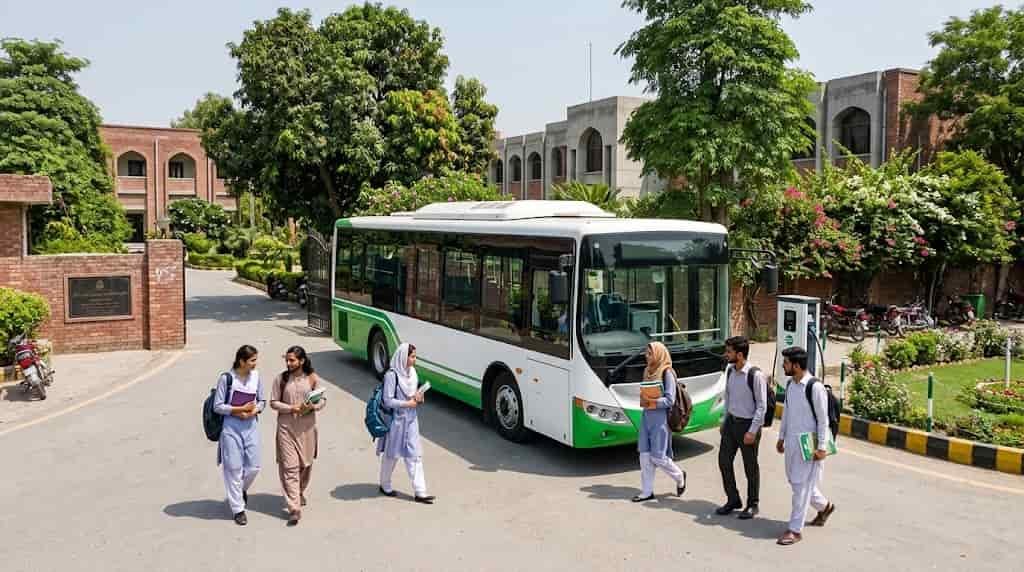
The Punjab Higher Education Department has approved the provision of electric buses for 25 government colleges across the province during the current financial year, aiming to improve student transport facilities and reduce rising fuel expenses.
The decision comes after several government colleges reported difficulties in managing transportation costs from their existing budgets. The Directorate of Public Instruction (DPI) Colleges highlighted that increasing fuel prices have created financial pressure for educational institutions that operate their own transport services.
To address the issue, the department has decided to introduce electric buses for government colleges as part of Punjab’s environment-friendly transport strategy.
The initiative is expected to provide better commuting facilities for students while helping colleges reduce recurring fuel costs.
The move also reflects the Punjab government’s broader focus on promoting clean energy solutions and shifting public transport systems towards electric mobility.
Electric Buses to Improve Student Transportation
Many government colleges in Punjab provide transport facilities for students, particularly those travelling from areas where public transport options remain limited.
However, increasing fuel prices have made it difficult for institutions to maintain regular transport operations.
College administrations often have to allocate significant portions of their budgets to fuel expenses, vehicle maintenance and transportation management.
With the introduction of electric buses, colleges are expected to experience lower operating costs compared with traditional fuel-based buses.
Electric vehicles generally require less mechanical maintenance because they have fewer moving parts compared with conventional engines.
The department believes the new buses will help institutions maintain reliable transport services while reducing financial pressure.
Punjab Expands Electric Vehicle Policy
The decision to provide electric buses to government colleges is part of Punjab’s growing focus on electric mobility.
The province has already taken several steps to promote electric transport, including the introduction of electric buses in major cities and initiatives aimed at encouraging cleaner transportation options.
Electric buses are increasingly being adopted worldwide because they can reduce fuel consumption, lower emissions and improve urban air quality.
For Pakistan, where fuel imports create economic pressure and urban pollution remains a major challenge, electric transportation has become an important policy area.
The government’s latest decision connects education sector transportation with environmental goals.
Colleges Facing Rising Fuel Expenses
According to the Directorate of Public Instruction (DPI) Colleges, several educational institutions have struggled to manage fuel expenses within their available budgets.
Transportation costs have increased significantly due to higher fuel prices and operational expenses.
For colleges operating multiple routes, fuel consumption can become a major monthly expense.
Administrations often have to balance transportation needs with other academic requirements, including laboratory facilities, student services and infrastructure improvements.
The introduction of electric buses could provide long-term financial relief by reducing dependence on diesel and petrol.
Although the initial cost of electric vehicles is generally higher than conventional buses, lower running expenses can make them financially beneficial over time.
Benefits for Students and Educational Institutions
The electric bus initiative is expected to benefit both students and colleges.
For students, improved transport facilities can make daily commuting easier, particularly for those who travel long distances to attend government colleges.
Reliable college transport can also help increase attendance by reducing difficulties faced by students who depend on limited public transport options.
For institutions, electric buses can help control transportation budgets and allow administrations to redirect savings towards academic development.
The initiative may also encourage students to become more aware of sustainable transportation and environmental protection.
Electric Transport and Environmental Goals
Air pollution remains one of Pakistan’s major urban challenges, particularly in densely populated areas.
Transport emissions contribute significantly to air-quality problems in major cities.
Electric buses produce no direct tailpipe emissions, making them a cleaner alternative to traditional diesel buses.
By introducing electric buses in educational institutions, Punjab aims to combine transport improvement with environmental responsibility.
Educational institutions can also become examples of sustainable practices by adopting cleaner technologies.
The presence of electric buses on college routes may encourage young people to understand the importance of renewable energy and environmentally friendly solutions.
Implementation During Current Financial Year
The Higher Education Department has approved the electric bus programme for implementation during the current financial year.
The selected 25 government colleges will receive buses under the approved initiative.
Further details regarding the names of colleges, delivery schedule and operational routes are expected to be announced by the relevant authorities.
The department will coordinate with the Directorate of Public Instruction (DPI) Colleges for implementation and monitoring.
The initiative will require proper planning, including charging facilities, maintenance arrangements and route management.
Successful operation of these buses will depend not only on procurement but also on creating the required support infrastructure.
Growing Demand for Electric Mobility in Pakistan
Pakistan has witnessed increasing interest in electric vehicles during recent years.
Government departments and private companies are exploring electric transport solutions to reduce fuel dependency and promote cleaner mobility.
Electric buses have already started operating in different parts of Punjab as cities move towards modern public transport systems. Wikipedia
The shift towards electric mobility is also creating opportunities in areas such as battery technology, charging infrastructure and vehicle manufacturing.
Experts believe that expanding electric transport requires long-term planning, including reliable electricity supply, charging networks and technical training.
Challenges Ahead
Despite the benefits, electric bus adoption also comes with challenges.
The biggest challenges include the high initial purchase cost, charging infrastructure requirements and battery maintenance.
Colleges will need proper charging facilities to operate buses efficiently.
Staff members may also require training for handling electric vehicle systems.
However, supporters of electric mobility argue that lower fuel and maintenance costs can help recover the initial investment over time.
The success of Punjab’s college electric bus programme will depend on effective implementation and continuous maintenance.
Conclusion
Punjab’s decision to provide electric buses to 25 government colleges represents a major step towards improving student transportation and reducing institutional fuel expenses.
The initiative addresses a practical challenge faced by colleges while supporting the province’s environmental goals.
By replacing traditional fuel-based transport with electric buses, educational institutions can reduce operating costs, provide better commuting facilities and contribute to cleaner air.
As Pakistan continues exploring sustainable transportation solutions, electric buses in government colleges could become an important example of how technology can improve public services.