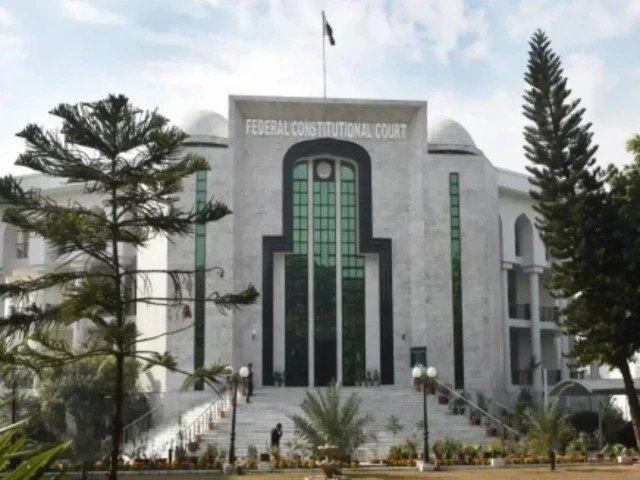
New FCC Rules Put Chief Justice Alone in Charge of Bench Formation
New FCC Rules Put Chief Justice Alone in Charge of Bench Formation
The chief justice of the Federal Constitutional Court will personally decide which judges hear each case under the newly notified FCC bench formation rules, which make him the “master of the roster” over the constitution of benches.
The Federal Constitutional Court (Practice and Procedure) Rules 2026, now on the court’s website, mark a clear departure from the Supreme Court, where a three-judge seniority committee has handled bench formation since 2023.
What the new FCC bench formation rules say
Every cause, matter or appeal, including an appeal arising from a judgment of a division bench of a high court, must be heard by a bench of not fewer than two judges, all nominated by the chief justice.
If the judges hearing a case are equally divided, the chief justice may, at his discretion, send it to another judge in chamber or place it before a larger bench nominated by him.
The chief justice may also constitute a larger bench at any stage, having regard to the importance, complexity or public significance of the questions involved, with the bench comprising as many judges as he determines by order.
A break from the Supreme Court model
Since the restoration of the judiciary in March 2009, Supreme Court chief justices have faced heavy criticism over the formation of benches described as “like-minded”. During former chief justice Umar Ata Bandial’s tenure, the PDM government under Prime Minister Shehbaz Sharif enacted the Supreme Court Practice and Procedure Act 2023, under which a three-member committee headed by the chief justice was tasked with constituting benches.
A full court headed by former chief justice Qazi Faez Isa later upheld the Act. A majority of judges, including incumbent FCC Chief Justice Aminuddin Khan and Justice Hasan Azhar Rizvi, had backed the three-judge committee.
Even after the 26th Constitutional Amendment, the three-judge committee was retained for constitutional benches and remains in place in the Supreme Court. The 27th Amendment, however, moved jurisdiction over fundamental rights and constitutional interpretation to the newly established FCC, which now runs on the one-man roster system.
Lawyers demand checks on discretion
Lawyers argue that with such significant responsibilities vested in the FCC, checks are needed on the chief justice’s discretion to ensure transparency.
Lawyer Abdul Moiz Jaferii said: “Once you have torn the heart out of an independent court; the replacement you prop up must function with precision and efficiency. It must be a disciplined unit, akin to a military camp. Any democracy within can only lead to weakness,”
He added: “Jaferii believes that the chief must have complete control. And so we are back again to the master of the roster. Unacceptable when the chief was heading an independent court. Completely necessary when you have the FCC”
FCC judges are also facing what some lawyers call a “battle of perception”, since they were appointed by the federal government, expected to be the main litigant before the court in politically sensitive matters.
The court has already taken up a string of cases involving the PTI: it sought the record of the case relating to Imran Khan’s health from the Supreme Court, issued notices on a petition against the de-seating of K-P Chief Minister Sohail Afridi, and restrained the Anti-Terrorism Court in Peshawar from entertaining a K-P government petition seeking the withdrawal of cases against PTI leaders.
The government has allocated Rs6.048 billion for the FCC in the 2026-27 budget, but ten months after it became operational, seven judicial seats remain vacant, and more than 23,000 cases are pending in the country’s apex court.
FAQs
What is the “master of the roster” system?
It is the doctrine under which the chief justice of a court has sole discretion to decide which judges sit on which bench and to assign cases. The FCC’s new rules preserve this system in full.
How does the Supreme Court form benches?
Under the Supreme Court Practice and Procedure Act 2023, a three-member committee headed by the chief justice decides the constitution of benches. A full court upheld the law, and the committee remains in place after the 26th Amendment.